


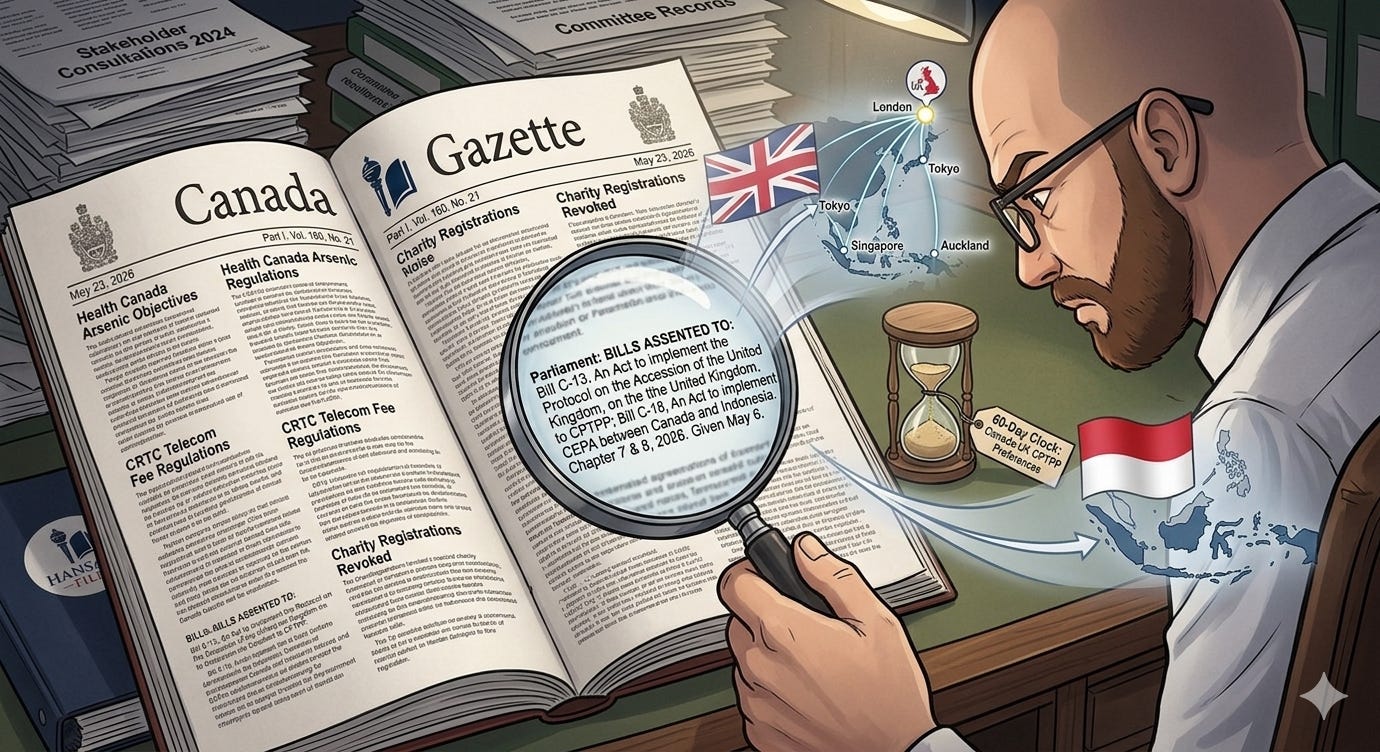
Her Excellency the Governor General signed two bills into law on a Wednesday afternoon in early May, and neither made much noise. No ceremony. No press scrum on the Hill. Just a written declaration, circulated to both chambers on May 6, 2026, and recorded quietly in the Canada Gazette, Part I, Vol. 160, No. 21 three weeks later. Two chapters. Two agreements. And the quiet end of a wait that had lasted, in one case, nearly three years.
The United Kingdom had been circling the Comprehensive and Progressive Agreement for Trans-Pacific Partnership for years before it finally signed its accession protocol in July 2023. By December 2024, nine of the eleven other CPTPP members had completed their ratification. The UK was in. The agreement was live. The preferential tariff network stretching from Auckland to Tokyo to Santiago was already humming along. Two holdouts remained: Mexico, and Canada. Canada, which helped found the agreement, which had championed it as the centrepiece of its Indo-Pacific strategy, which had watched every other member ratify, was last.
Then came Bill C-13.
The Last Member to Show Up
Canada’s delay wasn’t indifference. The ratification process requires implementing legislation, and Parliament’s calendar doesn’t bend easily. Bill C-13, styled in royal assent records as An Act to implement the Protocol on the Accession of the United Kingdom of Great Britain and Northern Ireland to the Comprehensive and Progressive Agreement for Trans-Pacific Partnership, moved through the 45th Parliament’s first session and cleared both chambers before the Governor General’s pen landed on May 6.
The practical consequence is real. Under the terms of the UK’s accession protocol, CPTPP preferences between Canada and the UK take effect 60 days after Canada deposits its ratification. That clock is now running. What that means for Canadian exporters: sectors like agri-food, fisheries, advanced manufacturing, and services will gain preferential access to the UK market under a framework already in operation with nine other Indo-Pacific economies. Canada had been trading with the UK under older arrangements while its CPTPP partners quietly collected the treaty benefits Canada was still owed.
The UK, for its part, has been in the same waiting position. British exporters have been watching Canadian competitors in third markets enjoy CPTPP preferences the UK couldn’t yet extend to Canada. The gap closes now.
Indonesia at the Same Desk
Signed on the same day, almost as a second paragraph to the same announcement, Bill C-18 brought the Canada-Indonesia Comprehensive Economic Partnership Agreement into force. An Act to implement the Comprehensive Economic Partnership Agreement between Canada and Indonesia (chapter 8, 2026) formalizes a bilateral trade relationship with Southeast Asia’s largest economy, a country of 280 million people that has long been underrepresented in Canada’s trade portfolio relative to its regional weight.
The Canada-Indonesia CEPA negotiations stretched across multiple years and multiple Canadian governments. Indonesia has been a priority market under Canada’s Indo-Pacific Strategy, released in late 2022, which identified the country as a critical partner for supply chain diversification, critical minerals, and clean technology investment. Royal assent on the same day as the CPTPP-UK bill wasn’t coincidence so much as legislative convergence, both bills clearing the schedule at roughly the same time. Their pairing in a single assent notice underscores how much Canada’s trade architecture in the Indo-Pacific has been built out in this legislative session.
What the Gazette Records, and What It Doesn’t
There’s a particular quality to how the Canada Gazette records these moments. The notice runs two paragraphs. The bill titles are long and precise. The clerk’s name is there. The date is there. And then it’s done.
What isn’t in those two paragraphs is any sense of the years of negotiation behind them, the stakeholder consultations, the parliamentary committee work, the quiet pressure from Canadian exporters who watched the UK activate CPTPP preferences with nine other trading partners before Canada had moved. The Gazette is a legal record, not a narrative one. It confirms that the law exists. It doesn’t explain why it took this long, or what it cost.
Both Canada-UK CPTPP preferences and the Canada-Indonesia agreement will shape trade flows for decades. The 60-day window before Canada-UK CPTPP provisions activate is a matter of weeks now. Canadian businesses that have mapped their export strategies around CPTPP markets had already accounted for the UK being in the tent. The legal reality is now catching up to the commercial expectation.
A Small Notice in a Crowded Issue
The May 23, 2026, issue of Canada Gazette Part I runs to nearly 30 pages. It contains proposed arsenic air quality objectives from Health Canada. It has telecom fee regulation amendments from the CRTC. It lists 100-plus charity registrations being revoked for failure to file. It carries CUSMA panel review notices for oil country tubular goods. The royal assent notice is two short paragraphs, tucked into the Parliament section, between the filing notice for private bills and the Chief Electoral Officer’s deregistration of riding associations.
That’s the texture of a sitting government. Enormous decisions compressed into the same flat register as administrative housekeeping. The Gazette doesn’t sort by importance. It sorts by department and by statute.
Canada completing the UK’s welcome into CPTPP after 17 months of being the last member standing isn’t a dramatic story. It’s a procedural one. But the procedures are the thing. The law didn’t exist two weeks ago. Now it does. The 60-day clock didn’t exist two weeks ago. Now it does.
Canadian exporters looking at the UK market should be watching that calendar.
Hansard Files spends weeks in the archives so you don’t have to. If stories like this matter to you, subscribe to keep this work independent.
Source Documents
King’s Printer for Canada. (2026, May 23). Canada Gazette, Part I, Vol. 160, No. 21. Ottawa: His Majesty the King in Right of Canada.
It is great news that these deals have been passed into laws and are now available for exporters to utilize. Of course, they now have to get off their collective asses and put them to good use. And I am sure the government has to get off it's ass and establish knowledgeable trade officers who can assist our exporters both in Canada and in the Canadian embassies in the trade partner (High Commission in the UK's case).
"The Gazette is a legal record, not a narrative one. It confirms that the law exists. It doesn’t explain why it took this long, or what it cost." One can only imagine the depth and detail of years of a consultative process. Thanks, Hansard.