


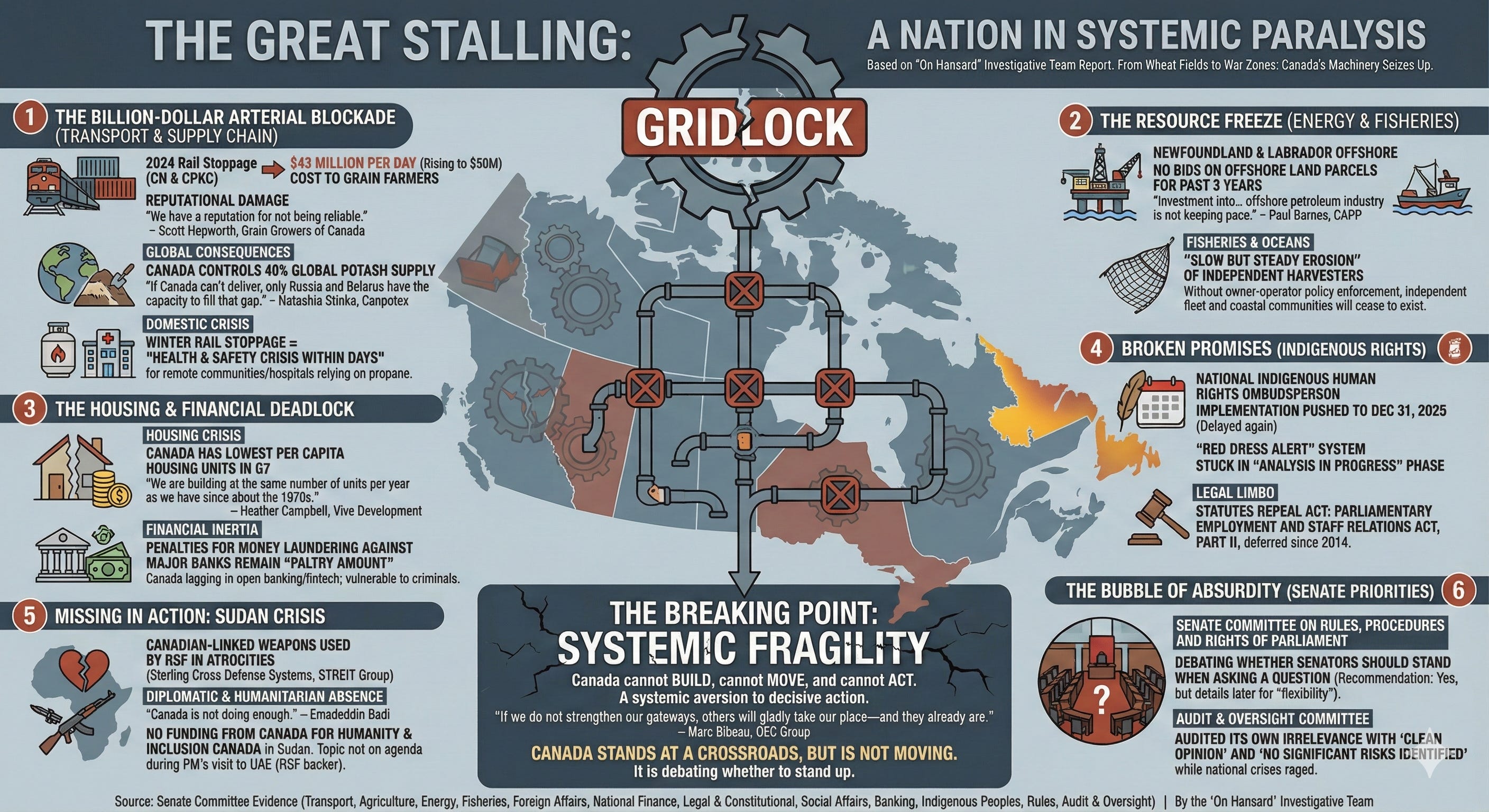
If you want to understand why Canada feels broken, don’t look at the polls. Look at the shipping containers rotting in Vancouver. Look at the empty drilling rigs off the coast of Newfoundland. Look at the refugee camps in Sudan where Canadian “leadership” is a ghost. And then, for the most chilling contrast of all, look inside the Senate Committee on Rules, Procedures and the Rights of Parliament.
While the national economy bled $1 billion a day due to supply chain failures, senators on the Rules committee spent their allotted time debating a matter of supreme urgency: whether they should stand up or sit down when asking a question.
Over the course of a single week in November 2025, seventeen Senate committee meetings painted a devastating portrait of a nation in gridlock. Witnesses from every corner of the economy—energy, agriculture, housing, and foreign aid—descended on Parliament Hill with a unified scream: The systems that keep Canada functioning are seizing up.
What emerges from thousands of pages of testimony is not a series of isolated problems, but a single, terrifying narrative of systemic fragility. Canada has become a country that cannot build, cannot move, and cannot act. And while the machinery of state obsesses over its own internal etiquette, the cost is being measured in lost billions and lost lives.
The Billion-Dollar Arterial Blockade
The most immediate symptom of this paralysis is the hardening of Canada’s economic arteries. In the Standing Senate Committee on Transport and Communications, the testimony was apocalyptic.
“We have a reputation for not being reliable,” confessed Scott Hepworth of the Grain Growers of Canada. It was a polite understatement for a catastrophe. In 2024, a dual rail stoppage by CN and CPKC cost grain farmers over $43 million a day, rising to $50 million as the stoppage dragged on. But the immediate financial bleed is only half the problem. The deeper wound is reputational. Hepworth recounted a trade mission to North Africa where he was confronted not with questions about quality, but with blunt fears about whether Canada could actually deliver the goods.
Natashia Stinka of Canpotex, which controls 40% of the global potash supply, revealed a geopolitical nightmare. Following the 2023 Port of Vancouver strike, Russia—Canada’s primary competitor and a global pariah—stepped in to fill the void. “If Canada can’t deliver,” Stinka warned, “only Russia and Belarus have the capacity to fill that gap”. By failing to keep its trains moving, Canada is effectively subsidizing Vladimir Putin’s war machine.
The domestic stakes are just as lethal. Katie Kachur of the Canadian Propane Association detailed how a rail stoppage in winter becomes a “health and safety crisis within days” for remote communities and hospitals that rely on propane for heat. Yet, despite the existential threat, the definition of “essential service” remains dangerously narrow, leaving the country’s energy security hostage to the bargaining table.
The Resource Freeze
While goods rot on the tracks, Canada’s resource sector is suffocating under a blanket of regulatory uncertainty.
In the Energy, Environment and Natural Resources committee, the mood was somber. Paul Barnes of the Canadian Association of Petroleum Producers dropped a stunning statistic: there have been no bids on offshore land parcels in Newfoundland for the past three years.
While the world clamors for energy security, investment is fleeing Canada. The Bay du Nord project hangs in limbo, a symbol of potential unfulfilled. “Investment into Newfoundland and Labrador’s offshore petroleum industry is not keeping pace,” Barnes noted, citing a “policy reset” as the only hope to stop the exodus of capital.
The paralysis extends to the seas. In the Fisheries and Oceans committee, independent harvesters described a “slow but steady erosion” of their way of life, strangled by corporate consolidation and a licensing system that prices out the next generation. Melanie Sonnenberg of the Canadian Independent Fish Harvesters Federation warned that without government intervention to enforce owner-operator policies, the independent fleet—and the coastal communities it supports—will simply cease to exist.
The Housing & Financial Deadlock
If Canada can’t move goods or extract resources, surely it can at least house its people? The testimony before the National Finance committee suggests otherwise.
“Canada currently has the lowest per capita number of housing units in the G7,” declared Heather Campbell of Vive Development. “We are building at the same number of units per year as we have since about the 1970s”.
It is a damning indictment. Despite a “generational housing crisis,” construction activity is actually falling due to soaring costs and bureaucratic friction. Campbell described a “boom-bust cycle” where the industry stops building during downturns, only to scramble when demand rebounds.
This physical stagnation is mirrored by financial inertia. In the Banking, Commerce and the Economy committee, the focus turned to the anemia of Canada’s financial enforcement. Witnesses noted that penalties for money laundering against major banks remain a “paltry amount,” signaling that Canada is not serious about policing its own financial system. While the world races toward open banking and fintech innovation, Canada is still debating the basics of regulation, leaving its financial ecosystem vulnerable to criminals and terrorists.
The Broken Promises
For Indigenous communities, the “Great Stalling” is not a metaphor—it is a lived reality of delay and deferral.
In the Committee on Indigenous Peoples, the discussion centered on the long-promised National Indigenous Human Rights Ombudsperson. The timeline for implementation? Pushed back yet again, now targeting December 31, 2025. Meanwhile, the “Red Dress Alert” system—a life-saving mechanism for missing Indigenous women and girls—remains stuck in the “analysis in progress” phase.
Even the laws that do exist are often illusions. In the Legal and Constitutional Affairs committee, senators spent hours debating the “Statutes Repeal Act”—a mechanism designed to clean up laws that were passed but never enforced. They heard about the Parliamentary Employment and Staff Relations Act, Part II, which has been deferred from repeal since 2014—over a decade of bureaucratic limbo where rights are promised but never delivered.
Missing in Action: The Sudan Crisis
Perhaps most shameful is Canada’s retreat from the world stage. In the Foreign Affairs committee, the testimony regarding the civil war in Sudan was harrowing—and it implicated Canada directly.
Emadeddin Badi of the Global Initiative Against Transnational Organized Crime delivered a bombshell: Canadian-linked weapons, including rifles from Sterling Cross Defense Systems and armored vehicles from the STREIT Group, are being used by the Rapid Support Forces (RSF) to commit atrocities.
Despite this, Canada’s diplomatic presence is nonexistent. “Canada is not doing enough,” Badi stated bluntly. He noted that during Prime Minister Justin Trudeau’s recent visit to the UAE—a key backer of the RSF—the topic of Sudan did not even make the agenda.
Humanitarian organizations described a hellscape where food is weaponized and aid workers are targeted. Yet, Anne Delorme of Humanity & Inclusion Canada revealed that her organization is receiving no funding from Canada for the Sudan crisis. “Canada has been missing in action,” agreed Rita Morbia of Inter Pares.
The Bubble of Absurdity
While the country’s supply chains fractured and its international reputation burned, what was happening inside the Senate’s own administrative committees?
The contrast is almost literary. In the Committee on Rules, Procedures and the Rights of Parliament, the pressing issue of the day was not the billion-dollar daily loss to the economy, but whether senators should be required to stand when addressing the chair during Question Period. After “careful consideration of all evidence,” the committee bravely recommended that yes, they should stand, though they agreed that the “procedural details and logistics” should be determined later to allow for “greater flexibility”.
Meanwhile, the Audit and Oversight Committee congratulated itself on a job well done. The external auditors reported “no significant risks identified” and offered a “clean opinion” on the Senate’s financial statements. While grain farmers lost millions and northern hospitals prayed for propane, the Senate’s internal machinery was humming along perfectly, auditing its own irrelevance with immaculate precision.
The Breaking Point
The composite image from these seventeen hearings is of a nation that has lost its metabolism. Whether it is the inability to load a ship in Vancouver, the failure to house a student in Toronto, or the refusal to call out a warlord in Sudan, the root cause is the same: a systemic aversion to decisive action.
As Marc Bibeau of OEC Group warned the Transport committee, the world is not waiting for us. “If we do not strengthen our gateways, others will gladly take our place—and they already are”.
Canada is standing at a crossroads, but it isn’t moving. It is sitting in a committee room, debating whether or not to stand up.
Source Documents
Standing Senate Committee on Transport and Communications. (2025, November 18). Evidence.
Standing Senate Committee on Transport and Communications. (2025, November 19). Evidence.
Standing Senate Committee on Agriculture and Forestry. (2025, November 20). Evidence.
Standing Senate Committee on Energy, the Environment and Natural Resources. (2025, November 20). Evidence.
Standing Senate Committee on Fisheries and Oceans. (2025, November 20). Evidence.
Standing Senate Committee on Foreign Affairs and International Trade. (2025, November 20). Evidence.
Standing Senate Committee on National Finance. (2025, November 18). Evidence.
Standing Senate Committee on Legal and Constitutional Affairs. (2025, November 19). Evidence.
Standing Senate Committee on Legal and Constitutional Affairs. (2025, November 20). Evidence.
Standing Senate Committee on Social Affairs, Science and Technology. (2025, November 19). Evidence.
Standing Senate Committee on Banking, Commerce and the Economy. (2025, February 18). Evidence.
Standing Senate Committee on Indigenous Peoples. (2024, September 24). Evidence.
Standing Senate Committee on Rules, Procedures and the Rights of Parliament. (2025, June 4). Report.
Standing Senate Committee on Audit and Oversight. (2025, October 29). Evidence.