


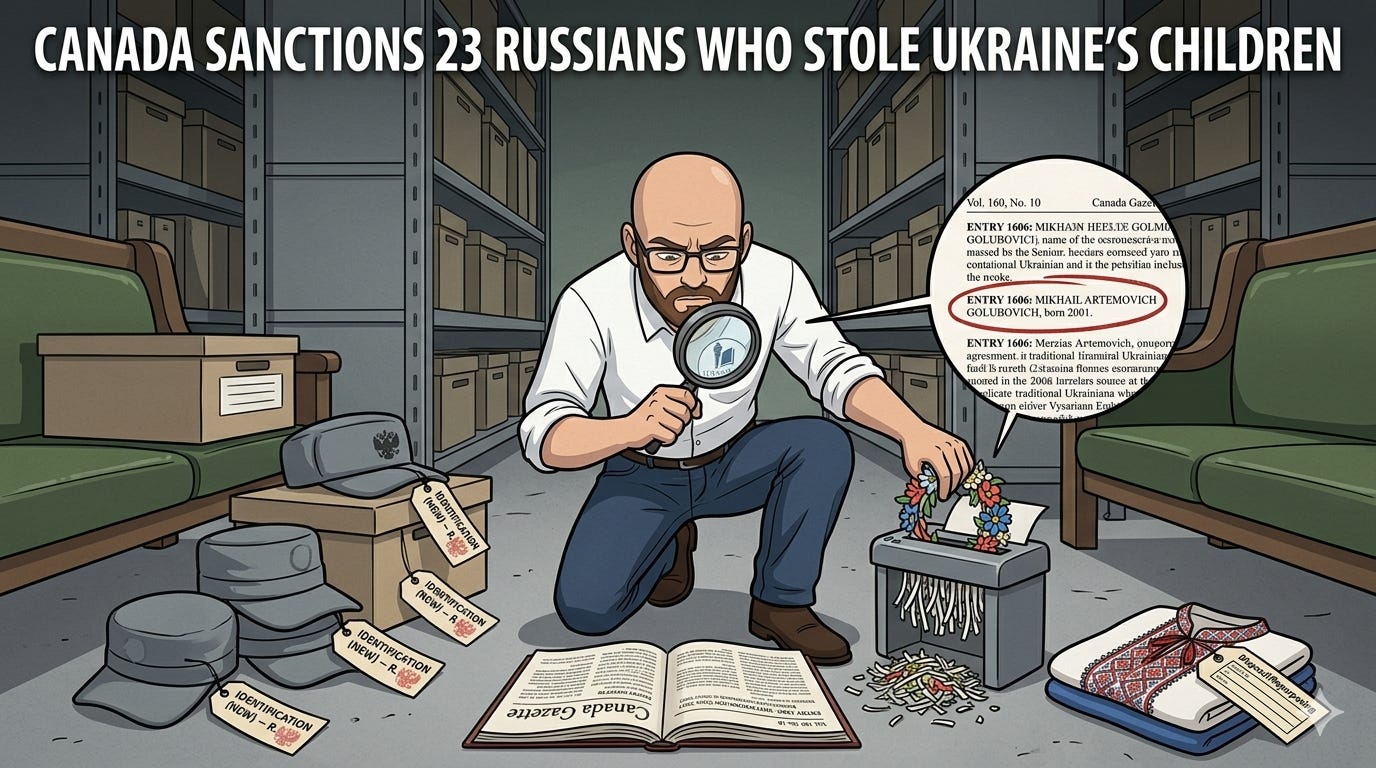
The names read like a bureaucratic inventory. Numbered entries, birthdates in parentheses, surnames in capital letters. But behind entry number 1606 in Canada’s expanding sanctions list sits Mikhail Artemovich Golubovich, born in 2001, barely old enough to have finished school himself. He’s now designated under SOR/2026-80 in the Canada Gazette, Part II, for his role in a system that took Ukrainian children and tried to make them Russian.
This is the part of the war that doesn’t make the front pages. There are no artillery exchanges to report, no satellite images of craters. Just children. Thousands of them, moved across borders, handed new names, given new flags to salute.
On May 8, 2026, Canada quietly registered new amendments to the Special Economic Measures (Russia) Regulations, adding 23 individuals and 5 entities to the sanctions list. The amendments took effect the same day, before publication, by design. Telling the targets in advance, the regulatory impact statement notes, would risk asset flight.
A System Built to Erase
The Gazette’s regulatory impact analysis is measured, clinical. But the facts it lays out are not.
Russia has been unlawfully deporting and forcibly transferring Ukrainian children since its first invasion in 2014. After the full-scale assault began in 2022, the pace accelerated. Thousands of Ukrainian children have been subjected to forced deportation, forced transfer, or what the regulations describe plainly as “destruction of their identity.” Russian citizenship, imposed. Ukrainian language, suppressed. National symbols, replaced.
Russia does not deny taking the children but has said it did so for their protection, moving them away from front-line areas, and claims it is willing to return them when relatives come forward and can be verified. The International Criminal Court disagrees. In March 2023, the ICC issued an arrest warrant for Russian President Vladimir Putin for the war crime of illegal deportation of children from Ukraine.
The five entities newly sanctioned by Canada are all facilities tied directly to this system: the Center for Military Sports Training and Patriotic Education of Youth “WARRIOR,” the Regional Branch of the All-Russian Children and Youth Military-Patriotic Public Movement “Yunarmiya” in Sevastopol, the Educational and Methodological Center “Avangard,” the Defense and Sports Camp “Avangard,” and the Volgograd Regional Youth Volunteer Public Organization “Uchastie.” These are not abstract bureaucratic constructs. They are places where Ukrainian children were taken and told who to be.
The 23 newly designated individuals include Children’s Rights Commissioners operating in Russia and in temporarily occupied Ukrainian territories, as well as officials who oversaw indoctrination and military training programs. Many have already been sanctioned by allied countries.
The Coalition Pressing for Their Return
Canada isn’t acting alone. Canada co-chairs the International Coalition for the Return of Ukrainian Children, which brings together 48 partner states and 3 international organizations to coordinate diplomatic efforts, strengthen data and tracing mechanisms, support rehabilitation and reintegration, and advance accountability. The May 8 sanctions were announced by Foreign Affairs Minister Anita Anand in Brussels, at a high-level meeting of that same coalition.
So far, approximately 2,100 children have been successfully returned, but it is estimated that thousands remain in Russia and temporarily occupied territories of Ukraine.
These Canada Gazette amendments land in that gap. Between the 2,100 who made it back and the thousands who haven’t.
The sanctions were coordinated with allies. The EU announced measures against 23 state institutions and individuals the same day. The UK simultaneously unveiled a broader package, roughly a third of it linked to Russia’s campaign to forcibly deport and militarize Ukrainian children. As EU top diplomat Kaja Kallas put it: “Stealing children is not incidental. It is a deliberate Russian policy, a calculated attack on Ukraine’s future.”
What the Sanctions Actually Do
Under the Special Economic Measures Act, the newly designated individuals and entities now face an asset freeze. Any person in Canada, and any Canadian abroad, is prohibited from dealing in their property, entering into transactions with them, or providing them any services. The 23 newly listed individuals also become inadmissible to Canada under the Immigration and Refugee Protection Act.
Since 2014, Canada has imposed sanctions on more than 3,400 individuals and entities complicit in the violation of Ukraine’s sovereignty and territorial integrity and in gross and systematic human rights violations. These 28 new additions bring the total of those sanctioned specifically for violations against Ukrainian children to over 80.
The Gazette’s regulatory analysis is candid about the practical limits of these measures. The newly listed individuals are believed to have limited Canadian ties. No significant Canadian business dealings were identified. The compliance cost to Canadian financial institutions amounts to updating existing monitoring systems. The RCMP and Canada Border Services Agency absorb enforcement costs within existing budgets.
None of that makes the designations meaningless. Sanctions work best when they’re coordinated, and when they signal international consensus. They impose reputational and financial costs, restrict mobility, and put those responsible on record.
The Youngest Name on the List
Entry 1606: Mikhail Artemovich Golubovich, born in 2001. He’s 24 years old. The regulation offers nothing more than his name and birthdate, but his presence alongside commissioners, generals, and administrators points to how wide this system runs, down into the youngest tier of those who operate it.
The regulatory impact statement says Canada’s objectives are to “deter, expose, and condemn human rights violations.” Deterrence is difficult to measure. Exposure is what documents like the Canada Gazette do quietly and continuously, building a public record that names names and assigns accountability.
These are the records that don’t expire. Long after the fighting stops, long after the diplomatic summits conclude, these entries will remain. A permanent, searchable list of who did what to whom.
“Ukrainian children are not a matter for negotiations or compromise,” the Ukrainian foreign minister said at the Brussels meeting where these sanctions were announced.
The Canada Gazette agrees. It just says so in the language of regulation numbers and schedule amendments. That’s how countries keep score.
Hansard Files spends weeks in the archives so you don’t have to. If stories like this matter to you, subscribe to keep this work independent.
Source Documents
Canada Gazette, Part II, Vol. 160, No. 10
I wonder if keeping the primary focus on individuals rather than on Russian state institutions deliberate to try to keep the hypocrisy less visible?
Taking children from domestic nations (Inuit, First Nations) and transferring them away from their communities has defined Canada’s historical assimilation policies and echoes into the modern child welfare system.
Even with the recent 2020 coming into force of Bill C-92 (An Act respecting First Nations, Inuit and Métis children, youth and families), children of other nationalities are regularly still treated as "just another Canadian" by a system that fixates on the Western European concept of Westphalian sovereignty and ignores – or seeks to erode – the relational (AKA: inherent, genos, peoples) sovereignty of Indigenous peoples.
The “millenium scoop” is still underway.
I'm not excusing what Russia does as a political entity that exploits historical grievances—such as the long, deeply rooted history of Western European exploitation of Slavic peoples (the literal etymology of the word 'slave') to claim the mantle of 'protector' against institutions like NATO and the UN's WEOG. But I don't think Canada is being honest in its participation when it ignores its own ongoing multi-generational colonization policies.