


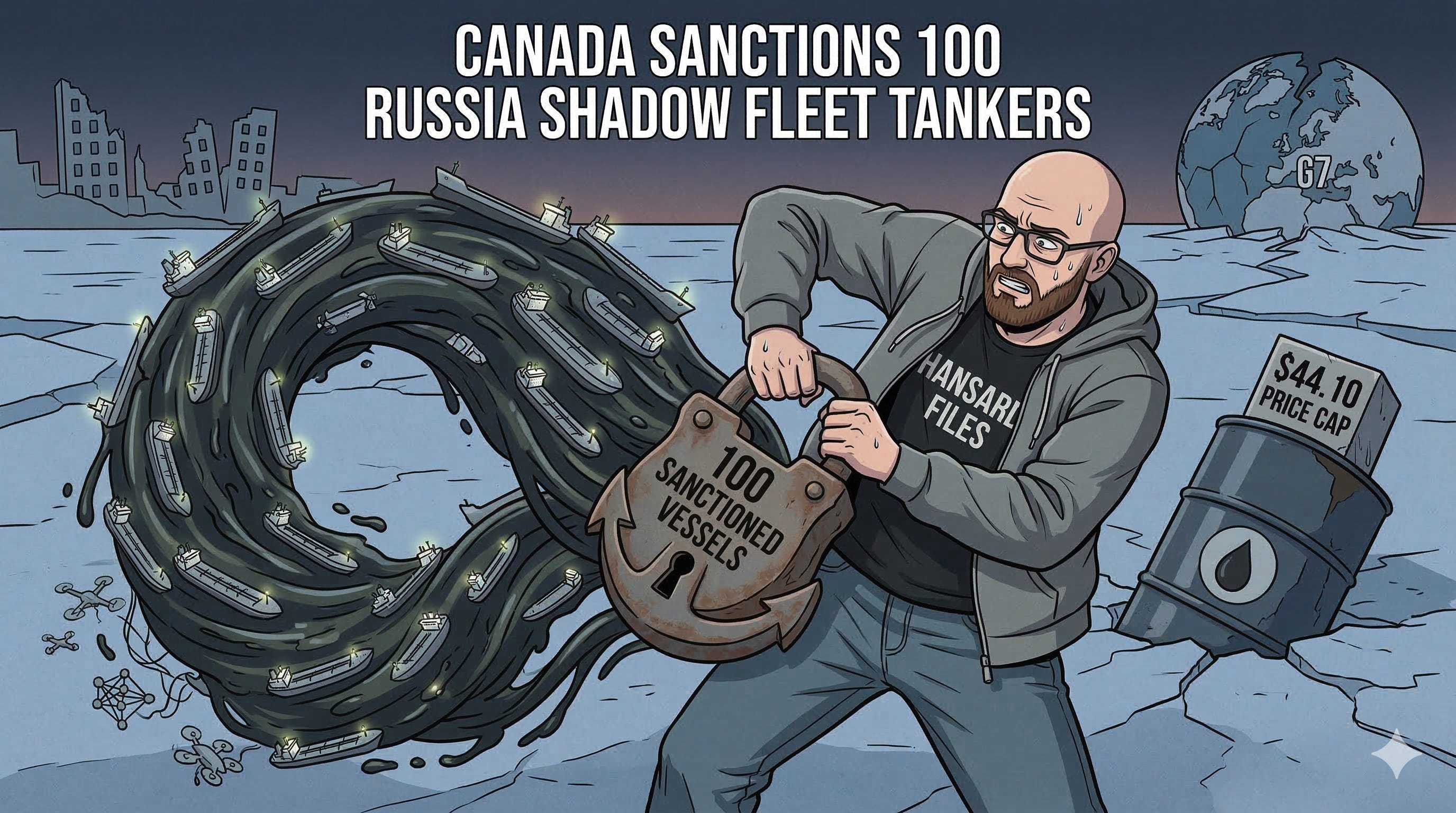
On February 19, 2026, as Russia’s full-scale invasion of Ukraine entered its fifth year, the Governor in Council registered sweeping amendments to the Special Economic Measures (Russia) Regulations. Published today in the Canada Gazette Part II, these changes mark one of the largest single expansions of Canada Russia sanctions since the conflict began.
The amendments target the very networks keeping Russian oil revenues flowing and military innovation advancing. They add 21 individuals, 53 entities and 100 vessels while lowering the Russian crude oil price cap from US$47.60 to US$44.10 per barrel. The moves directly address Russia’s reliance on a shadow fleet of tankers and its centralized push into artificial intelligence for defence.
100 Shadow Fleet Tankers Blacklisted: Closing the Maritime Loophole
The most visible strike comes in Schedule 1.1. One hundred new vessels, predominantly oil, chemical and products tankers, join the prohibited list. Each entry includes IMO number, vessel name, type and build date, from the 1995 Immanuel to the 2025 Ivan Aivazovsky.
Examples include the Akhty (IMO 9435337, chemical/products tanker, 2008), Azure (IMO 9387255, oil tanker, 2008), Gazpromneft Zuid East (IMO 9537109, oil products tanker, 2012) and the LNG carrier Perle (IMO 9630028, 2014). The list runs through Shturman Skuratov (IMO 9759915, oil tanker, 2017) and ends at Vozrozhdeniye (IMO 9377779, oil tanker, 2007).
These vessels now face a full dealings ban in Canada. Since 2022, Russian-linked ships have been barred from Canadian waters. Listing the 100 tankers gives enforcement authorities an immediate reference list, eliminating case-by-case checks. Canadian insurers, ship suppliers and financial institutions must now screen against this expanded Schedule 1.1 before providing any service.
Minor corrections to build dates for eight previously listed vessels appear alongside the new entries. The changes ensure precision but do not alter existing prohibitions.
AI Alliance and Drone Makers Enter the Crosshairs
The amendments also expand Part 1 and Part 2 of Schedule 1. Twenty-one individuals receive designations. They include senior military figures tied to hybrid and AI strategy, executives from drone and technology firms, cyber operators, energy traders and senior leaders at state-owned banks advancing cryptocurrency payment systems to bypass sanctions.
Fifty-three entities join the list. The additions reach deep into Russia’s defence-industrial base and sensitive technology sector. Notable entries include:
AI Alliance Russia (also known as Alliance)
Kapitza Institute for Physics Problems
Institute of Automation and Electrometry
Russian Artificial Intelligence Research Institute of the Russian Academy of Sciences (RAIRI)
Skolkovo Foundation
Rosatom Digital Solutions
NtechLab
Zala Aero (drone manufacturer)
Positive Technologies
TBank
VTB Bank (PJSC) Shanghai Branch
PJSC Tatneft, PJSC RussNeft and Rosneft PJSC
Special economic zones, military innovation hubs such as ERA Technopolis and research centres supporting military production also appear. These organizations now face a comprehensive dealings prohibition: no Canadian person or company may deal in their property, provide services or make goods available.
One entity previously subject only to new-debt financing restrictions under Schedule 3 moves to Schedule 1, receiving the full suite of measures.
Oil Price Cap Slashed to $44.10: Squeezing War Revenues
Schedule 10.01 now sets the price cap for Russian crude oil at US$44.10 per barrel. The reduction from US$47.60 aligns with recent G7 moves and follows Canada’s earlier cut to US$47.60 in August 2025.
A 45-day transitional provision protects contracts for oil loaded before the coming-into-force date. After that window, services linked to oil sold above the new cap remain prohibited.
The Regulatory Impact Analysis Statement notes that oil and gas revenues still account for about 25 percent of Russia’s federal budget. It highlights Moscow’s shadow fleet tactics: disabling tracking, concealing ownership, ship-to-ship transfers and use of free trade zones. The lower cap, combined with the vessel blacklist, aims to shrink that revenue stream.
Broader Canadian and G7 Strategy
These Canada Russia sanctions form part of ongoing G7 coordination. The amendments cite recent actions by the United Kingdom, United States and European Union targeting energy firms, defence industry and sanctions evaders. Under Canada’s 2025 G7 presidency, the Shadow Fleet Task Force with Nordic-Baltic partners enhanced monitoring and disruption efforts.
The Special Economic Measures Act framework prohibits all dealings with listed persons unless an exceptional permit is granted. Listed individuals also become inadmissible to Canada. Delisting applications can be made to the Minister of Foreign Affairs.
The changes came into force on registration. They apply before publication under the Statutory Instruments Act to prevent asset flight.
Canada has now sanctioned more than 3 300 individuals and entities and listed over 400 vessels since 2014. The latest package underscores a commitment to degrade Russia’s military capabilities, constrain energy revenues and close evasion pathways.
Hansard Files digs through dense archives like this Canada Gazette edition to uncover these stories. Subscribe to support independent investigative journalism into Canada’s sanctions regime.
Source Documents
Government of Canada. (2026, March 11). Regulations Amending the Special Economic Measures (Russia) Regulations, SOR/2026-30. *Canada Gazette* Part II, 160(5), 477-614.
"Canada has now sanctioned more than 3,300 individuals and entities and listed over 400 vessels since 2014."
"Canada has now sanctioned more than 3,300 individuals and entities and listed over 400 vessels since 2014."
How do these affect Canada's position with world neighbors? How will these affect Canada's economy for current and future generations?