


Written in collaboration with Heidi Legg.
Why would a law be created to keep the identities of foreign donors hidden? That is one of the important questions to ask.
The Narwhal was founded in May 2018, out of a basement in British Columbia, by two journalists who had spent years covering pipelines for a smaller outlet called DeSmog Canada. It launched as a nonprofit, funded by donations and reader memberships, covering environmental stories that the mainstream press wasn’t staffing. By 2020, it had won awards. By 2021, it had become something else entirely: the first English-language Registered Journalism Organization (RJO) in Canada.
That designation, created under the 2019 federal budget and effective January 1, 2020, matters more than it might sound. It gave The Narwhal the ability to issue official charitable tax receipts for donations. It allowed registered charities to make gifts directly to The Narwhal. And it placed The Narwhal inside a category of journalism organization whose foreign funding, above the $10,000 threshold, is reported to the CRA annually but not disclosed publicly.
The public has no way of knowing what foreign funders are funding the Narhwal’s stories. This does not imply wrongdoing but it would be useful to know what foreign funders in aggregate are giving $10,000 and what it adds up to when they are tallied.
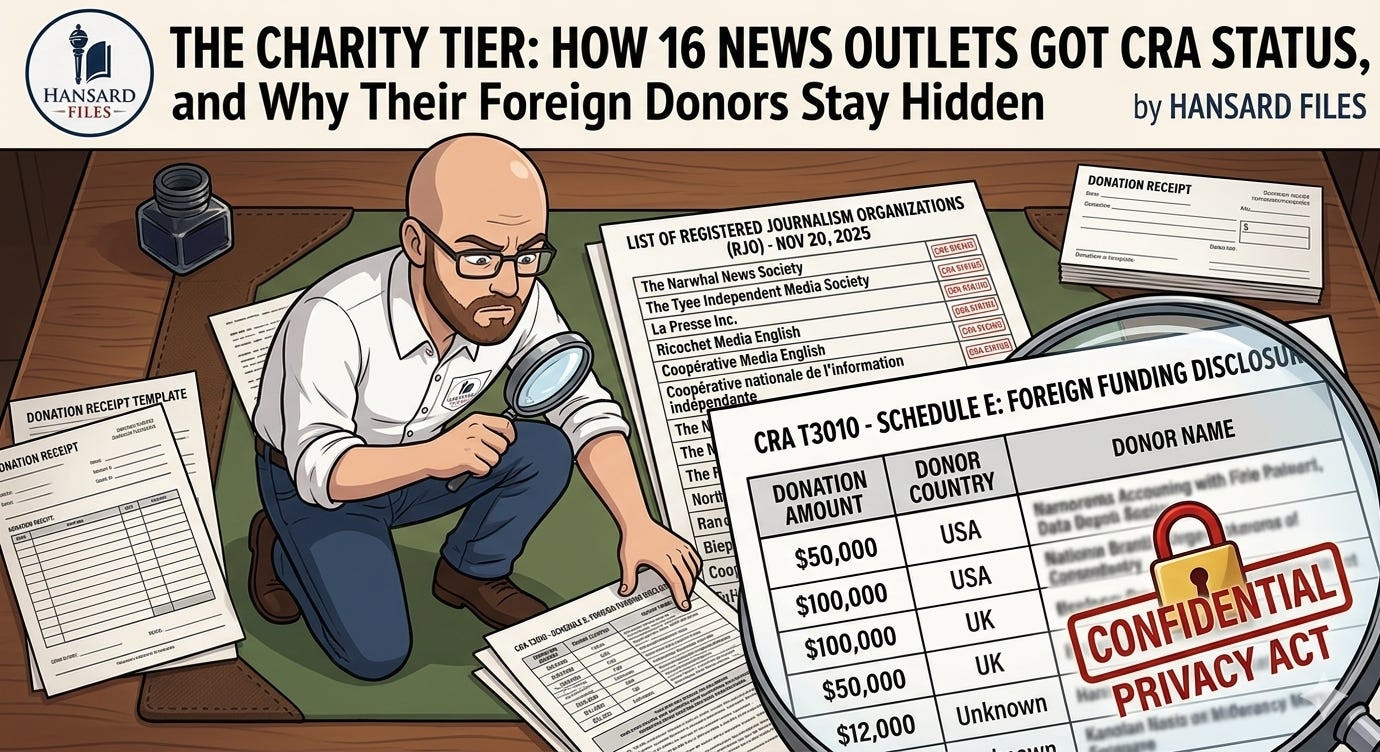
Sixteen news organizations hold or have held that RJO status today in Canada. The question of how the charity donation for journalism system works, and what it can and cannot reveal, is the subject of this piece.
What an RJO Is, and What It Isn’t
Budget 2019 introduced three interlocking tax measures for Canadian journalism:
a refundable labour tax credit for eligible newsroom salaries;
a 15 percent digital subscription tax credit for individuals;
and the creation of Registered Journalism Organizations as a new category of qualified donee under the Income Tax Act.
To become an RJO, a news organization first needs to be designated as a Qualified Canadian Journalism Organization, which makes it eligible for the labour tax credit. It then applies separately to the CRA for RJO status, a process the organization’s documentation describes as comparable to registering a charity. The criteria: the organization must be a corporation or trust, constituted and operated exclusively for journalism purposes, and any business activities must be related to its journalistic mission.
There are roughly 100 QCJOs in Canada. Only 17 have ever advanced to RJO status. Of those, 16 are currently registered. New Canadian Media had its status revoked in October 2024.
The active registered organizations, as listed on the CRA’s official table last updated November 20, 2025, span a range of editorial mandates and organizational sizes. Most are francophone community outlets or Quebec-based independents: Coopérative nationale de l’information indépendante, La Presse Inc., Le Devoir Inc., Journaldesvoisins.com, La Converse, La Gazette de la Mauricie, Nouvelles d’ici, Presse-Ouest Ltée, and Services d’information communautaire de la Vallée de la Châteauguay. The English-language registrants include The Narwhal News Society, The Local TO Publishing, COOP DE SOLIDARITÉ PIVOT, Ricochet Media English, Future of Good Media, The Canadian Jewish News, and TYEE Independent Media Society, which received its registration in October 2025.
What Their Government Revenue Looks Like
The Narwhal and The Tyee are the two most publicly discussed RJOs in English Canada, partly because both have been transparent about their funding mix in ways most outlets have not.
The Narwhal’s revenues for fiscal year 2020-21, as reported by The Charity Report, were split across three streams: 38 percent reader donations, 44 percent grants and contracts, and 18 percent government sources. Its RJO registration was retroactive to October 2020, meaning it scrambled in early 2021 to issue tax receipts for donations already received that year. The Narwhal has stated publicly that it ensures undisclosed funding sources total no more than 15 percent of total annual revenue, and that it generally names donors contributing $5,000 or more in a fiscal year.
The Tyee, operated by TYEE Independent Media Society, received its RJO registration in October 2025. It had previously operated as a QCJO. Its publisher, Jeanette Ageson, told the Columbia Journalism Review in January 2025 that government funding constitutes less than 20 percent of The Tyee’s annual revenue, and that losing it entirely “wouldn’t put us out of business, but we couldn’t grow as quickly.”
Both outlets have said publicly that editorial decisions are made independently of funding sources. Both are signatories to editorial independence standards through the Institute for Nonprofit News. Neither claim is unusual; most journalism funding agreements include similar language. The point is not that these outlets are editorially compromised. The point is structural.
The Formula and the Fit
The CPF’s original purpose was to support publishers who faced market disadvantages: high distribution costs, a small domestic advertising base, competition from American titles. The Aid to Publishers formula weighted circulation and editorial expenditures. Larger, established publishers, print-first, mass-market, would naturally collect more.
Then came the 2020 modernization. Canadian Heritage announced a shift, phasing in over five years, from rewarding print circulation to rewarding investment in editorial and journalistic content regardless of platform. Digital-only publications became eligible for the Aid to Publishers stream. The Special Measures for Journalism component, initially an emergency COVID measure, was extended repeatedly and became a standing vehicle for free-circulation and low-circulation publishers. Budget 2025 committed $38.4 million over three years to extend it through 2029.
The effect of these changes, read alongside the RJO list, is to have created two adjacent but distinct systems running simultaneously. In the first, legacy publishers with high circulation, Quebecor’s magazine empire, Postmedia’s community papers, Zoomer, Maclean’s, collect CPF grants at scale through the formula. In the second, a smaller cohort of digitally native, mission-driven outlets collects through the Special Measures and Journalism Labour Tax Credit streams, while also accepting charitable donations from foundations and individuals through their RJO status.
There is nothing improper about either channel. Both are operating within the rules as written. But the rules were not written with this bifurcation in mind, and the formula’s logic, built for a print circulation world, increasingly rewards outcomes the program’s stated values don’t necessarily prioritize. Zoomer magazine at $864,851 in annual CPF grants raises a different question than the Prince Rupert Northern View at $25,000. Both are eligible. The formula doesn’t distinguish between them on any basis other than circulation and editorial spending.
The Foreign Funding Rules, and Their Limits
RJOs occupy a particular position in the foreign funding question because of what charitable status enables. Any registered charity in Canada must report on its annual T3010 information return whether it received donations of $10,000 or more from a non-resident donor. The requirement has been in place since January 1, 2009. RJOs, as a class of qualified donee, operate under the same disclosure obligation.
What the T3010 requires is the fact of the donation and its total value. What it does not require to be made public is the name of the donor. The CRA holds that information internally. In documented correspondence about potential reforms to the T3010 regime, the CRA noted that making donor names public would require “assessing the legal implications of accidentally disclosing donor information of Canadian residents” and estimated that a full database overhaul to enable public disclosure could cost up to $3 million.
There is also a 20 percent rule: in any given taxation year, an RJO may not receive gifts from any single source representing more than 20 percent of its total revenues, with limited exceptions. This governs concentration, not visibility.
The result is a disclosure gap that is entirely legal, fully anticipated when the system was designed, and genuinely difficult to close without a legislative or regulatory change. A foreign foundation can contribute $50,000 in a year to an RJO. That donation gets reported to the CRA. The CRA confirms the organization is compliant. No member of the public can find out who gave the money.
The Narwhal confirmed this framework directly in 2021, noting it as a feature of the system. The outlet’s own transparency policy, which goes beyond the minimum required, names donors at the $5,000 threshold. But that is voluntary. The legal floor is considerably lower.
The Question the Records Can’t Answer
When Canada’s National Observer, which is not an RJO, reported in one recent fiscal year that 40 percent of its revenue came from government grants, and 12 percent from philanthropic organizations or private donations, it was describing a funding structure now common to digitally native outlets in this ecosystem. When The Narwhal described 18 percent of its revenue as government-sourced in 2020-21, it was doing the same. None of that is hidden. It’s on their websites.
What no public document currently answers is the full foreign funding picture across the RJO tier. How many of the 16 registered organizations received donations of $10,000 or more from non-resident donors in the most recent fiscal year? In aggregate, from how many foreign foundations or entities? Across what categories of mandate?
The T3010 filings exist. The CRA has them. They don’t appear in any searchable public database.
This is not a story about wrongdoing. It is a story about a system that was designed with transparency floors rather than ceilings, and that has grown considerably larger than the architects of that system likely envisioned in 2019. Sixteen outlets now hold RJO status. Budget 2025 extended the funding streams that feed them. The formula governing the larger CPF continues to reward scale in ways that haven’t been publicly renegotiated since the program’s launch under a Conservative government fifteen years ago.
The money is public. The rules are public. Much of the rest is not. Whether that balance still makes sense, in a media environment where both foreign hedge funds and foreign foundations now have a seat at the table of Canadian journalism funding, is a question that belongs in a committee room.
It hasn’t gotten there yet.
Hansard Files spends weeks in the archives so you don’t have to. If stories like this matter to you, subscribe to keep this work independent.
Source Documents
Canada Revenue Agency. (2025, November 20). List of Registered Journalism Organizations. Canada.ca. https://www.canada.ca/en/revenue-agency/services/charities-giving/other-organizations-that-issue-donation-receipts-qualified-donees/other-qualified-donees-listings/list-registered-journalism-organizations.html
Canada Revenue Agency. Registered Journalism Organizations. Canada.ca. https://www.canada.ca/en/revenue-agency/services/charities-giving/other-organizations-that-issue-donation-receipts-qualified-donees/registered-journalism-organizations.html
Blumbergs. (2019, December 4). CRA will not alert public about charities that get funds from foreign states that support terrorism. CanadianCharityLaw.ca. https://www.canadiancharitylaw.ca/blog/cra_cannot_alert_public_about_charities_that_get_funds_from_foreign_states/
Canadian Heritage. (2026). Special Measures for Journalism. Canada.ca. https://www.canada.ca/en/canadian-heritage/services/funding/periodical-fund/special-measures-journalism.html
Cowen, C. (n.d.). Charity boosting journalism start-ups while incumbents pocket millions and still flail. The Charity Report. https://www.thecharityreport.com/features/charity-funded-journalism-start-ups-boosted-while-incumbents-pocket-millions-and-still-flail
Dubé, C. (2024, July 15). Canada runs on subsidies. Why shouldn’t news media get them? Canadian Dimension. https://canadiandimension.com/articles/view/canada-runs-on-subsidies-why-shouldnt-news-media-get-them
Kierans, C. (2025, January 23). Bracing for Poilievre. Columbia Journalism Review. https://www.cjr.org/analysis/canada-poilievre-and-public-funding-press.php
The Narwhal. (n.d.). Code of Ethics. https://thenarwhal.ca/code-ethics/
Wikipedia contributors. The Narwhal. Wikipedia. https://en.wikipedia.org/wiki/The_Narwhal
Mike, was there any debate around the foreign funding? I notice that the rules use the term Canadian “residents” not Citizens can donate and fund media. So why not limit donations to media to voters? How will that work if a group of people from another country gather together to create a digital news outlet in Canada and fund it through donations from residents around foreign issues that are maybe not in lock step with Canadian values?
I wish this and the large number of other government programs to fund new and other media was adequately included in Bill C-18 https://www.parl.ca/LegisInfo/en/bill/44-1/C-18 conversations.
The issue should be about funding of Canadian Journalistm, with creating a specialized link tax as a disincentive to linking to Canadian News outlets being extremely counterproductive.
More stable funding is needed that isn't tied to cross-sector subsidies. C-18 is a government program funded by taxes and paid to Canadian media, and the objections are not to taxpayers paying for media but the counterproductive placing of taxes on references/links/etc.