


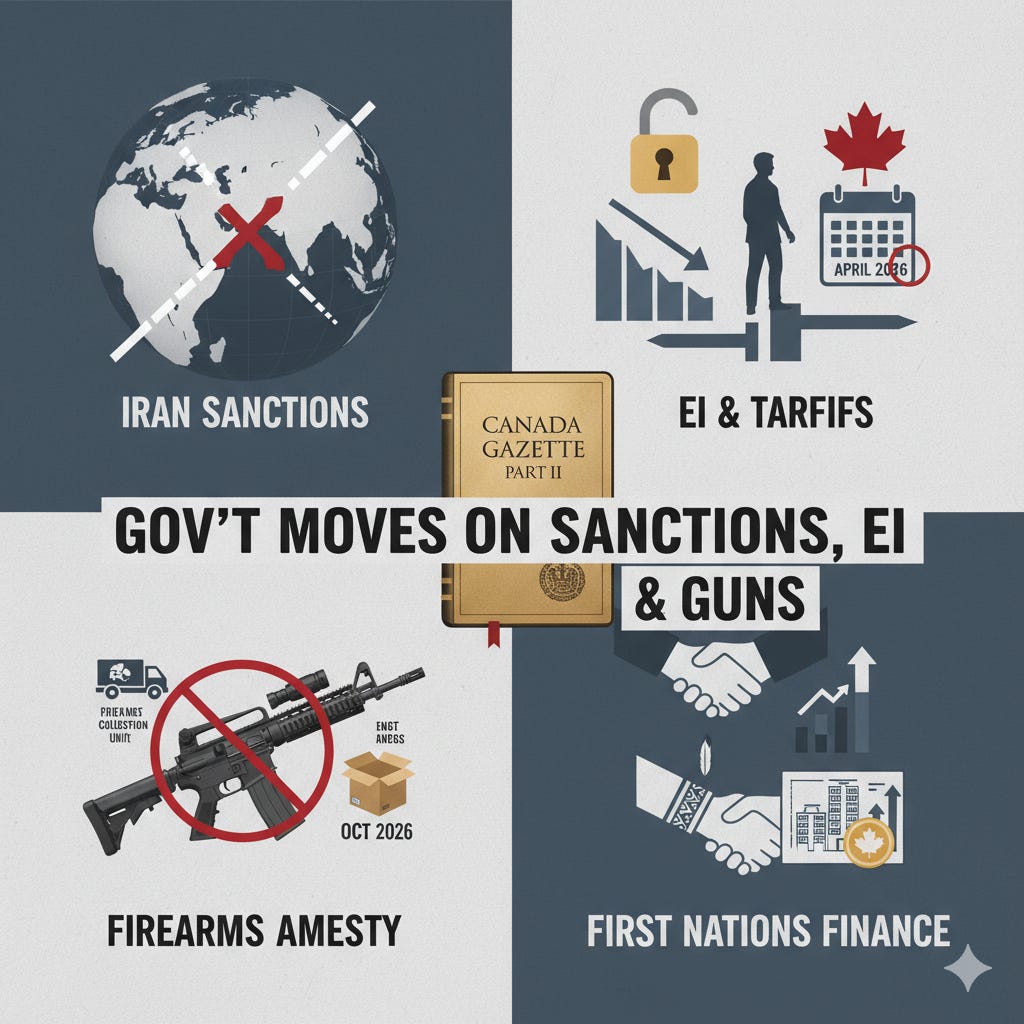
This week’s official publication from the King’s Printer, the Canada Gazette, reveals a government actively responding to a complex mix of international pressures and domestic policy challenges. Through a series of regulatory updates, Ottawa has moved to reimpose sanctions on Iran, extend economic support for Canadian workers hit by foreign tariffs, and fine-tune the implementation of major programs like the national dental care plan and recent firearms prohibitions. These documents give you a direct look at the government’s operational priorities, from geopolitical alignment to the intricate details of social program delivery.
The Iran Sanctions Snapback
The government has officially amended its Regulations Implementing the United Nations Resolutions on Iran. What’s behind this? The move follows a notification to the UN Security Council by France, Germany, and the United Kingdom (the E3) on August 28, 2025, concerning Iran’s non-compliance with its nuclear-related obligations under the Joint Comprehensive Plan of Action (JCPOA).
This notification triggered the “snapback” mechanism built into the 2015 agreement. In practical terms, this means that UN sanctions on Iran, which were lifted when the JCPOA was adopted, have automatically re-entered into force. As a UN member state, Canada is legally obligated to implement these binding decisions.
The amendments reimpose a series of prohibitions aimed at curtailing Iran’s nuclear and ballistic missile programs. For Canadians and Canadian businesses, this means new restrictions are in place. These include prohibitions on:
Acquiring arms or related materials from Iran.
Supplying, selling, or transferring a wide range of sensitive goods to Iran. This includes nuclear-related materials, missile technology, battle tanks, combat aircraft, and warships.
Providing technical or financial assistance related to the supply, sale, or manufacture of these prohibited goods.
Servicing Iranian vessels believed to be carrying prohibited items, unless necessary for humanitarian purposes.
The regulations also repeal definitions and references related to the JCPOA and UN Security Council Resolution 2231, reflecting the new reality that those frameworks no longer apply in the same way. This is a non-discretionary change, meaning the government had to act to align Canadian law with its international obligations.
Responding to Tariff Pressures
In a move to cushion the Canadian economy from ongoing trade volatility, the government has amended its Employment Insurance Regulations. The changes extend and expand a series of temporary measures under what’s known as Pilot Project No. 24, which was first introduced in response to the threat of foreign tariffs.
The rationale is clear: continued labour market uncertainty and tariff volatility pose a risk of job displacement and prolonged unemployment. The government is using the EI system to test how to best support workers during major economic shifts.
Three key measures are affected:
Waiting Period Waived: The one-week waiting period for EI benefits will continue to be waived for claims established up to April 11, 2026. This helps soften the immediate income shock for newly unemployed workers.
Separation Pay Suspended: The rules that delay or reduce EI benefits for those who receive severance or separation pay from an employer are also suspended until April 11, 2026. This ensures workers get financial support sooner.
New Support for Long-Tenured Workers: A new measure provides 20 additional weeks of regular EI benefits to eligible “long-tenured workers.” Who qualifies? A long-tenured worker is defined as someone who has paid into EI for at least seven of the last ten years and has collected less than 36 weeks of benefits in the last three years. This is designed to give experienced workers, who may face challenges finding new employment, a longer bridge to re-employment. This measure applies to claims established between June 15, 2025, and April 11, 2026.
These changes are expected to cost an estimated $2.4 billion over three years, funded through the EI Operating Account.
Navigating Firearms Prohibitions
The government is also adjusting the rules surrounding its recent prohibitions of assault-style firearms. Several amnesty orders, put in place in 2020, 2024, and 2025, have been amended.
The primary goal is to give individuals and businesses more time and more flexible options to comply with the law, particularly for those participating in the Assault-Style Firearms Compensation Program.
First, the amnesty periods have been extended and harmonized. All three orders will now expire on October 30, 2026. This gives owners continued protection from criminal liability while they take steps to dispose of their now-prohibited firearms.
Second, the government is introducing more practical ways for individuals to turn in these firearms. Previously, the main option for individuals was delivering them to a police officer. The amendments now permit individuals to:
Deliver their firearm to a Mobile Collection Unit (MCU) for destruction, which can be deployed to different parts of the country.
Deliver the firearm to a licensed carrier (a shipping service) to be sent to an approved business for deactivation.
These new pathways are intended to make compliance safer, more convenient, and more effective, especially for owners in rural or remote areas. The existing safety requirements for transportation, such as ensuring the firearm is unloaded and secured in a vehicle, will apply to these new options.
Financing for Self-Governing First Nations
A significant new regulation, the First Nations Fiscal Management Act Adaptation Regulations, opens up a key economic tool for self-governing and modern treaty Indigenous groups.
The First Nations Fiscal Management Act (FNFMA) created a framework allowing First Nations (defined as bands under the Indian Act) to access capital markets through a pooled borrowing regime run by the First Nations Finance Authority (FNFA). This has allowed participating First Nations to secure low-interest, long-term financing for infrastructure and economic development. However, self-governing Indigenous groups, whose legal status is different, could not participate.
These new regulations adapt the FNFMA to solve that problem. What does this look like in practice?
Self-governing or modern treaty Indigenous groups can now choose to opt into the regime by being added to a schedule in the regulations. Once they opt in, they can work with the First Nations Financial Management Board (FNFMB) to get the necessary certifications. This involves the FNFMB reviewing the Indigenous group’s financial administration laws to ensure they are robust and consistent with the standards required for the pooled borrowing system.
After receiving certification from the FNFMB, an Indigenous group can apply to the FNFA to become a borrowing member and secure loans guaranteed by their “Other Revenues” (e.g., revenues from leases, business activities, or certain government transfers). This gives these governments access to the same favourable, fixed-rate financing as other FNFMA participants, supporting their economic self-determination.
Course-Correcting on Dental Care
Finally, the government has issued a remission order to address two eligibility issues that emerged during the rollout of the Canadian Dental Care Plan (CDCP). This order effectively forgives debts for individuals who received dental care coverage due to either a system error or unclear communication.
The first issue was a programming error in the calculation of an applicant’s Adjusted Family Net Income (AFNI). Since eligibility and the level of co-payment are based on income, this error led to some individuals being incorrectly approved for coverage or assigned the wrong co-payment amount.
The second issue relates to seniors aged 70 and over who applied by phone before May 1, 2024. During this early phase, communication about the eligibility criteria, specifically the rule that applicants cannot have access to other dental insurance, may have been unclear. This resulted in some ineligible individuals gaining coverage.
The Remission Order in respect of Canadian Dental Care Plan Eligibility Issues cancels the requirement for these individuals to repay the amounts paid out by the CDCP for services they received. The government has determined that collecting these debts would be unreasonable. The total cost of the remission is estimated to be up to $29 million.
The Data Brief
Iran Sanctions: UN sanctions on Iran’s nuclear and missile programs, previously lifted under the 2015 JCPOA, are now back in force. Canadian regulations have been updated to prohibit the sale of arms and sensitive technology to Iran.
EI Benefits: Temporary EI support measures (waived waiting period, suspended separation pay rules) are extended until April 11, 2026. A new measure offers 20 extra weeks of benefits for long-tenured workers.
Firearms Amnesty: Amnesty periods for recently prohibited assault-style firearms are extended to October 30, 2026. Individuals now have more disposal options, including Mobile Collection Units and shipping via licensed carriers for deactivation.
First Nations Financing: New regulations adapt the First Nations Fiscal Management Act, allowing self-governing and modern treaty Indigenous groups to access the First Nations Finance Authority’s pooled borrowing regime for the first time.
Dental Plan Remission: Debts are forgiven for individuals who incorrectly received CDCP benefits due to either a government income calculation error or unclear eligibility communication during the plan’s initial rollout for seniors.
Source Documents
Government of Canada. (2025, October 22). Canada Gazette, Part II, 159(22).