


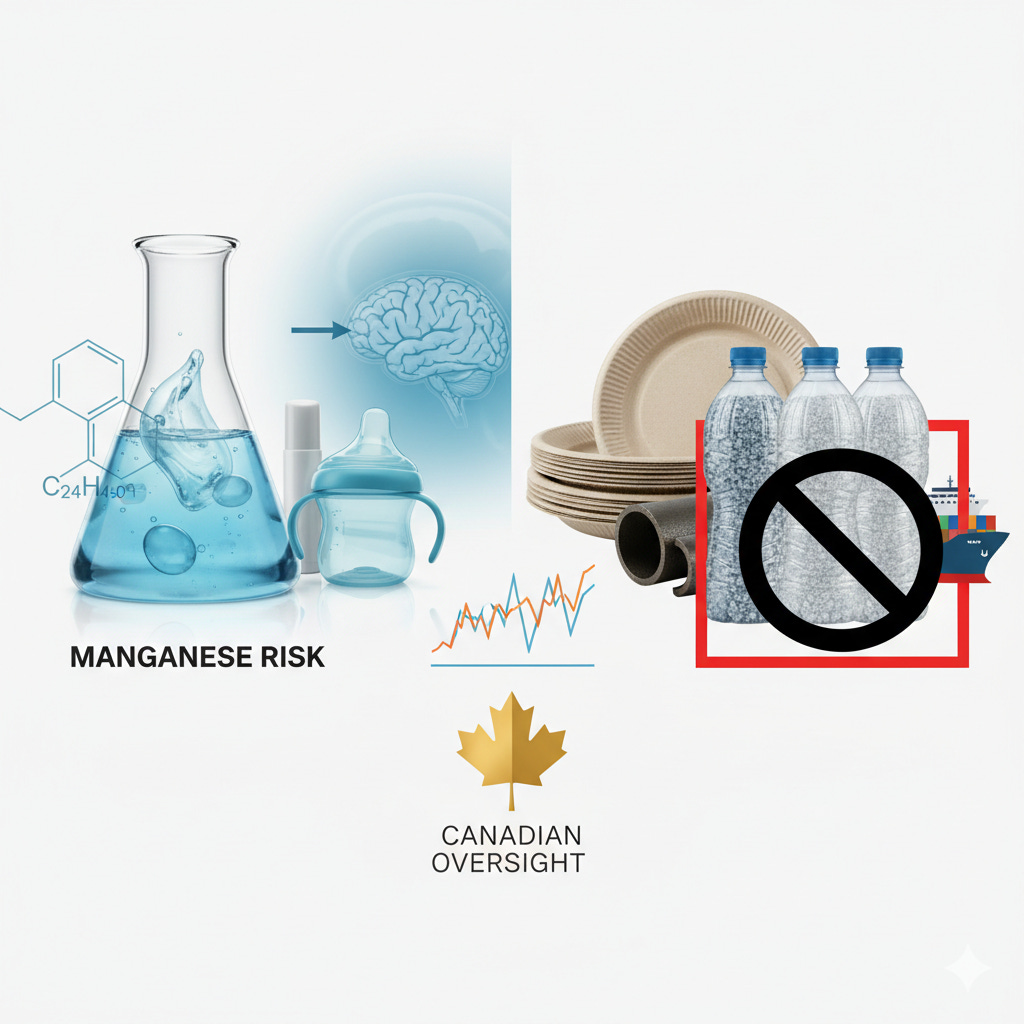
The federal government is quietly advancing significant regulatory changes that will affect the chemical composition of consumer products and scrutinize international trade practices. Recently published notices in the Canada Gazette reveal a dual focus: protecting Canadians from potentially harmful substances in everyday items and shielding domestic industries from what it considers unfair competition. These actions, though technical, point to a more assertive stance on both public health and economic protection.
A Closer Look at “DIDA”
The government has formally announced its intention to regulate a substance called hexanedioic acid, diisodecyl ester, more commonly known as DIDA. What is DIDA? It’s a chemical often used to make plastics more flexible and is found in a wide range of products, from automotive fluids and lubricants to cosmetics and natural health products.
Health Canada and Environment Canada have assessed the substance and suspect that in certain circumstances, it could be toxic or become toxic as defined by the Canadian Environmental Protection Act, 1999 (CEPA). The core concern is the potential for direct and significant human exposure.
So, how will this look in practice? The proposed rules don’t ban DIDA outright. Instead, they apply what are called “Significant New Activity” (SNAc) provisions. This means anyone who wants to manufacture or import products containing DIDA above specific concentration thresholds must notify the government at least 90 days in advance and provide detailed safety information.
The new thresholds are highly specific:
For manufacturers, notification is required if DIDA concentration is greater than 84% in non-aerosol lubricants, greater than 15% in aerosol lubricants, or 0.2% or more in most other consumer products. For cosmetics like lip liners, the trigger is 10%, while for other cosmetics, natural health products, and non-prescription drugs, it’s 0.2%.
For importers, the rules apply if the total quantity of DIDA imported in these products exceeds 10 kg per year, using the same concentration triggers.
This is a targeted approach designed to give regulators a chance to assess the risk before new high-concentration products hit the Canadian market, without disrupting existing uses that are considered safe.
Manganese Flagged as a Health Risk
In another major health-related move, the government has published its draft assessment of manganese and its compounds. While manganese is an essential nutrient, the assessment concludes that overexposure presents a danger to human health and the environment.
The central nervous system is the most sensitive target of manganese toxicity. The government identifies the developing fetus, infants, and young children as the most susceptible groups, as excessive exposure can harm brain development.
Where is the risk coming from? The assessment points to several key sources of exposure:
Drinking Water: Manganese concentrations in the water of several provinces (British Columbia, Saskatchewan, Manitoba, Quebec, New Brunswick, and Newfoundland and Labrador) and some First Nations communities have exceeded the maximum acceptable concentration.
Consumer Products: The use of some children’s paints, aerosol spray paints, and loose face powders could lead to potentially unsafe levels of exposure through ingestion or inhalation.
Air Quality: People living near specific industrial sectors, such as metal ore mining and iron and steel mills, face potentially higher exposure from airborne manganese.
Based on these findings, the government proposes to add manganese and its compounds to Part 2 of Schedule 1 of CEPA, officially classifying them as substances that “constitute or may constitute a danger in Canada to human life or health.” This is the first step toward developing risk management strategies to reduce Canadians’ exposure.
Probing Unfair Trade from China
Shifting from health to economics, the Canada Border Services Agency (CBSA) and the Canadian International Trade Tribunal (CITT) have launched multiple investigations into imported goods. The focus is primarily on products from the People’s Republic of China.
These notices signal concerns that foreign producers may be “dumping” (selling goods in Canada at prices lower than in their home market) or benefiting from unfair subsidies, which harms Canadian manufacturers.
Here are the key investigations underway:
Thermoformed Molded Fibre Tableware: The CBSA has initiated an investigation into the alleged injurious dumping and subsidization of items like disposable plates and bowls from China.
Cast Iron Soil Pipe: The CITT has started an inquiry into whether dumped and subsidized cast iron soil pipe from China has caused injury to the domestic industry.
Polyethylene Terephthalate (PET) Resin: Following a final determination from the CBSA, the CITT has concluded that dumped PET resin from China and Pakistan, and subsidized resin from China, has indeed caused injury to the domestic industry.
These actions show that Canada is actively using its trade remedy system to protect its industries from what it deems to be predatory pricing and unfair foreign government support. The outcomes could lead to the imposition of duties on these imported goods, making them more expensive for importers and potentially leveling the playing field for Canadian producers.
The Data Brief
New rules for DIDA: The government is placing new notification requirements on the manufacture and import of products containing higher concentrations of the chemical plasticizer DIDA, affecting cosmetics, lubricants, and some health products.
Manganese deemed toxic: A federal assessment has concluded that manganese poses a risk to human health and the environment, particularly for young children. This will lead to new risk management measures to reduce exposure from drinking water, air, and certain consumer goods.
Trade investigations launched: Canada is actively investigating whether tableware and pipes from China are being dumped or unfairly subsidized. A separate ruling confirmed that dumped PET resin from China and Pakistan has harmed Canadian industry.
Source Documents
Government of Canada. (2025, October 25). Canada Gazette, Part I, Volume 159, Number 43.