


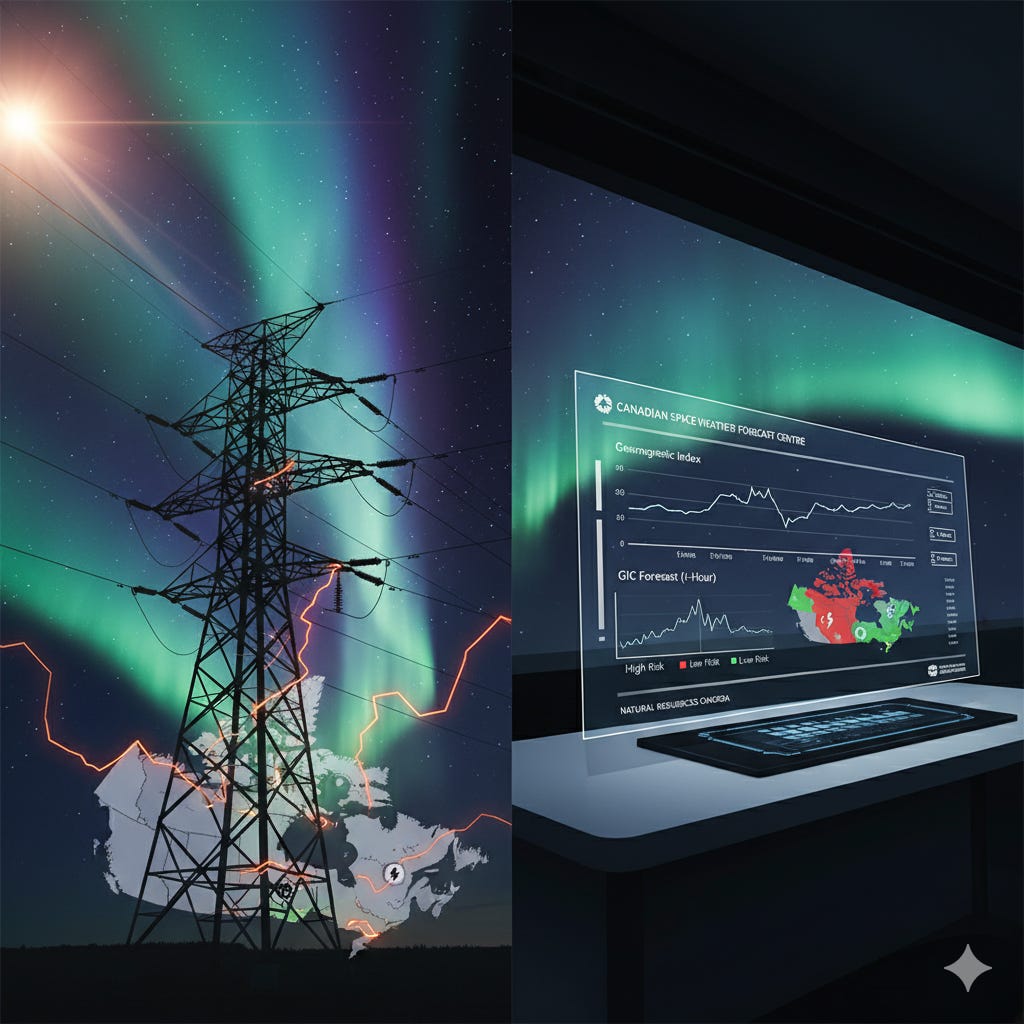
This analysis begins with a fundamental question of public safety. How do you prepare for a threat that is invisible, travels from 150 million kilometers away, and can disable the technological backbone of modern society? This isn’t a hypothetical. Severe space weather, in the form of geomagnetic storms, poses a direct and significant risk to Canada’s electrical power systems. A 2022 report from the Geological Survey of Canada outlines a novel approach to national defence against this threat, not with weapons, but with data. It details the creation of a forecasting system designed to predict geomagnetically induced currents (GICs), the very phenomena that can lead to voltage fluctuations, transformer damage, and widespread blackouts.
A Threat from the Sun
What is the actual danger here? When a solar storm hits the Earth, it creates a geomagnetic disturbance (GMD). According to the report, these disturbances can produce significant GICs in power networks. The potential consequences are not minor, ranging from simple power fluctuations to the destruction of essential transformers.
This risk is serious enough that the North American Electric Reliability Corporation (NERC) has mandated that power utilities assess their vulnerability and develop mitigation plans. The most effective mitigation, the report argues, is a real-time forecasting system that can predict when and where these currents will occur. This allows power grid operators to prepare for an incoming event, protecting the system from its worst effects.
How to See the Invisible
The core challenge in predicting GICs is that they are driven by the geoelectric field, which is not typically monitored in real time. So, to forecast the GIC, you must first forecast the geoelectric field. The report is clear on this point: no space weather forecast centre has ever provided such a service before. This project represents a new frontier in space weather prediction.
The Canadian Space Weather Forecast Centre, operated by Natural Resources Canada, already provides forecasts for geomagnetic activity. The new model builds on this foundation. Researchers have established a strong correlation, as high as 93%, between the hourly GIC index and the hourly geomagnetic index. This statistical link is the key. If you can accurately forecast geomagnetic activity, you can then model the resulting geoelectric field, and from there, predict the GICs that will flow through a specific power grid.
Building the Model
How would this look in practice? The researchers developed two distinct approaches to creating a forecast.
The first method uses the existing geomagnetic forecast as its starting point. It takes the predicted geomagnetic hourly index, uses a regression model to estimate the resulting geoelectric field, and then uses that result to calculate the final GIC forecast for each substation in a power network.
The second method is more direct. It bypasses the geomagnetic forecast and instead forecasts the geoelectric field index directly, using statistical patterns derived from years of observational data. From this, it calculates the GIC forecast.
To build and test these models, the team relied on three key data sets:
Geomagnetic Data: Sourced from Canadian observatories in locations like Fort Churchill, Manitoba.
Geoelectric Data: Modelled using the geomagnetic data and detailed maps of the Earth’s conductivity.
GIC Data: Calculated using a “benchmark” power network model designed to mimic the features of typical high-voltage grids.
Does It Work?
A forecast is only as good as its accuracy. To test the system, the researchers ran a simulation of a major geomagnetic storm that occurred in November 2004. They applied their forecasting models to the data from that event to see how well they could have predicted the resulting GICs in their benchmark network.
The results are promising. The 1-hour forecast provided the best and most accurate representation of the actual GIC values. When comparing the two primary approaches, the first method, which builds on the existing geomagnetic forecast, performed slightly better when predicting lower levels of activity. For more intense, stormy conditions, both methods performed comparably.
The report concludes that while the method has been successfully demonstrated, further evaluation, validation, and testing are required before it can be used in an operational capacity to protect Canada’s power grids.
The Data Brief
The Threat: Space weather can induce powerful currents (GICs) in power grids, risking transformer damage and widespread blackouts.
The Goal: Natural Resources Canada is developing a first-of-its-kind forecasting system to predict GICs before they occur.
The Method: The system works by forecasting the geoelectric field, which drives GICs. It uses statistical relationships between historical geomagnetic data, Earth conductivity models, and power grid configurations.
The Result: Initial tests using a 2004 geomagnetic storm show the system is promising, with the 1-hour forecast proving most accurate. The project was developed with Manitoba Hydro, but it is not yet ready for operational use.
Protecting the System
This work is a quiet but critical function of a modern state: anticipating and preparing for low-probability, high-impact events. The science is complex, but the mission is simple. By turning raw geomagnetic data into an actionable forecast, the government provides grid operators with the one resource that matters most in a crisis: time. This is not about preventing the storm itself, but about building a resilient system that can withstand the blow.
Source Documents
Trichtchenko, L., & Nikitina, L. (2022). Forecasting of GIC indices for Canadian power utilities (Geological Survey of Canada, Open File 8856).