


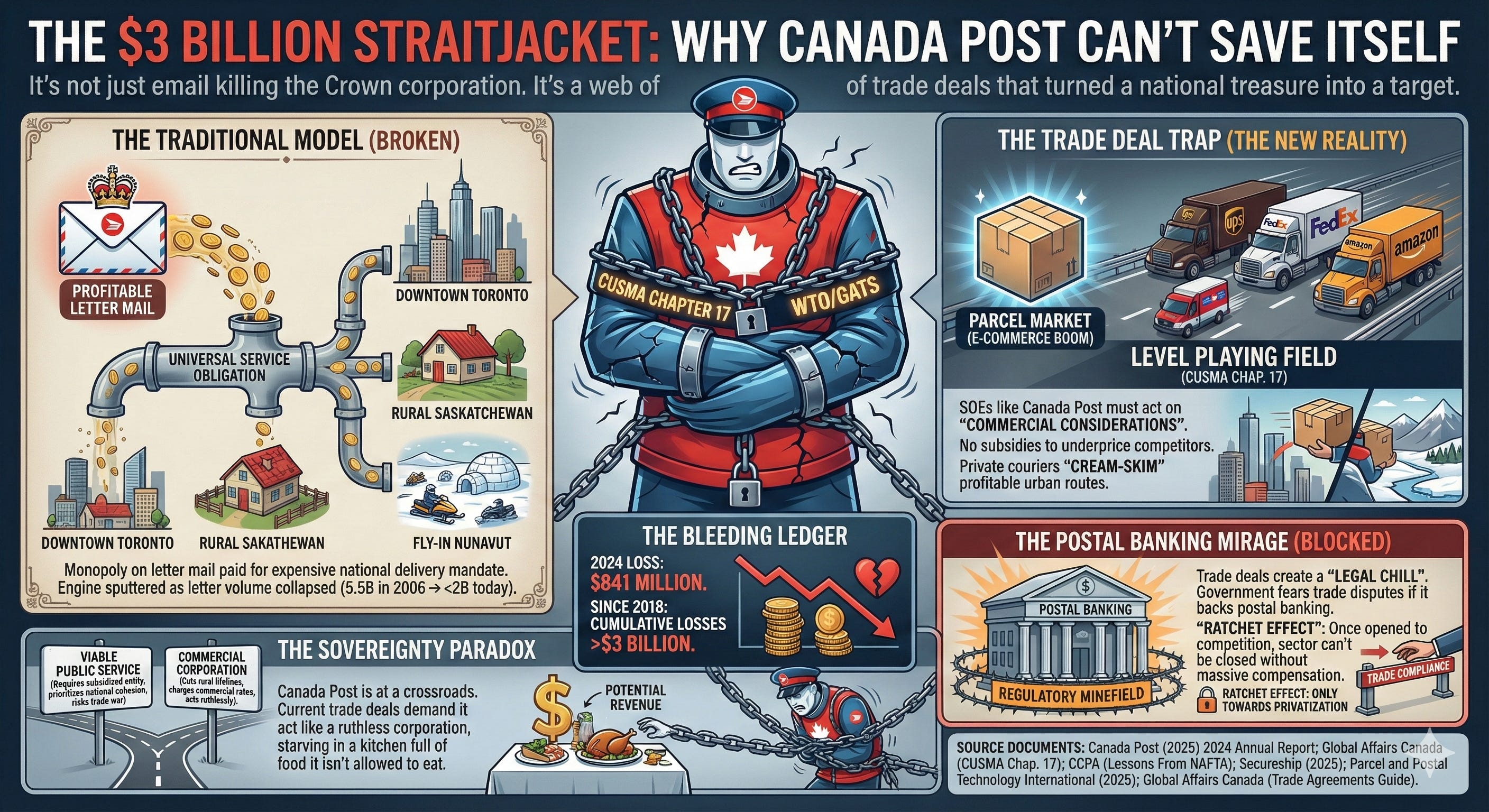
The numbers are catastrophic. In 2024 alone, Canada Post bled $841 million. Since 2018, the cumulative losses have surpassed $3 billion. To the average Canadian watching the recent labor disruptions and rising stamp prices, the story seems simple: the internet killed the letter, and the Crown corporation is a dinosaur failing to adapt.
But that is only half the story. The other half is buried in legal texts in Geneva and Washington.
You asked if Canada Post international trade agreement restrictions are limiting its viability. The answer is a resounding yes. While the digital revolution weakened the corporation’s knees, it is the “golden straitjacket” of modern trade deals—specifically the CUSMA (USMCA) and the WTO’s GATS—that has tied its hands. We are witnessing a clash between the sovereignty of a national service designed to bind a vast country together, and a global trading system designed to treat that service as just another competitor in a ruthless market.
The Bleeding Ledger
To understand the trap, we must first look at the bait. For decades, Canada Post operated on a cross-subsidization model. The profitable monopoly on letter mail paid for the expensive, money-losing mandate to deliver to every single address in Canada, from downtown Toronto to the fly-in communities of Nunavut. This is the “Universal Service Obligation.” It is the price of Canadian sovereignty; it ensures that a grandmother in Tuktoyaktuk pays the same for a stamp as a banker on Bay Street.
But as letter volumes collapsed—dropping from 5.5 billion pieces in 2006 to under 2 billion today—that revenue engine sputtered. The obvious pivot was to parcels, the booming sector of e-commerce.
Here is where the trap snapped shut. In the parcel market, Canada Post is not a monopoly; it is a competitor against giants like UPS, FedEx, and Amazon. And because it is a State-Owned Enterprise (SOE) competing with private American corporations, it is subject to the supreme law of North American trade: the “Level Playing Field.”
CUSMA Chapter 17: The Invisible Handcuffs
When the USMCA (known in Canada as CUSMA) replaced NAFTA in 2020, it tightened the screws on State-Owned Enterprises. Chapter 17 is the smoking gun.
This chapter mandates that SOEs like Canada Post must act in accordance with “commercial considerations” when buying or selling goods and services. On the surface, this sounds fair—it prevents the government from cheating. But in practice, it acts as a prohibition on the very advantages a national post office needs to survive.
If the Canadian government wanted to heavily subsidize Canada Post’s parcel division to underprice competitors and win back market share, FedEx or UPS could cry foul. They could argue that Canada is violating CUSMA by using state resources to distort the market. This creates a “legal chill.” The government is terrified of triggering a trade dispute or an investor-state challenge, so it forces Canada Post to operate like a private business, even though it carries the burden of a public mandate that no private business would touch.
Private couriers are free to “cream-skim”—taking the profitable urban routes and leaving the expensive rural deliveries to Canada Post. Canada Post is left holding the bag for the entire country’s infrastructure but is legally restricted from using its state backing to aggressively fight back in the profitable sectors.
The Postal Banking Mirage
This dynamic explains the mysterious absence of postal banking. For years, the Canadian Union of Postal Workers (CUPW) and sovereignty advocates have pointed to countries like France, Italy, and Japan, where postal banking brings in massive revenue and keeps rural post offices open.
Why hasn’t Canada done it? It isn’t just lack of political will; it’s the shadow of the trade deals.
The major Canadian banks are terrified of a state-backed competitor. If Canada Post opened a bank, it would arguably need government backing to be viable. Under CUSMA and the WTO’s General Agreement on Trade in Services (GATS), private banks (including foreign ones operating here) could argue that such backing constitutes an unfair subsidy or non-conforming measure.
While trade deals do not explicitly write “No Postal Banking,” they create a regulatory minefield. To launch postal banking profitably, the government would likely need to favor Canada Post in ways that current trade laws define as “discrimination” against private investors. The result? Paralysis. We study the idea to death, but the “trade-compliant” version of postal banking is so watered down it never launches.
The Ratchet Effect
The most insidious part of these agreements is the “ratchet effect.” Trade deals are designed to move in only one direction: toward more privatization. Once a sector is opened to competition (like parcels), you cannot close it again without paying massive compensation to foreign investors.
We cannot simply declare, “Parcels are now a public monopoly again to save Canada Post.” That would trigger billions in lawsuits from American logistics companies under international law. We have locked the door and thrown away the key.
Furthermore, recent trade hostilities have worsened the situation. In August 2025, the U.S. suspended the “de minimis” threshold for Canada, meaning even small postal shipments into the U.S. now face duties and red tape. This erased one of the few remaining advantages Canada Post had for small business exporters, driving even more volume to private couriers who have better integrated customs brokerage systems.
The Sovereignty Paradox
You described Canada Post as a “national treasure we need to defend for our sovereignty.” You are correct. In a country with Canada’s geography, the market will never naturally serve the margins. There is no profit in delivering a parcel to a remote farmhouse in Saskatchewan for $15.
A purely commercial Canada Post—the version demanded by trade agreements—will eventually have to cut those rural lifelines or charge “commercial rates” that would bankrupt rural residents.
We are at a crossroads. To make Canada Post viable under current trade restrictions, it must shrink, cut services, and act like a ruthless corporation. To make it viable as a public service, we would need to break the “commercial considerations” shackles of CUSMA, creating a subsidized entity that prioritizes national cohesion over trade compliance.
Doing the latter would require a government willing to fight a massive trade war with the United States and face down the banking lobby. Until that happens, Canada Post remains in the straitjacket, starving in a kitchen full of food it isn’t allowed to eat.
Source Documents
Canada Post. (2025). 2024 Annual Report: Our Financial Picture. Canada Post Corporation.
Global Affairs Canada. (2020). Canada-United States-Mexico Agreement (CUSMA) – Chapter 17 – State-Owned Enterprises and Designated Monopolies. Government of Canada.
Canadian Centre for Policy Alternatives. (n.d.). Lessons From NAFTA: The High Cost of “Free Trade”.
Secureship. (2025, October). The End of De Minimis: What Canadian Businesses Need to Know About Shipping to the US.
Parcel and Postal Technology International. (2025, November 26). Canada Post reports largest ever pre-tax loss but agrees deal with union.
Global Affairs Canada. (n.d.). International Trade Agreements and Local Government: A Guide for Canadian Municipalities.
Thank you for answering my question. The situation needs to be addressed.