


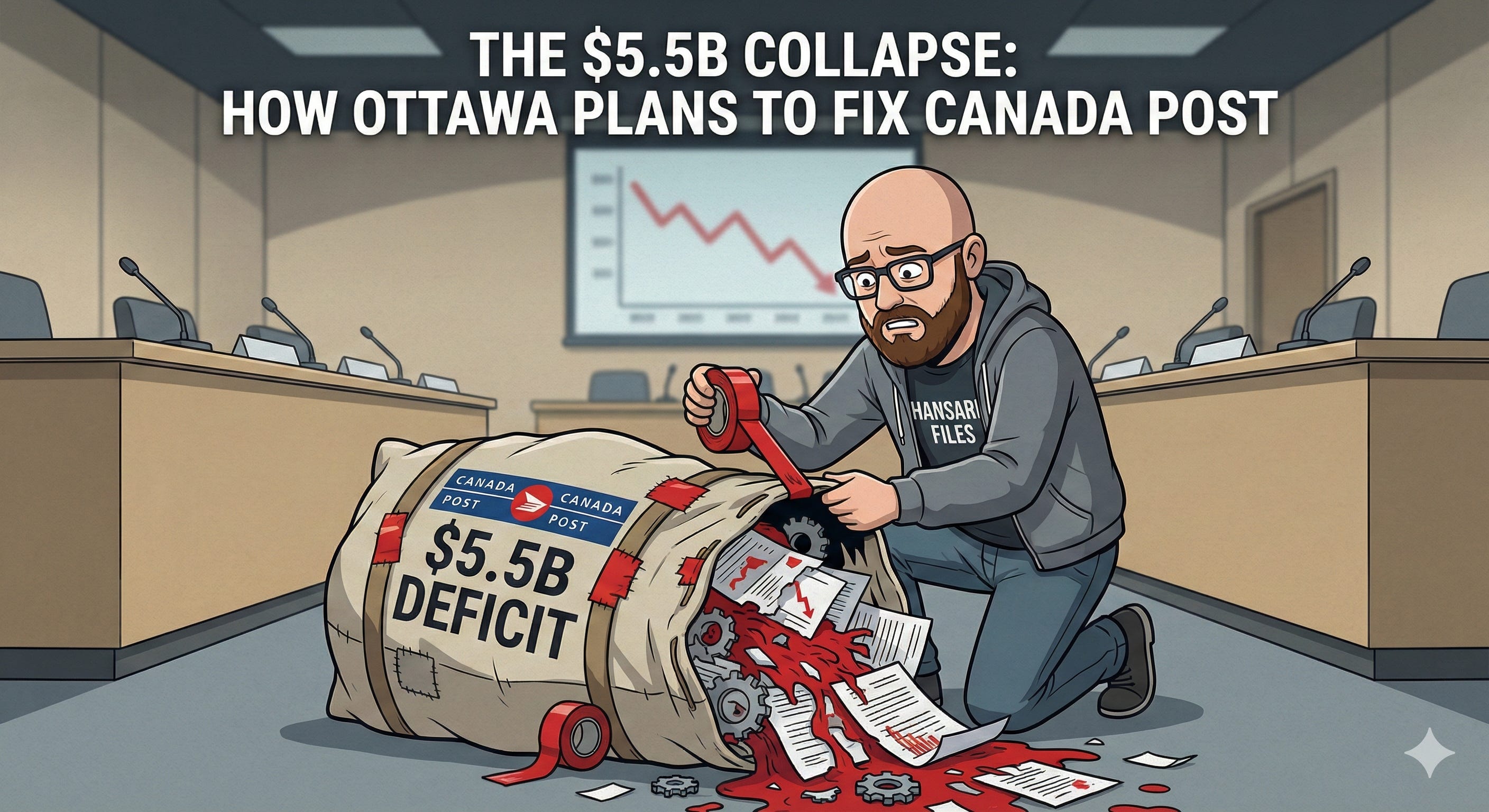
The sheer scale of the financial hemorrhage is difficult to comprehend. Since 2018, Canada Post has bled over $5.5 billion in operating losses. This devastating fiscal decline has pushed one of the nation’s most historic institutions to the brink of insolvency. It is a quiet crisis, playing out not in dramatic public protests, but in the sterile, fluorescent-lit committee rooms of the Canadian Senate. Here, amidst repeated warnings from committee chairs about audio feedback and the proper placement of translation earpieces, the future of the Canadian state is being meticulously renegotiated.
During the first week of February 2026, a series of Senate committee meetings laid bare the hidden mechanisms of Ottawa’s administrative machine. Before the heavy policy debates even begin, the sheer procedural routine of the Senate must be satisfied. On February 4, the Subcommittee on Veterans Affairs met simply to organize its activities. Amidst strict warnings from the clerk regarding audio feedback protocols, Senator Dawn Anderson was quietly elected as chair. It is in these highly formalized, polite exchanges that the gears of government begin to turn, setting the stage for the massive financial and social oversight that follows.
From the desperate financial triage of the national postal service, to the friction of enforcing bilingualism at our airports, to the remote fisheries of the Northwest Territories, the recurring theme is undeniable. The systems built to govern a twentieth-century Canada are buckling under the weight of modern realities.
The $5.5B Oversight at Canada Post
In the Standing Senate Committee on Transport and Communications, Carrie Chisholm did not mince words. As the Vice-President of Product Management and Customer Experience at Canada Post, she arrived to explain exactly why the Crown corporation is suffocating. In 2006, the postal service delivered over 5.5 billion letters. Today, that volume has plummeted by 70 percent. Simultaneously, the number of addresses requiring delivery continues to expand across the vast Canadian geography.
“The cost of delivering these letters is no longer supported by the revenue we receive from letter mail,” Chisholm told the committee. The decline in letter mail is compounded by a catastrophic drop in parcel market share, which fell from 62 percent in 2019 to just 24 percent in 2024. Last year, the federal government had to inject a staggering $1.034 billion simply to keep the corporation afloat.
Enter Bill C-15, the Budget 2025 Implementation Act. Division 2 of Part 5 of the Bill proposes sweeping amendments to the Canada Post Corporation Act. The primary objective is deregulation, specifically removing the requirement for an Order-in-Council to approve postage rate increases. Currently, navigating the bureaucratic labyrinth to raise the price of a stamp takes upwards of nine months. This delay was described by the recent Industrial Inquiry Commission as both time-consuming and hopelessly cumbersome.
Lorenzo Ieraci, Assistant Deputy Minister at Public Services and Procurement Canada, testified that lifting this regulatory ceiling is essential. He explained that the price of stamps in Canada has been kept artificially low to encourage public use, noting that Canadian rates are well below the OECD average. For comparison, Australia hiked its stamp prices by 25 percent early last year to combat similar geographic and economic hurdles.
But deregulation breeds anxiety. Senators Paula Simons and Julie Miville-Dechêne aggressively questioned the witnesses regarding the repeal of statutory protections for free mailings for the blind and discounted rates for library materials. If the postal service is given absolute autonomy to set rates to cover its multi-billion-dollar deficit, lawmakers worry it might balance its books on the backs of small rural libraries and visually impaired Canadians.
Chisholm and Ieraci offered solemn verbal guarantees. Chisholm promised that regardless of any legislative changes related to Bill C-15, the corporation will continue to maintain reduced postage rates for library mail and free postage for blind or partially sighted individuals. Ieraci added that the government already appropriates $22.2 million annually to offset the costs of literature for the blind.
Senator Simons was not entirely placated by promises absent from the legislative text. She noted the deluge of concern from the library community, who felt utterly excluded from the consultation process. “What we can take from this is that librarians like to read the fine print,” Simons remarked dryly.
Senator Todd Lewis raised the geographic reality of Canada, asking if variable rates for letters based on rural versus urban destinations were on the horizon. Chisholm clarified that while competitive products like parcels use origin-and-destination pricing, stamp prices will remain national. However, to cut costs, the corporation is adjusting its delivery standards to a three-to-seven-day window. By reducing the strict two-to-four-day requirement, the corporation can shift mail transport from expensive air freight to ground transportation. This move generates substantial operational savings while aligning with net-zero greenhouse gas emission goals.
Bureaucratic Friction and the Official Languages Act
While the Transport Committee debated the survival of the national postal service, the Standing Senate Committee on Official Languages convened to scrutinize another cornerstone of Canadian identity. They gathered to review proposed regulations surrounding administrative monetary penalties (AMPs) under the modernized Official Languages Act.
The goal is to ensure federal institutions operating in the transportation sector serve the travelling public in both English and French. The new regulations double the maximum penalty to $50,000 per violation. However, testimony from the Office of the Commissioner of Official Languages revealed a regulatory framework bogged down by excessive administrative burden.
Pascale Giguere, General Counsel for the Office, painted a picture of a system paralyzed by its own design. Before imposing a penalty, the Commissioner must satisfy a laundry list of criteria, each requiring substantive, documented justification. When the Office analyzed fifteen other federal AMP regimes, they found that the official languages framework was uniquely and excessively onerous.
Giguere pointed out that the Commissioner is not charting new territory. Environmental legislation and the Pay Equity Act both allow for financial penalties against publicly funded federal departments. Yet, the specific regulations drafted for official languages demand that the methodology used to calculate the penalty amount be substantively justified in the notice of violation itself. This creates a highly vulnerable legal document, practically inviting alleged violators to challenge the penalty based on minor technicalities.
Furthermore, Assistant Commissioner Patrick Wolfe expressed deep concern over the arbitrary exclusion of key players. Port authorities and the Canadian Air Transport Security Authority (CATSA) are inexplicably exempt from these financial penalties. For a bilingual traveler flying out of Toronto Pearson or boarding a ferry in the Maritimes, the expectation of service in both languages is universal. Yet, the regulatory teeth to enforce those rights are being applied selectively.
Senator Rene Cormier pressed the witnesses on the practical reality of the traveling public. If a traveler traverses the country from Saint John to Edmonton, they encounter numerous third-party vendors inside the terminal. Wolfe conceded that while the $50,000 penalties are a last resort meant to force airport authorities into compliance agreements, the actual enforcement against a stubborn fast-food franchise remains a daunting logistical hurdle.
The Northern Transition and the Fisheries Divestiture
Thousands of kilometers away from the bureaucratic tangles of Ottawa, the economic survival of northern communities hinges on a different kind of government restructure. The Standing Senate Committee on Fisheries and Oceans met to discuss Division 33 of Part 5 of Bill C-15, focusing on the divestiture of the Freshwater Fish Marketing Corporation Act.
For decades, the Crown corporation has held a monopoly on purchasing and marketing freshwater fish caught in the Northwest Territories, primarily from the vast, icy expanse of Great Slave Lake. Joel Holder, Director of Economic Diversification for the Government of the Northwest Territories, appeared via videoconference to explain the precarious transition now under way.
The statistics highlight the region’s localized dependency. Committee Deputy Chair Senator Bev Busson noted that in 2023, the Department of Fisheries and Oceans reported 429 tonnes of commercially caught freshwater fish were landed in the Northwest Territories. Holder confirmed this represents an average year, with 99.9 percent of that commercial catch coming directly from Great Slave Lake.
With Ontario, Saskatchewan, Manitoba, and Alberta having already exited the federal marketing framework, the Northwest Territories remains the sole participant. Knowing the Crown corporation’s days were numbered, the territorial government constructed a new fish-processing plant in Hay River. The facility only began temporary operations last summer, relying on an operating agreement with the federal corporation to refine its processing line and test equipment.
Now, that agreement is sunsetting. The territory is actively searching for a northern entity, preferably an Indigenous cooperative or corporation, to assume permanent operation of the Hay River plant.
But the shift is fraught with anxiety. Fishers who have spent their entire careers selling their catch to a federal entity must now trust a newly minted territorial facility. “How are they going to feel about selling to the Hay River plant and ensuring that we can meet the expected professionalism and level of consistency that FFMC has been able to provide fishers over the decades?” Holder asked the committee.
Senator Colin Deacon probed the depth of local consultations regarding the divestiture. The response was troubling. The Department of Fisheries and Oceans holds the mandate for consultation, yet the territorial government has been entirely sidelined from face-to-face meetings with Indigenous groups, relegated merely to advising federal bureaucrats on who should receive a letter in the mail.
Modernizing the Chamber With a Digital Scroll
While these committees dissected the operational failures of national services, the Standing Committee on Rules, Procedures and the Rights of Parliament turned its gaze inward. The operations of the Senate itself are quietly undergoing a much-needed digital revolution.
For generations, the scroll (the minute-by-minute agenda of the Senate chamber) has been a closely guarded paper document. It is updated manually, often keeping non-affiliated senators in the dark regarding sudden procedural shifts or surprise motions. Senator Percy Downe introduced a proposal to permanently replace this antiquated system with a real-time digital scroll accessible to all members equally.
“Basically, what I’m concerned about is that in this day and age using a paper document of a scroll is not only dated, it is not timely,” Downe argued. He pointed out that the Canadian Senators Group has utilized an internal digital scroll for over a year, proving the technology is simple and the staffing requirements minimal.
The debate quickly pivoted to the mechanics of power. The committee wrestled with who should control this flow of information. Should it be the Government Representative’s Office (GRO), which holds political stakes in the timing of legislation, or the Chamber Operations and Procedure Office (COPO), a strictly neutral administrative body?
Senator David Wells cautioned against leaving the responsibility to political entities. “Motions can come up any time, and the GRO may not know if I’m going to provide a motion, and I may not want them to know,” he noted. The consensus formed around tasking neutral administrators with the operational execution, ensuring that all senators, regardless of their political affiliation or independent status, receive vital information symmetrically.
The Cost of Moving Forward
Whether the issue is a staggering multi-billion-dollar deficit at the national postal service, the selective enforcement of bilingual rights, the fragile economy of northern fisheries, or the internal communication of the Senate, the underlying narrative remains constant. Canada’s administrative state is struggling to adapt to the velocity of the modern era.
The solutions being debated (deregulation, divestiture, and digital modernization) are necessary but deeply perilous. As the Senate continues to scrutinize these sweeping legislative changes, the promises of bureaucrats will be tested against the lived realities of visually impaired readers, Great Slave Lake fishers, and everyday citizens waiting for the mail. The cost of modernizing the state is high, and as these committee transcripts reveal, the ultimate price is rarely borne by the government alone.
Hansard Files spends hours digesting dense parliamentary transcripts to bring you the stories that shape Canada’s future. If you value this deep-dive, neutral investigative journalism, please subscribe and support our mission to hold the administrative state accountable.
Source Documents
Standing Senate Committee on Official Languages. (2026, February 2). Evidence.
Standing Senate Committee on Transport and Communications. (2026, February 3). Evidence.
Standing Committee on Rules, Procedures and the Rights of Parliament. (2026, February 3). Evidence.
Standing Senate Committee on Fisheries and Oceans. (2026, February 3). Evidence.
Subcommittee on Veterans Affairs. (2026, February 4). Evidence.
These are stellar examples of why communism always fails. Central planning isn't fast or flexible.
Life moves fast. Actual progress (as opposed to the DEI/woke version) changes how society functions on an ongoing basis. If you'd told someone in 1970 that post offices would be redundant in 50 years, they would laugh in your face.