


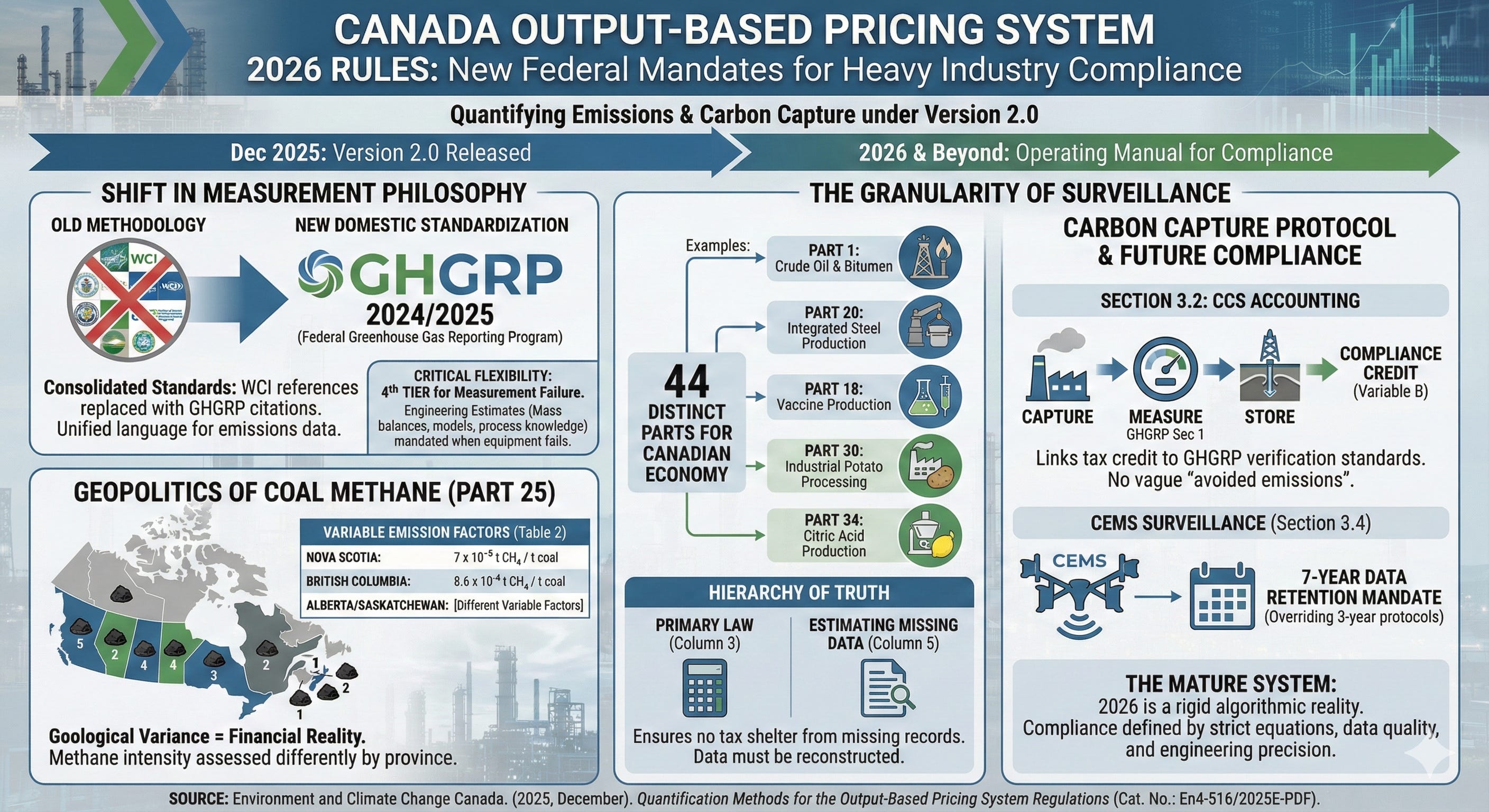
The architecture of Canada’s industrial climate policy is often debated in the House of Commons, but its reality is forged in the quiet release of technical documents. In December 2025, Environment and Climate Change Canada published “Version 2.0” of the Quantification Methods for the Output-Based Pricing System Regulations. This document is not merely a bureaucratic update. It serves as the operating manual for the entire national carbon pricing regime for the 2026 compliance period and beyond. It determines how the Output-Based Pricing System (OBPS) functions on the ground, dictating the precise mathematical formulas that refineries, steel mills, and power plants must use to calculate their financial liabilities to the state.
For the engineers and compliance officers working within Canada’s heavy industries, this document represents the boundary between compliance and penalty. The 2026 update signals a tightening of the surveillance grid and a standardization of the ruler used to measure the nation’s invisible exhaust.
The Shift in Measurement Philosophy
The most significant evolution in Version 2.0 is the consolidation of measurement standards. For years, Canadian regulations relied heavily on a patchwork of methodologies, often referencing the Western Climate Initiative (WCI), a collaboration of American and Canadian jurisdictions. The 2026 regulations mark a decisive pivot toward domestic standardization. Throughout the sector-specific guidelines, references to WCI methods are systematically replaced with citations to “GHGRP 2024/2025,” the federal Greenhouse Gas Reporting Program.
This is a subtle but profound shift in regulatory sovereignty. By aligning the Output-Based Pricing System with the GHGRP, the government creates a unified language for emissions data. A facility can no longer measure its output one way for reporting purposes and another way for pricing compliance. The document explicitly states that wherever conflicts arise between the regulations and the reporting program, the Output-Based Pricing System regulations prevail.
The new rules also introduce a critical flexibility mechanism for when the machinery of measurement fails. Section 2.1 now includes a “fourth tier” for quantifying greenhouse gases: engineering estimates. When standard monitoring equipment goes dark, or when specific protocols from the IPCC or federal reporting programs do not apply, facilities are now permitted—and mandated—to use engineering estimates based on mass balances, models, process knowledge, and facility-specific data. This clause acknowledges the messy reality of industrial operations, where sensors corrode and data streams break, ensuring that the ledger of emissions never remains blank.
The Granularity of Surveillance
The scope of the document reveals the sheer breadth of the Output-Based Pricing System. It does not treat industry as a monolith. Instead, it breaks the Canadian economy down into forty-four distinct “Parts,” each with its own bespoke set of equations and sampling requirements.
The regulations cover the obvious giants of pollution. Part 1 covers Bitumen and Other Crude Oil Production, detailing the math required to track stationary fuel combustion, flaring, and the methane that leaks from on-site transportation. Part 20 covers Integrated Steel Production, regulating everything from the blast furnace to the coke oven battery. However, the surveillance grid extends into niche corners of the economy. Part 18 establishes rules for Vaccine Production. Part 30 governs Industrial Potato Processing. Part 34 regulates Citric Acid Production.
This granularity is essential because the chemical signature of emissions varies wildly between sectors. A scrap-based steel mill (Part 19) emits carbon differently than a wet corn milling facility (Part 33). The regulations account for these variances by assigning specific “Specified Emission Types” to each sector. For a cement producer, the focus is on the industrial process emissions from the calcination of limestone. For a natural gas transmission pipeline, the focus shifts to the methane venting from pneumatic devices and compressors.
The document creates a specific hierarchy of truth. For most sectors, the “Column 3” method for calculating greenhouse gases is the primary law. But the regulations also anticipate the inevitable gaps in the record. “Column 5” in every sector table dictates the “Method for Estimating Missing Analytical Data.” This ensures that a missing spreadsheet or a corrupted hard drive does not become a tax shelter. The data must be reconstructed, estimated, and reported.
The Geopolitics of Coal Methane
One of the most revealing sections of the document is hidden within Part 25, regarding Coal Mining. Here, the federal government quantifies the geological differences of the Canadian landscape. The regulations dictate how mining companies must calculate fugitive methane leakage—the invisible gas that seeps out of coal seams when the earth is disturbed.
The regulations do not trust a single national average. Instead, Table 2 of Part 25 assigns specific “Emission Factors” based on the province and the type of coal. A bituminous coal mine in Nova Scotia is assigned a factor of 7 times 10 to the power of negative 5 tonnes of methane per tonne of coal. A mine in British Columbia, however, faces a factor of 8.6 times 10 to the power of negative 4. This implies that the government assesses the methane intensity of British Columbian mining operations as significantly higher than those in the Maritimes or the lignite fields of Saskatchewan.
These coefficients are not abstract numbers. They are multipliers that directly impact the bottom line of mining corporations. By codifying these factors, the regulations translate geological variance into financial reality. A mine in Alberta extracting sub-bituminous coal pays a different carbon price on its fugitive emissions than a mine in New Brunswick, solely based on the government’s assessment of the rock beneath their feet.
The Carbon Capture Protocol
As the Canadian government pivots toward technological solutions for climate change, the 2026 regulations formalize the accounting for Carbon Capture and Storage (CCS). Section 3.2 provides the formula for “Quantity of CO2 captured and stored,” designated by the variable B.
The text is rigid. The quantity of sequestered carbon must be determined using the quantification method described in Section 1 of the GHGRP 2024/2025. This links the tax credit directly to the technical verification standards of the reporting program. There is no room for vague claims of “avoided emissions.” The carbon must be captured, measured, and injected into a storage project that meets the federal definition.
Furthermore, the document tightens the leash on Continuous Emissions Monitoring Systems (CEMS). These complex arrays of sensors, which sniff smokestacks in real-time, are the gold standard for measurement. Section 3.4 mandates that any facility using CEMS must comply with the 2023 “CEMS Protocols” published by Environment and Climate Change Canada. Crucially, the regulations extend the memory of the law. While technical protocols might require data retention for three years, the Output-Based Pricing System overrides this, demanding that CEMS records be kept for at least seven years. This alignment with the Greenhouse Gas Pollution Pricing Act ensures that auditors can look back nearly a decade into a facility’s operational history to verify compliance.
The Future of Compliance
The release of Version 2.0 establishes the playing field for the second half of the decade. By removing the “interim” feel of earlier methodologies and locking in the 2024/2025 reporting standards, the government is signalling that the testing phase of carbon pricing is over. The system has matured into a permanent feature of the industrial landscape.
For the facility managers in Hamilton, Fort McMurray, and Saint John, the 2026 compliance period will not be defined by political rhetoric, but by the strict columns of this document. Every gigajoule of natural gas burned, every tonne of clinker produced, and every cubic metre of methane vented must now be filtered through these specific equations. The Output-Based Pricing System has evolved from a policy concept into a rigid algorithmic reality, where the only thing that matters is the quality of the data and the precision of the engineering estimate.
Source Documents
Environment and Climate Change Canada. (2025, December). Quantification Methods for the Output-Based Pricing System Regulations (Cat. No.: En4-516/2025E-PDF).