


Your tax dollars fund the complex machinery of government, and few areas are as tied to Canada's identity and economic future as natural resources. Every year, the federal budget outlines a roadmap, revealing priorities through dollars and cents. The 2025-26 Main Estimates for Natural Resources Canada (NRCan) offer a clear picture of a department in transition, navigating the dual challenges of climate change and global economic shifts.
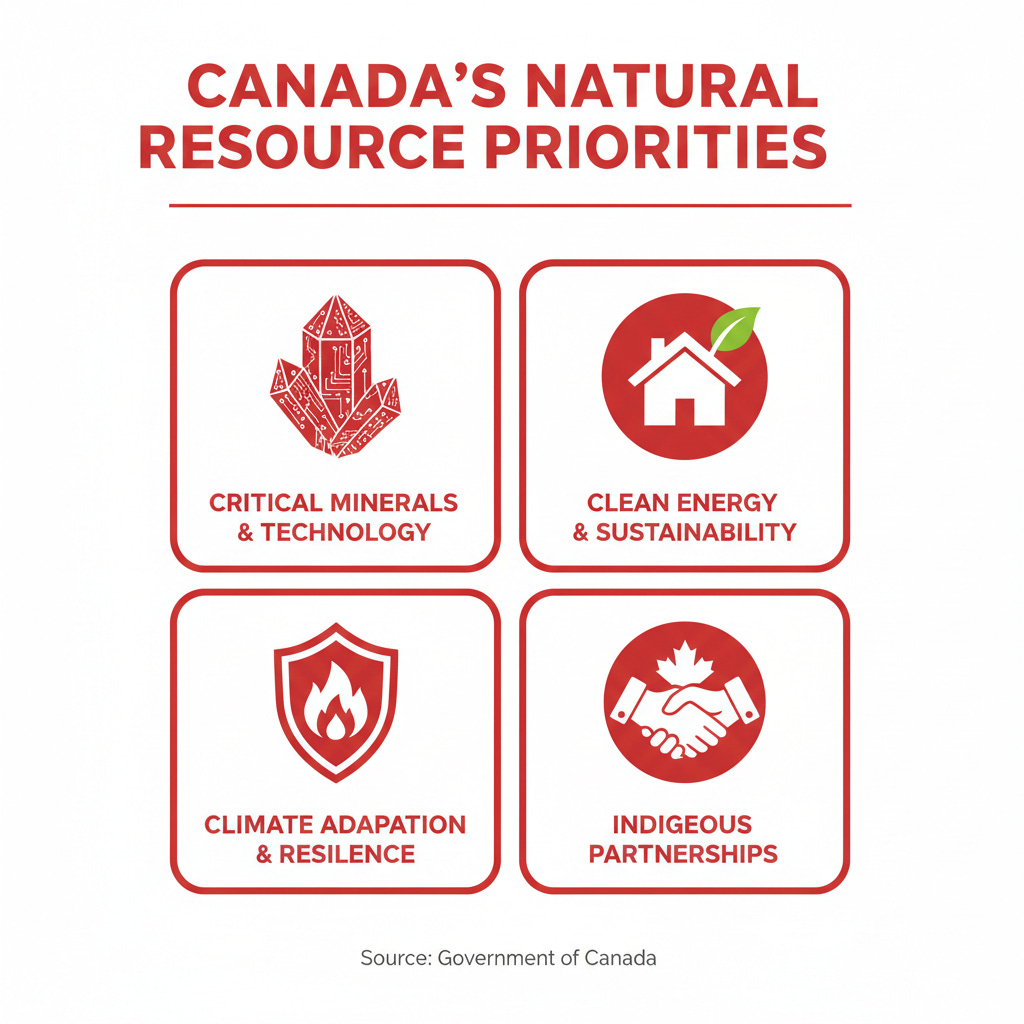
While the department's overall budget is seeing a decrease of $418.6 million, this top-level number hides a more complex story of strategic reallocation. Funding is being directed away from some areas and channelled into others deemed critical for the future. The government is making calculated investments in greening your home, securing essential minerals for new technologies, defending against wildfires, and fundamentally reshaping its partnership with Indigenous communities.
These spending decisions affect everything from the cost of heating your home to the jobs available in your community and Canada's standing on the world stage. Understanding these shifts provides insight into the nation's long-term economic and environmental strategy.
1. The Global Race for Critical Minerals Is a Top Priority
The world needs specific minerals to build everything from electric vehicle batteries and wind turbines to semiconductors and smartphones. The government is positioning Canada to be a leading supplier in this competitive global market. NRCan is increasing its spending on critical minerals by over $33 million this year, part of a multi-year, multi-billion dollar Canadian Critical Minerals Strategy.
This funding is not just about digging minerals out of the ground. The strategy focuses on building the entire supply chain within Canada. This includes funding for clean energy and transportation infrastructure to support new mining projects. The goal is to process and refine more minerals here at home, creating higher-value products and jobs. The government has already funded over 100 projects and is working with international allies like the United States and the European Union to build secure supply chains that are less dependent on single sources like China. This investment signals a major industrial strategy to align Canada's resource wealth with the green and digital economy.
2. Big Investments Are Coming to Help You Green Your Home
The government is making energy efficiency a cornerstone of its climate and affordability plan, with a significant focus on helping you reduce your energy bills. Funding for home retrofit programs is increasing by over $25 million, building on existing initiatives like the Greener Homes Grant and the Oil to Heat Pump Affordability Program.
A major new element is the Canada Greener Homes Affordability Program, backed by nearly $800 million over five years. This program will focus on providing no-cost energy retrofits for low-to-median-income Canadian households, including tenants. The goal is to make energy efficiency accessible to everyone, not just those who can afford the upfront costs.
This focus is important for two reasons. First, it directly addresses cost-of-living concerns by lowering monthly heating and electricity bills. Second, improving the energy efficiency of Canada's homes and buildings is one of the most effective ways to reduce greenhouse gas emissions. These programs show a commitment to tackling climate change at the household level.
3. Wildfire Defence Is Receiving a Major Funding Injection
After several devastating fire seasons, the federal government is significantly increasing its investment in wildfire management. Multiple programs are seeing budget increases, including a $17 million rise for fighting and managing wildfires and a $15.6 million boost for the Wildfire Resilient Futures Initiative.
These funds support a more holistic approach to fire management that goes beyond just suppression. The strategy includes:
Prevention and Mitigation: Expanding programs like FireSmart to help communities reduce their wildfire risk before a fire starts.
Modern Equipment: Helping provinces and territories buy new equipment, from trucks and pumps to advanced communications technology.
More Firefighters: Funding the training of 1,000 additional community-based firefighters.
Better Science: Investing in a new satellite mission, WildFireSat, to monitor active wildfires daily and improving the models used to predict fire behaviour.
Indigenous Knowledge: Supporting and mobilizing Indigenous fire stewardship and traditional knowledge in fire management.
This spending reflects a recognition that wildland fires are becoming more frequent and extreme. The government is shifting from a reactive stance to a proactive one, aiming to build long-term resilience in communities and landscapes across the country.
4. Indigenous Economic Partnership Is Now Central to Resource Development
The government is moving to ensure Indigenous communities are not just consulted on natural resource projects, but are active partners and beneficiaries. A key part of this strategy is the new Indigenous Loan Guarantee Program, which is being expanded to provide up to $10 billion in loan guarantees. This program helps Indigenous groups secure the capital needed to buy equity stakes in major energy and resource projects.
The first loan guarantee under this program was recently announced, supporting 36 First Nations in British Columbia to acquire an ownership interest in Enbridge's Westcoast natural gas pipeline system.
Complementary programs are also in place to provide funding for capacity building. This helps communities access the legal, financial, and technical expertise needed to evaluate and negotiate complex project partnerships. This approach represents a fundamental shift. It aims to advance economic reconciliation by ensuring Indigenous communities share in the economic benefits generated from projects on their lands.
5. Canada Is Actively Seeking New Energy Markets Beyond the U.S.
For decades, the United States has been the primary customer for Canada's energy exports. Heightened geopolitical tensions and recent American tariffs have highlighted the economic risks of this overreliance. In response, the government is actively working to diversify its energy markets, with a particular focus on Asia and Europe.
The completion of the Trans Mountain Expansion (TMX) pipeline is a key piece of this strategy, allowing Canadian oil to reach global markets from the West Coast. This access is expected to generate billions in new revenue by reducing the price difference between Canadian and U.S. oil.
Liquefied Natural Gas (LNG) is another major focus. The LNG Canada project, one of the largest private investments in Canadian history, is nearing its first delivery. Several other LNG projects are either under construction or in the planning stages. The government views Canadian LNG as a way to displace higher-emitting fuels in other countries, contributing to global decarbonization efforts while strengthening the Canadian economy.
6. The Government Wants to Fast-Track Major Projects
Industry stakeholders have long raised concerns that Canada's complex regulatory system slows down the development of major projects, discouraging investment. The government is responding with a plan to significantly accelerate approval timelines. The goal is to reduce the time for all federal decisions on major projects from a target of five years down to just two.
To achieve this, the government has introduced new legislation, the Building Canada Act. This act creates a process to identify certain projects as being in the "national interest." For these projects, the regulatory focus will shift from "whether" to build the project to "how" to build it efficiently and responsibly.
A new Federal Major Project Office will be created to guide these priority projects through the streamlined process. The government also plans to sign cooperation agreements with provinces and territories to create a single, coordinated assessment process that eliminates duplication. This initiative aims to restore investor confidence and get nationally significant projects built faster.
7. Some Clean Energy Programs Face Reductions
While spending on home retrofits and EV chargers is up, some major clean energy funds are seeing their budgets decrease this year. The Clean Fuels Fund is down by $182 million, and the Smart Renewables and Electrification Pathways (SREPs) program is decreasing by over $175 million.
These reductions are largely due to the planned funding profiles of the programs, meaning the spending was scheduled to ramp down. The SREPs program, for example, received significant new funding in recent budgets that extends to 2036, so the current decrease reflects the end of an earlier funding stream. The Clean Fuels Fund is also being retooled and extended to 2030 to better support Canadian industry.
This highlights the dynamic nature of government spending. While the long-term commitment to clean energy remains, the specific allocation of funds can fluctuate year to year as older programs sunset and new ones begin. It underscores the importance of looking beyond a single year's budget to understand the full picture of government investment.
The latest federal spending plans for natural resources reveal a clear direction. The government is investing heavily in areas it sees as critical for future prosperity and stability: securing a place in the global clean technology supply chain, helping you lower your energy bills, defending against the growing threat of wildfires, and ensuring Indigenous communities are true economic partners. At the same time, it is trying to make Canada a more attractive place to invest by speeding up project approvals. These choices will shape Canada's economy and environment for years to come. Do you believe these priorities will best position Canada for the challenges ahead?
Source: Natural Resources Canada. (2025). Committee of the whole: NRCan's main estimates 2025-26.