


On September 18, 2025, senior officials from the Department of National Defence and Global Affairs Canada appeared before the Standing Committee on National Defence. Their testimony, documented in official parliamentary records, was meant to provide a threat analysis of the Euro-Atlantic and Indo-Pacific regions. What it provided instead was a rare, unvarnished look into a growing gap between our country’s stated foreign policy goals and the Canadian Armed Forces’ (CAF) capacity to meet them.
Beneath the calm professionalism of the officials’ responses, the evidence points to a condition of “Strategic Sprawl.” Canada is making significant, concurrent commitments in two of the world’s most contested geopolitical theatres. At the same time, the foundational elements of our military power, from equipment maintenance to personnel readiness, are showing signs of deep, structural strain. This isn’t a failure of our soldiers, but a systemic disconnect between ambition and reality. The situation is best understood not as a series of isolated problems, but as a nation operating in a state of “Security Overdraft.” We are writing security cheques that our military readiness account is struggling to honour.
The Two-Front Stretch
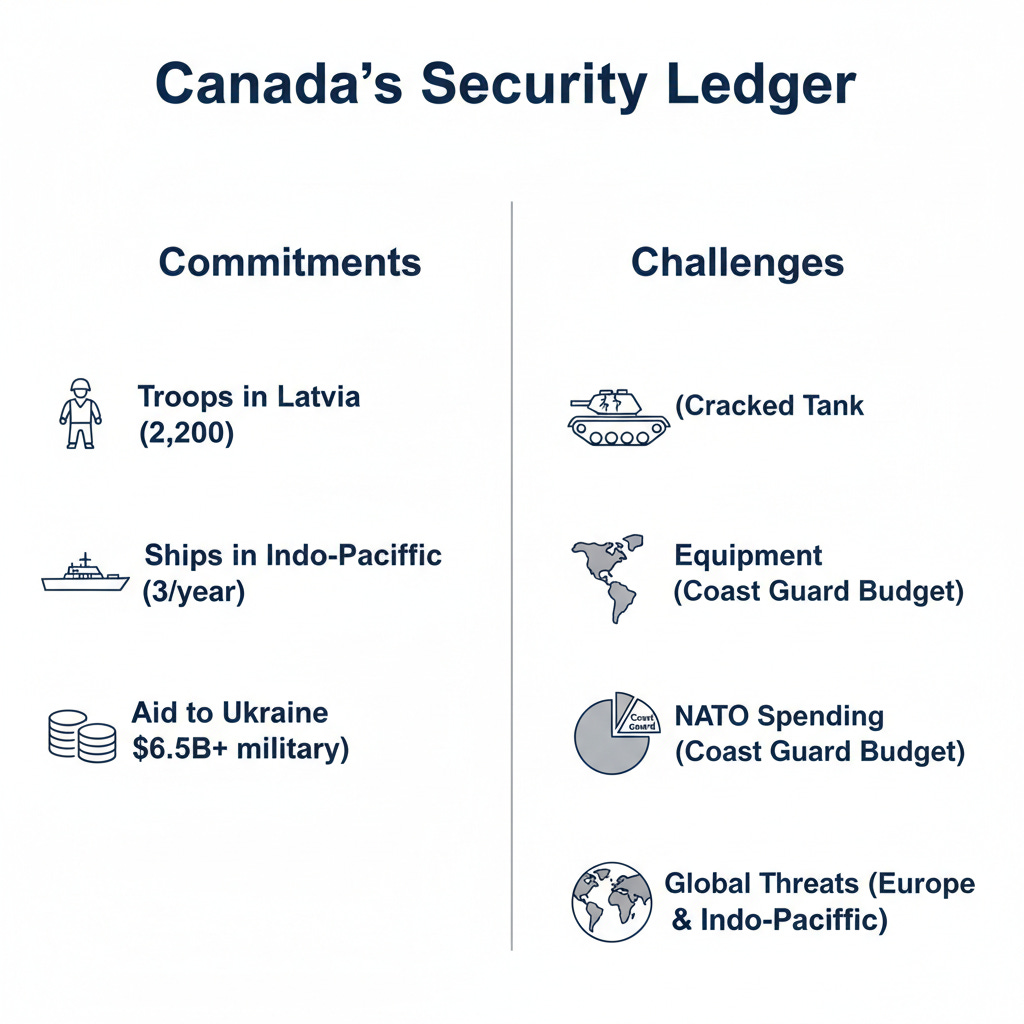
The central challenge is geographic and logistical. Canada is simultaneously anchoring a major NATO mission in Europe while expanding its presence in the Indo-Pacific. In Europe, Operation Reassurance in Latvia is our largest overseas mission, with approximately 2,200 troops on the ground as part of NATO’s deterrence posture against Russia. As Major-General Robert Ritchie explained, this mission has been extended for another three years, and our troop presence can surge to around 3,000 when air and maritime forces are included.
Simultaneously, through Operation Horizon, Canada is committed to deploying three navy ships to the Indo-Pacific region annually and participating in major exercises like Talisman Sabre. When members of the committee pressed on the CAF’s ability to handle these dual commitments, the reality of finite resources became clear. Major-General Ritchie noted the military is working with “fixed forces” and that “there are choices to be made about how to employ the Canadian Armed Forces based on the global instability that we see around the world.” This points to a critical question: in trying to be a meaningful security actor in two distant regions, are we spreading our limited resources too thin to be truly effective in either?
A Cheque the CAF Can’t Cash: The Latvian Tank Shortfall
The most concrete evidence of our Security Overdraft appeared in a discussion about equipment readiness in Latvia. A member of Parliament raised a recent report that a large number of Canadian vehicles were out of service during a critical NATO certification exercise. The testimony on this point is revealing.
The lack of past resourcing eroded a couple of things, the first being the reserve stock that we had on the shelves of spare parts to sustain these fleets. As well, some of our long-standing suppliers pivoted to other contracts, given that we’d had periods of time without a contract... The war in Ukraine has intensified global demand against fixed production.
This statement from Major-General Ritchie on the state of the Leopard tank fleet is not an admission of a temporary problem. It is a diagnosis of a chronic illness. Years of underfunding have hollowed out our supply chains. We lack spare parts, and the industrial base we rely on has atrophied. Of the 17 Leopard tank chassis in Latvia, a significant number were not operational for a key exercise because of these systemic shortfalls. When your armoured fist on NATO’s eastern flank is compromised, you are deep in overdraft.
The Appearance of Strength: Creative Accounting and the NATO Target
The testimony also exposed a troubling approach to meeting our international commitments, particularly NATO’s 2% of GDP defence spending target. At the recent NATO summit, Canada committed to meeting this target. A line of questioning from the committee revealed how we plan to get there. Officials confirmed that the entire budget of the Canadian Coast Guard, a civilian agency, will now count towards our NATO spending metric following its move under the Department of National Defence umbrella.
While officials argue this will strengthen sovereignty and maritime domain awareness, it raises a fundamental question of integrity. The Coast Guard’s 120 vessels are not warships. They perform critical science, navigation, and search-and-rescue functions, but they lack kinetic military capability. Including their budget to reach a political target feels like an accounting trick, one that boosts our numbers on a spreadsheet without adding a corresponding level of military power that our allies expect from the 2% commitment. This is a classic symptom of overdraft behaviour, finding clever ways to meet obligations on paper when the actual funds are not there.
A Reckoning with Reality
The principle at stake is Strategic Coherence. A responsible nation ensures its foreign policy ambitions are in alignment with its actual military and industrial capacity. The testimony from the committee suggests Canada’s strategic coherence is fraying. We are committing to complex, long-term missions abroad while the logistical foundations of our military show deep cracks. We are using accounting maneuvers to present an image of strength that the facts on the ground do not fully support. The Security Overdraft is not a problem for the future, it is here now. It exists in the maintenance hangars in Latvia, in the strained deployment cycles of our sailors, and in the budget lines presented to our allies. You cannot solve a problem you refuse to name, and the first step toward restoring our strategic solvency is to acknowledge the depth of our current deficit.
In Other News...
Beyond this deep dive, you can find more analysis and commentary on the On Hansard site.


Sources:
House of Commons. (2025, September 18). Standing Committee on National Defence, Evidence, Number 003 (45th Parliament, 1st Session).