


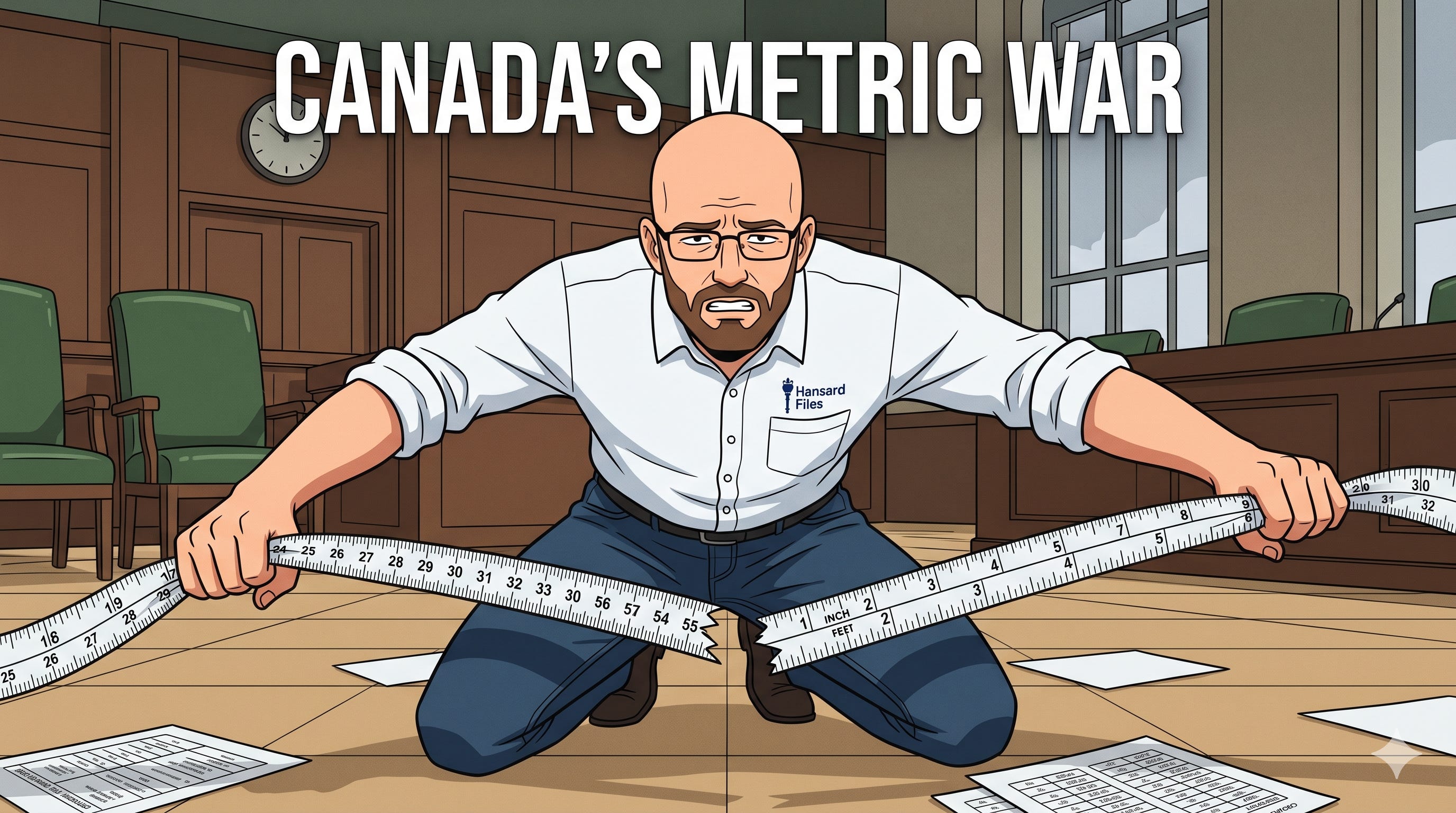
It was an ordinary pump at an ordinary gas station. But in the winter of 1984, that pump had become a constitutional problem.
An Ontario court had ruled that forcing Canadians to buy gasoline in litres violated the Charter of Rights and Freedoms. Judge William Ross found that disallowing imperial measures at the pumps infringed on individual freedoms. The federal government, mid-appeal, had no choice but to declare a moratorium on enforcing its own metric regulations. Not just at gas stations. Across home furnishings, diesel fuel, individually weighed foods. The whole retail machinery of Canada’s conversion program ground into an uncomfortable pause.
It had taken twelve years to get this far. Twelve years of retooled pumps, rewritten textbooks, rebuilt supply chains, and $10 million worth of conversions at Imperial Oil’s 4,000 outlets alone. All of it now sitting in a kind of legal no-man’s-land while the government waited for the courts to catch up.
Jim Hastings, President of IGA Canada Ltd., wasn’t patient about waiting. “We are running out of time,” he said. “Evidence of backsliding among retailers could be the start of a snowball, and all the time and money spent to get this far could be lost.”
He wasn’t wrong to be nervous.
The moratorium and what it cost
The court’s decision didn’t just suspend a set of regulations. It reopened a door that the industry had already agreed was closed.
Petro-Canada wouldn’t switch back to imperial. Neither would Gulf, Shell, or Imperial Oil. Imperial’s position was blunt: they’d spent approximately $10 million converting their outlets in 1977, and they weren’t going back. But the moratorium created ambiguity. What applied? What didn’t? Retailers who’d invested in metric infrastructure now operated beside competitors who hadn’t, with no enforcement regime to level the field.
The government’s appeal of the gasoline retailing decision was formally adjourned until September 10, 1984. An intermediate hearing was expected around May 23. In the meantime, Consumer and Corporate Affairs Minister Judy Erola held the line publicly, extending dual advertising of food prices to the end of 1985, but insisting that metric predominance remained a legal requirement. The extension wasn’t a retreat, her office said. It was a bridge.
Whether anyone believed that depended on where they stood.
April in Ottawa: 200 people and 25 resolutions
The Metric Forum on April 13 drew roughly 200 participants to Ottawa. Industry groups, government officials, consumer advocates, construction associations. Erola hosted it herself, which said something about the political weight the government still placed on the file.
What emerged from the room wasn’t celebratory. Participants drafted approximately 25 resolutions, most of them pressing the government to reinstate metric enforcement quickly. The Consumers’ Association of Canada went further, recommending the government leapfrog the appeals process and take the case directly to the Supreme Court of Canada.
Gina Hartley of the CAC took on the “freedom of choice” argument that had animated the Ontario court’s reasoning. “We never had much freedom of choice in our measuring system,” she said. “You had to buy gasoline in gallons. You bought milk in quarts. Freedom of choice was not something you generally brought to measurement in the marketplace.”
The argument cut through the legal fog. Freedom of choice, she was pointing out, had never applied to measurement. What the court had framed as a rights question was, on closer inspection, a question about which arbitrary standard would be enforced. The issue wasn’t freedom. It was which measuring system would win.
The construction industry sets its own deadline
While the government litigated, the Canadian Construction Association didn’t wait for instructions.
July 1, 1984 had been set as the CCA’s internal target date: all new construction projects were to be designed and executed in hard metric sizes. The industry had been wrestling with what insiders called a chicken-and-egg problem. Suppliers wouldn’t stock hard-metric materials because contractors weren’t ordering them. Contractors couldn’t order them because suppliers didn’t carry them. Someone had to move first.
CCA Chairman Bob Schuett had strong words for hesitation. “It is not a question of whether or not we should go metric,” he said. “It is a crucial question of economic survival. Anybody who doesn’t actively promote metric conversion is doing the industry a disservice.”
One project manager who’d already crossed the line offered evidence for Schuett’s position. He’d built three major structures in metric, including the $60 million Westin Hotel in Ottawa, and found that decimal calculations produced tighter tolerances, fewer errors, and cleaner construction. The math was cleaner. The results were better. The argument for holding onto imperial was, at its foundation, an argument for keeping familiar inconvenience.
Why the U.S. Department of Defense was selling Canadian metric
The stranger angle on this story came from Washington.
Mary Ann Gilleece, U.S. Deputy Under Secretary of Defense, showed up in Canadian metric discussions that year with a message that inverted the usual anxiety. Canadian businesses worried about being out of step with the United States. Gilleece was saying the United States was out of step with everybody else.
The U.S. Department of Defense, she explained, was requiring metric specifications for all new designs. Not out of idealism. Out of return-on-investment. Imperial measurements, she argued, were a “fragile and temporary barrier” against overseas competition, not a protection for domestic industry.
“The sooner we realize that the United States is like a fisherman using inch-worms to catch fish which are biting better on metric worms and start using the right bait,” she said, “the more fish we’re going to catch.”
The numbers behind her argument were substantial. Canadian export sales had grown from $17 billion in 1970 to $85 billion in 1982. Metric capability was being cited by exporters as the second most important competitive advantage they held. Companies like Deere & Company had reported annual savings of $750,000 at a single factory just by rationalizing steel inventories alongside conversion. IBM estimated savings of $2 to $5 million annually from metric position dimensioning in just two software products. Versatile Farm Equipment was exporting 65% of its production, underpinned by full SI system design.
The markets demanding metric weren’t minor. Japan, with $8 billion in Canadian exports in 1983, required it. China had ordered all of its industries to complete conversion to SI by 1990 as part of its broader modernization push. The math wasn’t complicated. Converting wasn’t just a domestic policy question. It was an access condition.
A Carleton professor and a classroom of students who’d never heard of an acre
The education data from 1984 told a story with a paradox buried in it.
By that year, 80% of Canadian students were being taught in metric. A Carleton University professor found that his undergraduate students were largely unfamiliar with imperial measures. When he asked them to estimate the square footage of an acre, about half of them couldn’t even guess.
That might sound like a victory for the conversion program. It was, in one sense. The new generation was growing up metric. But an Ontario study found that 50% of parents still wanted schools to teach common imperial units alongside the new system. The two populations weren’t in conflict so much as they were simply living in different eras. Parents who’d spent their lives in pounds and miles were watching their children reach for metres and kilograms without hesitation. Britain was seeing the same generational split: under-30s fully comfortable with metric, older Britons adapting through dual labeling.
Kevin Wilks of the Australian National Standards Commission put the inevitability plainly. Australia had converted so thoroughly that, as he described it: “You can’t have a baby in pounds and ounces anymore.”
The commission ends, the conversion doesn’t
In the background of all this, the government was winding down the Metric Commission itself, the agency established in 1971 to manage the conversion program. After twelve years, it had largely done its job. 118 of 195 categories of packaged consumer goods had completed the metric transition by mid-1983. The commission’s mandate was running out.
Erola addressed the question of what the wind-down meant directly. “While the Metric Commission will become history, the metric conversion program will still be moving along,” she said. “It is our intention to phase out the Commission, not metric conversion.”
The steel industry had converted 90% of can manufacturing to metric ordering and rationalized plate thicknesses from 64 imperial to 32 metric sizes. The automotive sector had folded conversion into the redesign of front-wheel-drive vehicles necessitated by the energy crisis. The transition had happened, in many cases, not as a pure policy victory but as a byproduct of industries solving other problems at the same time.
The Ontario court ruling had put a crack in the wall. But the wall had been built in a dozen different ways by a dozen different industries, and most of them had no intention of rebuilding it in the other direction.
Conservative MP Bill Domm was vocal that year about his opposition, arguing Canada couldn’t afford to “go it alone” without identical pacing from the United States and United Kingdom. It was the classic delay argument. And by the fall of 1984, it was running up against the fact that the U.S. military was buying metric, the Japanese were selling metric, China was converting by decree, and the Westin Hotel in Ottawa had been built to tolerances that imperial math couldn’t easily match.
The appeal was scheduled. The moratorium held through the summer. The pumps stayed in litres at the companies that had already converted. And somewhere in a federal building in Ottawa, a commission that had spent twelve years doing its job was quietly getting ready to close its doors.
The measuring system stayed.
Hansard Files spends weeks in the archives so you don’t have to. If stories like this matter to you, subscribe to keep this work independent.
Source documents
Metric Commission, Canada. (1984, January). Metric Monitor, Vol. 21, No. 3 (January 1984 issue).
Metric Commission, Canada. (1984, February). Metric Monitor, Vol. 21, No. 3 (February 1984 issue).
Metric Commission, Canada. (1984, March). Metric Monitor, Vol. 21, No. 3 (March 1984 issue).
Metric Commission, Canada. (1984, April). Metric Monitor, Vol. 21, No. 3 (April 1984 issue).
Metric Commission, Canada. (1984, May). Metric Monitor, Vol. 21, No. 3 (May 1984 issue).
Metric Commission, Canada. (1984, June). Metric Monitor, Vol. 21, No. 3 (June 1984 issue).
Metric Commission, Canada. (1984, July/August). Metric Monitor, Vol. 21, No. 3 (July/August 1984 issue).
Metric Commission, Canada. (1984, September). Metric Monitor, Vol. 21, No. 3 (September 1984 issue).
In 1984 I was 13 years old, so I'm part of that small cadre of Gen Xers that grew up measurement-bilingual, and I remember the metric war very well.
I grew up on the prairies, where any new idea pushed by Ottawa was (sometimes fairly) greeted with skepticism, but the fight for gallons was some next level stuff. People swore metric was a communist plot, a tool to brainwash the next generation. It starts with buying gas in litres...then the next thing you know people are growing beards, smoking weed, and listening to Pink Floyd records. We had a neighbour that bought out Canadian Tire's stock of jerry cans so he could stockpile gas bought by the gallon. Like somehow the stuff dispensed by the litre would be inferior, or carry a plague virus.
The only other government mandate I remember causing as much of a ruckus was the mandatory seatbelt usage law.
my kids describe themselves in feet, inches and pounds as do I, but I am still uncomfortable with personal metric measurements