


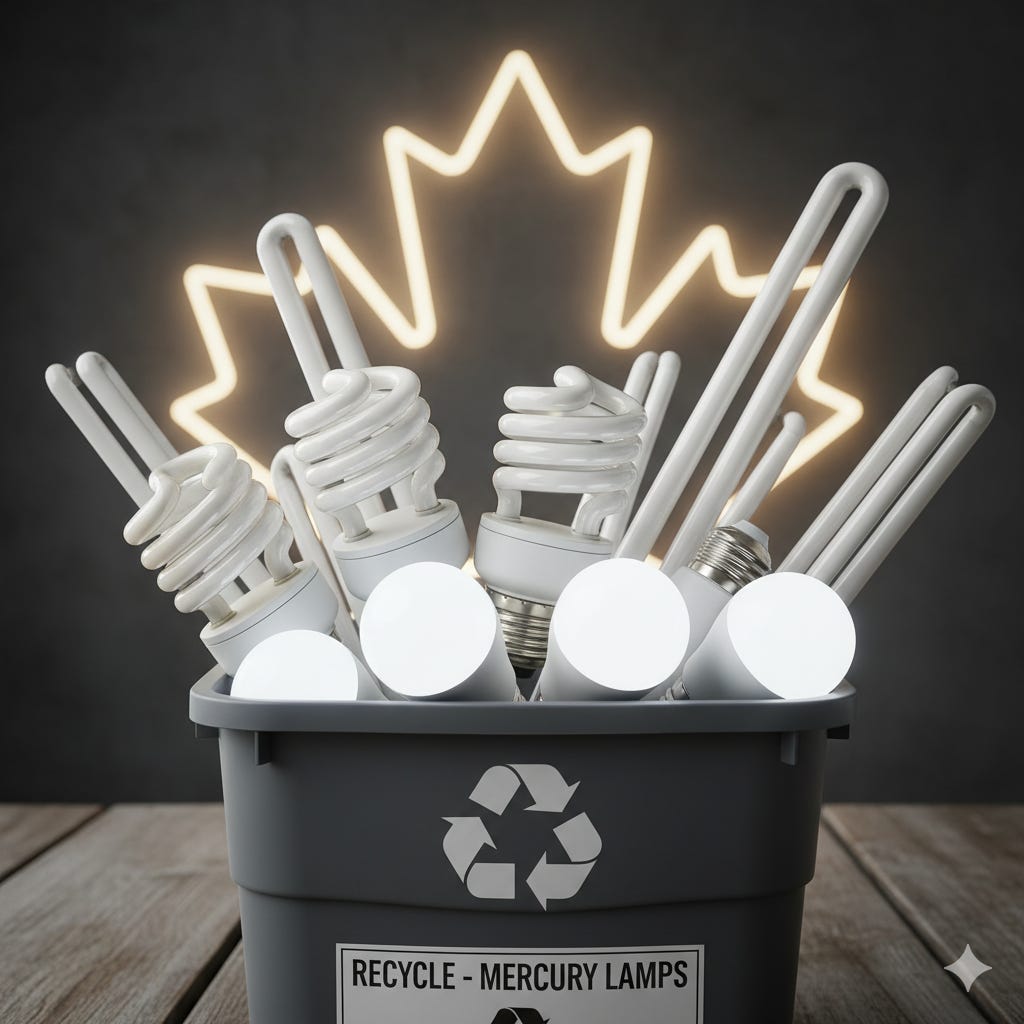
A recent report to Parliament, the National Strategy for Lamps Containing Mercury, chronicles the end of an era for a once-common household item. You likely remember the push in the early 2000s to replace old incandescent bulbs with the spiral-shaped compact fluorescent lamps (CFLs). They were championed as energy-efficient, long-lasting alternatives. Yet, they came with a well-known catch: each bulb contained a small amount of toxic mercury, creating a significant environmental risk if broken or improperly thrown in the trash. The new report details how Canada has systematically tackled this problem, and the results show a quiet but remarkably effective policy victory.
The Decline of an Era
The core finding of the report is the staggering collapse in demand for mercury-containing lamps. How dramatic is the shift? Between the peak sales year of 2007 and 2022, sales plummeted by 79%, from 83.5 million units down to just 17.6 million. Even in the short period since the national strategy was published in 2019, sales have dropped by nearly 25%.
This isn’t just a regulatory phenomenon; it’s a market-driven transition. The report makes it clear that mercury-free LED lamps are the primary driver. As of 2022, LEDs command 73% of the Canadian lighting market. They have become not only affordable but are also more energy-efficient and have a longer lifespan than the fluorescent lamps they are replacing. The market shift has happened, as the report notes, “at a faster rate than initially anticipated.” The transition is so advanced that the majority of remaining mercury lamp sales are now to the industrial, commercial, and institutional (ICI) sector, not residential homes.
The Regulatory Hammer
While consumer choice has accelerated the transition, the federal government is ensuring it becomes permanent. The report highlights a key priority of the national strategy: amending the Products Containing Mercury Regulations. On June 19, 2024, the government published final amendments that will officially phase out most mercury lamps.
What does this look like in practice?
As of December 31, 2025, the import and manufacture of the most common types of mercury-containing lamps for general lighting will be prohibited.
This includes the screw-in CFLs once common in homes, as well as the linear fluorescent tubes used in offices and basements.
The regulations include a gradual phase-out for certain products to ease the transition. For example, some replacement lamps will be allowed for a few extra years, and high-intensity discharge (HID) lamps, used for things like streetlights, have a longer phase-out timeline to 2029.
This sends a clear signal to the market. The federal government is not just encouraging a transition; it is mandating its completion.
Closing the Loop on Disposal
With millions of mercury lamps still in circulation, the second half of the strategy focuses on end-of-life management. How do you prevent these legacy bulbs from ending up in landfills and releasing mercury into the environment? The answer has been the expansion of Extended Producer Responsibility (EPR) programs. These industry-funded programs are designed to manage the collection and recycling of specific products.
The progress here is significant. With the recent launch of programs in Ontario and Nova Scotia, and another coming to New Brunswick, over 80% of Canadians now live in a jurisdiction with a provincially mandated light recycling program. These programs, all administered by Product Care Recycling, provide a network of over 1,500 collection sites. Between 2018 and 2022, this system successfully diverted over 103 million lamps from landfills, responsibly managing approximately 630 kilograms of mercury.
Interestingly, the report reveals that the end market for recovered mercury has “all but disappeared,” thanks to global efforts to phase out the toxin. As a result, the mercury powder recovered from recycled lamps is no longer reclaimed. Instead, it is encapsulated in a concrete-like material and permanently stored in specially designed, secure landfills, ensuring it stays out of the ecosystem for good.
The Data Brief
Sales of mercury-containing lamps fell 79% between their 2007 peak and 2022.
As of 2022, mercury-free LEDs make up 73% of the Canadian lighting market.
The manufacture and import of most common mercury lamps will be prohibited as of December 31, 2025.
Over 80% of Canadians now have access to provincially mandated light recycling programs.
Between 2018 and 2022, over 103 million mercury lamps were recycled, preventing 630 kg of mercury from entering the environment.
A Blueprint for Environmental Policy
The phase-out of mercury lamps is a case study in effective, methodical environmental policy. It demonstrates how a clear vision, supported by federal regulation, industry accountability, and superior technological alternatives, can systematically address a specific environmental threat. This wasn’t a flashy climate victory announced on the world stage, but a quiet, behind-the-scenes success that provides a blueprint for how to methodically eliminate a known toxin from our homes and the broader environment.
Source Documents
Environment and Climate Change Canada. (2024). National Strategy for Lamps Containing Mercury: Report to Parliament.