


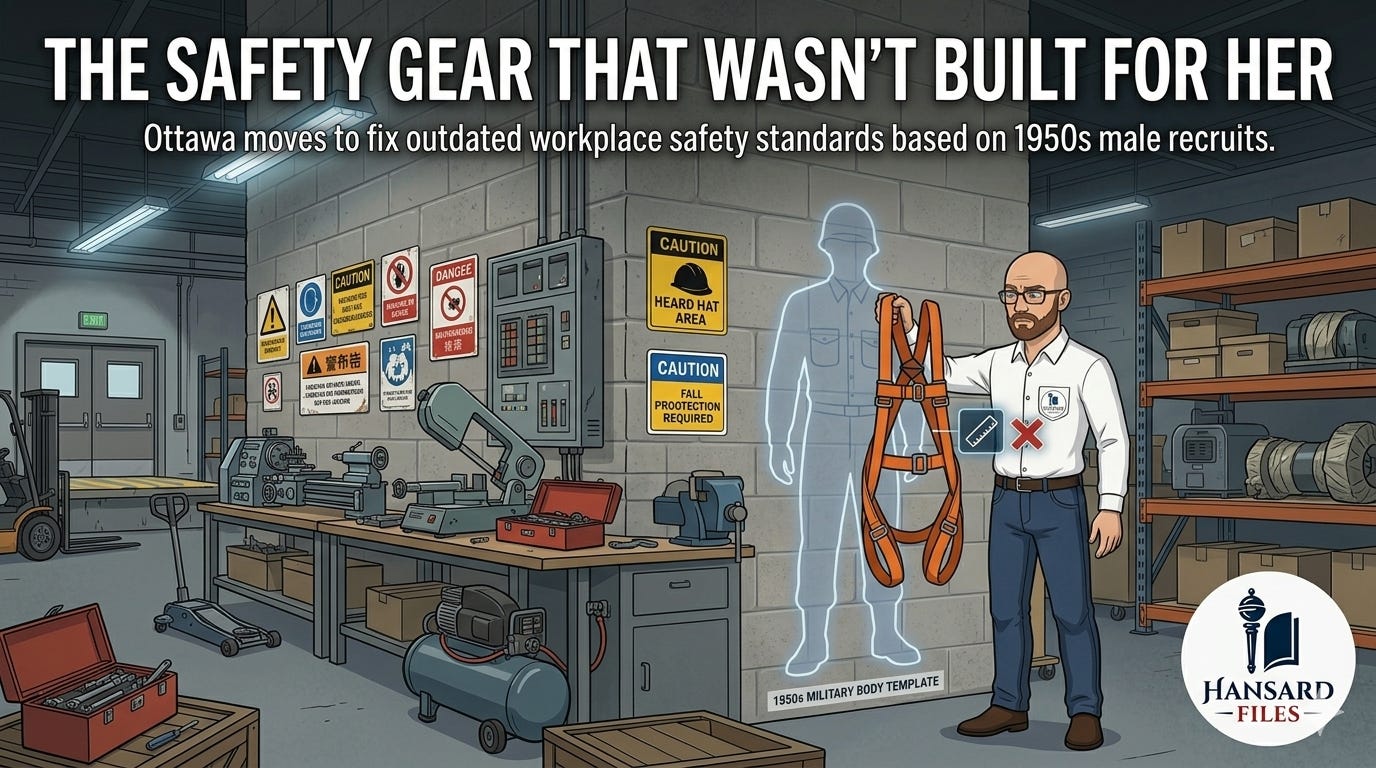
The body that shaped much of the personal protective equipment worn on federally regulated Canadian worksites belonged to an American military recruit. He was young. He was fit. He was Caucasian. His measurements were collected sometime in the 1950s or 1960s and filed into an anthropometric database. That database, decades later, still informed the dimensions of the fall-arrest harnesses, respirators, and welder’s masks issued to Canadian workers in federal jurisdiction.
On June 13, 2026, the federal regulator placed that history in the public record.
In the June 13, 2026 edition of the Canada Gazette, Part I, Employment and Social Development Canada published proposed amendments to five sets of regulations under the Canada Labour Code. The technical title is Regulations Amending Certain Regulations Made Under the Canada Labour Code (Personal Protective Equipment and Other Preventive Measures). Inside the Regulatory Impact Analysis Statement, the regulator describes the origin of current PPE designs in unusually direct language.
“Current PPE designs have largely been developed using body dimension data from early studies that did not consider the diverse range of body dimensions outside of the traditional white male phenotype.” The studies, the statement continues, were “conducted by the United States military during the 1950s and 1960s,” and sampled “the body dimensions of their recruits, which were predominantly made up of young, fit Caucasian men.”
2,752 women told CSA Group what the gear actually does
Behind the proposed amendments sits a CSA Group survey of 2,752 Canadian women working in federally regulated industries. More than 80% reported problems with their PPE: improper fit, discomfort, or simple unavailability of equipment in sizes that fit them.
Then the number that moved the file. Approximately 40% reported an injury or incident attributable to the equipment that was supposed to prevent it.
Four in five, problems. Two in five, hurt by the thing meant to protect them.
The regulator’s own analysis names the mechanism. A fall-arrest harness sized for the wrong torso does not arrest a fall the way it is engineered to. A respirator that does not seal does not respirate.
The Regulatory Impact Analysis Statement records that current PPE regulations “do not adequately accommodate the diversity of the federally regulated workforce” and that ill-fitting equipment is associated with “increased injury risks.”
What the new rule actually requires
The proposed amendments write fit into federal law. PPE, the regulations now state, must be “safely and properly fitted to each user by a qualified person, taking into account body dimensions.”
The amendments harmonize standards across federal, provincial, and territorial jurisdictions. Employers will be required to develop fall-protection plans, identify fall hazard zones, and follow a strict hierarchy of fall-protection systems. Passive barriers come first. Personal fall-arrest systems, the harnesses at the centre of the CSA findings, come last.
The threshold defining an “oxygen-deficient atmosphere,” the air a worker can enter without supplied breathing equipment, is raised. The new regulations classify any atmosphere containing less than 19.5% oxygen by volume as oxygen-deficient, up from the previous threshold of 18%. That percentage-point shift determines when a confined-space entry triggers a respirator requirement under federal rules.
$2.64 million over ten years
The Regulatory Impact Analysis Statement pegs total compliance cost to employers across the ten-year period at $2.64 million. Of that, $1.93 million covers adoption of new CSA standards. $705,868 covers the development of employer fall-protection plans.
That is the figure Ottawa has assigned to amending a federal safety regime whose underlying body-measurement template the regulator itself traces back to US military intake lines of the 1950s and 1960s.
What happens next
The amendments are published in Part I of the Canada Gazette, which opens the public comment window before final adoption. Until the regulations are finalized in Part II and brought into force, the federal regulatory baseline for PPE design remains the one identified in the Regulatory Impact Analysis Statement: body dimension data drawn from a Cold War-era American recruit pool.
For the 2,752 women in the CSA survey, the new fit requirement is a proposal. It does not take effect at the worksite until adoption in Part II.
Hansard Files reads the regulatory record so you don’t have to. If primary-source journalism like this matters to you, subscribe to keep this work independent.
Source Documents
Government of Canada. (2026, June 13). Canada Gazette, Part I, Vol. 160, No. 24. Regulations Amending Certain Regulations Made Under the Canada Labour Code (Personal Protective Equipment and Other Preventive Measures). https://gazette.gc.ca/rp-pr/p1/2026/2026-06-13/html/index-eng.html