


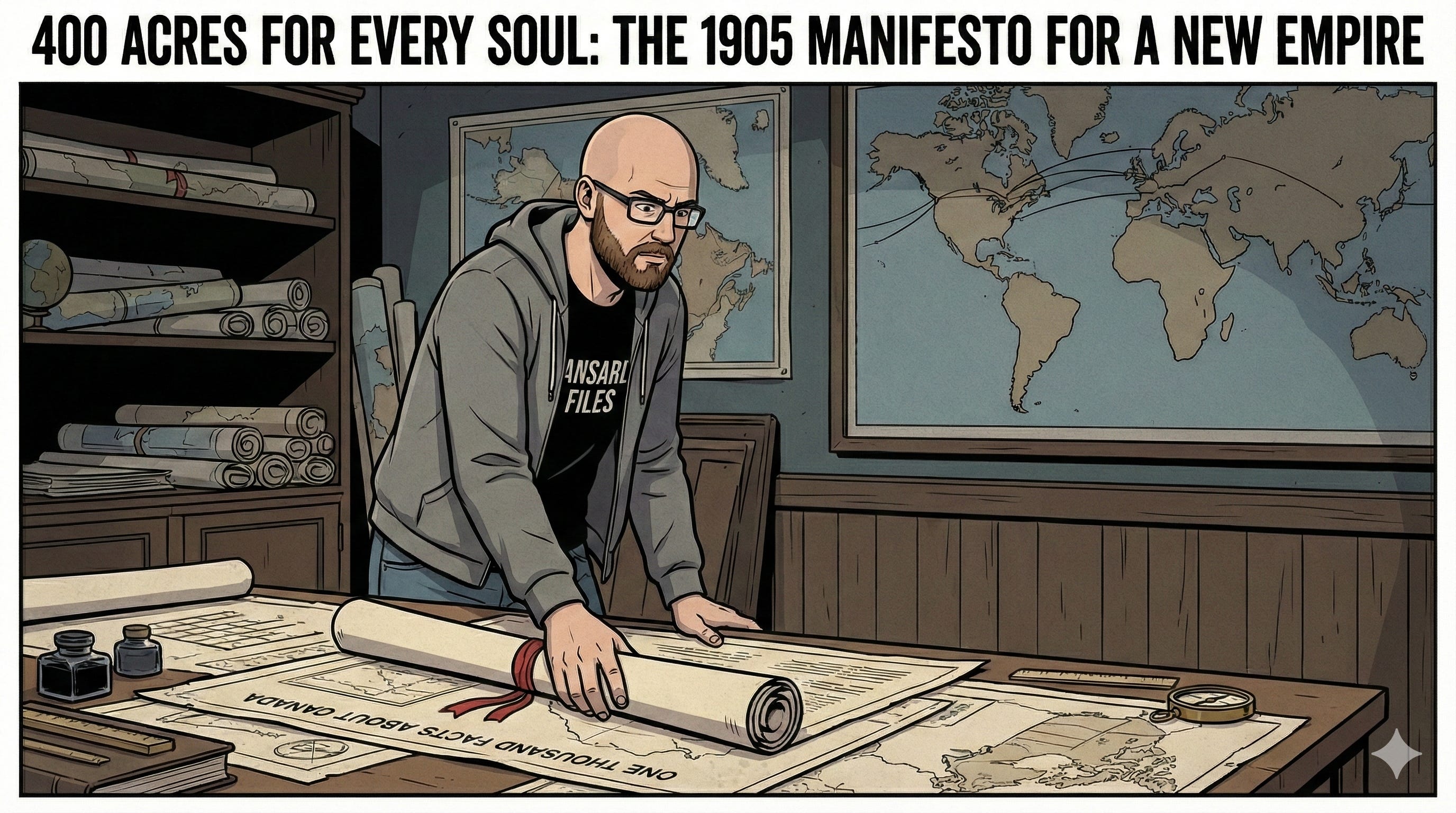
The year 1905 was not a time for subtlety in Ottawa. In the cramped offices of the Department of Agriculture’s Exhibition Branch, a group of bureaucrats was hard at work on a document that was less a statistical yearbook and more a blueprint for a superpower. They were operating in the heady days of the early 20th century, a time when maps were still being filled in and the concept of “limits” felt foreign to the North American mind.
The result of their labor was a dense, feverish pamphlet titled One Thousand Facts About Canada. To the modern eye, it looks like a dry list of numbers. But read closely, and it reveals itself as a frantic, high-stakes manifesto. It is the portrait of a government trying to desperately engineer a nation out of a void, selling a dream of biblical proportions to the starving masses of Europe and the restless capitalists of America.
At its core, the document argues a single, audacious thesis: that Canada in 1905 was not merely a colony, but the inevitable successor to the British Empire’s grandeur—a “Resource Vault” destined to eclipse the United States. The text brags that the Dominion extends “from Rome to the North Pole,” a spatial claim that attempts to map the wild, frozen north onto the classical geography of Europe. It is a sales pitch for a kingdom where every peasant could be a lord, promising “enough land to give each inhabitant 400 acres”.
The Geometry of Empire
The psychological obsession of the 1905 government was scale. The pamphlet does not simply state square mileage; it desperately tries to translate Canadian vastness into terms the cramped European mind could grasp. The authors claim Canada is “as large as 30 United Kingdoms” and “18 Germanys”. They boast that British Columbia alone is equal to “24 Switzerlands,” while the “four organized Territories are larger than France and Germany” combined.
This insecurity about size versus population drives the narrative. The document notes that while England packs 558 people into every square mile, Canada has only 1.5. This disparity was not treated as a weakness, but as an inventory error waiting to be corrected. To the men in Ottawa, the “practically unexplored area” of nearly a million square miles was not a terrifying wilderness; it was a blank check.
They measured their geography in terms of global dominance. Victoria is described not as a frontier outpost, but as being “half-way between London and Hong Kong,” positioning Canada as the pivot point of the world. The Mackenzie River is equated to the distance “from Liverpool to Halifax,” effectively suggesting a single Canadian river is as significant as the entire Atlantic Ocean.
The Granary of the World
If land was the raw material, wheat was the alchemy that would turn it into gold. The 1905 document reveals a government monomaniacally focused on the “Great West” as the engine of the British Empire. They identify a continuous wheat field measuring 300 by 900 miles, declaring it the “largest wheat field in the world”.
The projections found in these pages are staggering. The government estimated that the Canadian West was capable of producing “3 billion bushels of wheat”—a figure twenty times the size of Great Britain’s annual imports at the time. This was not just agriculture; it was a security policy. Lord Strathcona is quoted asserting that within a decade, Canada could produce “all the grain needed by Great Britain,” effectively insulating the Empire from starvation in the event of war.
To prove the “frozen north” was a myth, they enlisted science. The text cites a Professor Tanner, an English agricultural chemist, who declared Western Canada to have the “richest soil in the world,” and notes that Canadian wheat contained “10 per cent more albuminoids than the best European varieties”. They proudly claimed that wheat was successfully grown at Fort Simpson, 818 miles north of Winnipeg, proving the breadbasket extended almost to the Arctic Circle.
The Flesh Market
The most fascinating—and calculating—data points in the 1905 report concern the commodification of human beings. The Canadian government had reduced immigration to a precise science of investment and return. They calculated the “cost of bringing immigrants to Canada” down to the penny: $4.68 for a Briton, $4.53 for an American, and a mere $2.24 for a “Continental” European.
But the return on investment was projected to be massive. The government estimated each immigrant was worth “$1,000 to Canada”. They tracked the influx with the same rigor they applied to wheat yields. In the fiscal year of 1904 alone, 130,330 immigrants arrived, and the government proudly noted that “sixty per cent... was agricultural in its character”.
The document also reveals a surprising shift in North American demographics. For decades, the “brain drain” had flowed south, but by 1905, the tide was turning. The report gloats that 167,000 Americans had moved to Canada in the past seven years, bringing with them 58 million dollars in cash and effects. This was a point of immense pride: “For every British immigrant in nine years there has been an American”.
Yet, the anxiety of integration remained. The document carefully tallies the racial and national composition of the newcomers. It lists 60,000 Galicians, 20,000 Mennonites, 7,000 Mormons, and the “Doukhobor migration of 8,000,” which it terms the “greatest exodus of a whole people ever known”. There is a defensive tone regarding the “foreign-born,” with the text quickly adding that 55 per cent were already naturalized and that the West was being “largely built up by Ontario’s sons”.
The Resource Vault
While wheat was the headline, the government was keen to show that Canada was also a fortress of mineral wealth. The pamphlet asserts with a shrug that “practically all the valuable minerals are found in Canada”. It highlights the “accidental” discovery of nickel in Sudbury in 1882, boasting that Canada now held the “greatest nickel deposits in the world”.
The ghost of the Klondike still haunts the pages. The Yukon is credited with producing $10 million in gold in 1904 alone, with the total gold production since 1862 sitting at $200 million. But the ambition went deeper than gold. The government pointed to the “Crow’s Nest coal beds,” estimating they held enough fuel to last for “5,000 years”.
The forestry stats are equally Herculean. Canada is described as having the “largest white pine areas on the continent” and a “million square miles of standing timber”. This was a nation viewing its forests not as ecosystems, but as infinite inventory.
The Iron Nervous System
To bind this impossible geography together, the 1905 government placed its faith in steel. The railway statistics are presented as the vital signs of the nation. The Canadian Pacific Railway (C.P.R.) is described in heroic terms, a project that cost over 300 million dollars and was “built in 5 years instead of 10”.
The scale of infrastructure investment was enormous. The government notes that Canada possessed “20,378 miles of railway,” costing over a billion dollars. Relative to population, they boasted a greater railway mileage per head than “any other country” in the world. This was a nation building capacity for a population that did not yet exist. They were laying track through empty wilderness, confident that the cities would follow.
The “Wild West” nature of this expansion is evident in the details. The report mentions that the C.P.R. land grant sales realized $3.60 per acre, while the Cochrane ranch lands sold for $6 per acre in 1905. It paints a picture of a booming real estate market on the frontier, where land companies and railways sold over a million acres in a single year.
The Thin Blue Line
Perhaps the most cinematic element of the pamphlet is its description of how this vast empire was policed. In a section that reads like the treatment for a western film, the document reveals that the entire territory—from the Hudson’s Bay to the Rockies, and the US boundary to the Arctic Ocean—was patrolled by just “600 Mounted Policemen”.
These 600 men were responsible for an area “as large as Europe”. The cost of this force was a mere half a million dollars a year. It was a “thin blue line” in the truest sense, a handful of men in red serge holding together a continental dominion against the chaos of the frontier.
Meanwhile, the government was preparing for war on a larger scale. The text notes that Canada had sent 8,372 men to South Africa during the Boer War, and that the country maintained a militia force of 46,000 that could be “expanded to a war strength of 100,000 as a first line of defence”.
A Nation in the Black
Ultimately, One Thousand Facts About Canada is a financial report card. The ambition was backed by hard currency. The document proudly states that Canada’s volume of trade had “more than doubled in ten years,” reaching 464 million dollars in 1904. Unlike many developing nations, Canada was running a surplus of 15 million dollars.
The banking system was portrayed as a fortress of stability. The Bank of Montreal is singled out, its capital having grown from a modest $350,000 to 14 million dollars, with the claim that “only 6 other banks in America or Europe have a larger capital”. This was the government’s way of telling the world that Canada was not just a farm; it was a vault.
Reading this document more than a century later, one is struck by the sheer, unadulterated optimism. There is no mention of the looming World Wars, the Great Depression, or the environmental costs of such rapid expansion. There is only the “Rome to the North Pole” spread—a vision of a country that believed, with mathematical certainty, that it was destined to rule the future.
The “Hansard Files” combs through forgotten government archives to resurrect the raw ambition of the past. To support this independent research and discover the blueprints of history, please subscribe.
Source Documents
Exhibition Branch, Department of Agriculture. (1905). One Thousand Facts About Canada.
You know, Hansard if there was a lifetime “Legislative and Constitutional Award for Canadian Affairs” you would be the first honouree!
Fascinating read! Thanks for the stroll through our past! It has me looking at present day nation building a bit differently. Has me thinking about time and perspective…and all the things we can’t know about what the future will hold.