


The document lands with the weight of a course correction, a bureaucratic admission that the machinery of national growth had begun to overheat. For years, the narrative of Canadian prosperity was written in the ink of open borders and expanding population graphs. But the 2025 Annual Report to Parliament on Immigration signals a profound shift in the nation’s trajectory. It is no longer a story of unbridled expansion, but one of retraction, stabilization, and the stark reality of capacity limits.
As the government unveils the new Canada immigration levels, the subtext is clear: the era of rapid, unplanned growth is ending. The report outlines a strategy to aggressively curb the number of temporary residents and stabilize permanent admissions, a move designed to alleviate the crushing pressure on housing, healthcare, and infrastructure that has defined the post-pandemic landscape. The numbers presented are not just statistics; they are the blueprint for a leaner, more controlled immigration system that seeks to balance economic ambition with social reality.
The Great Retraction
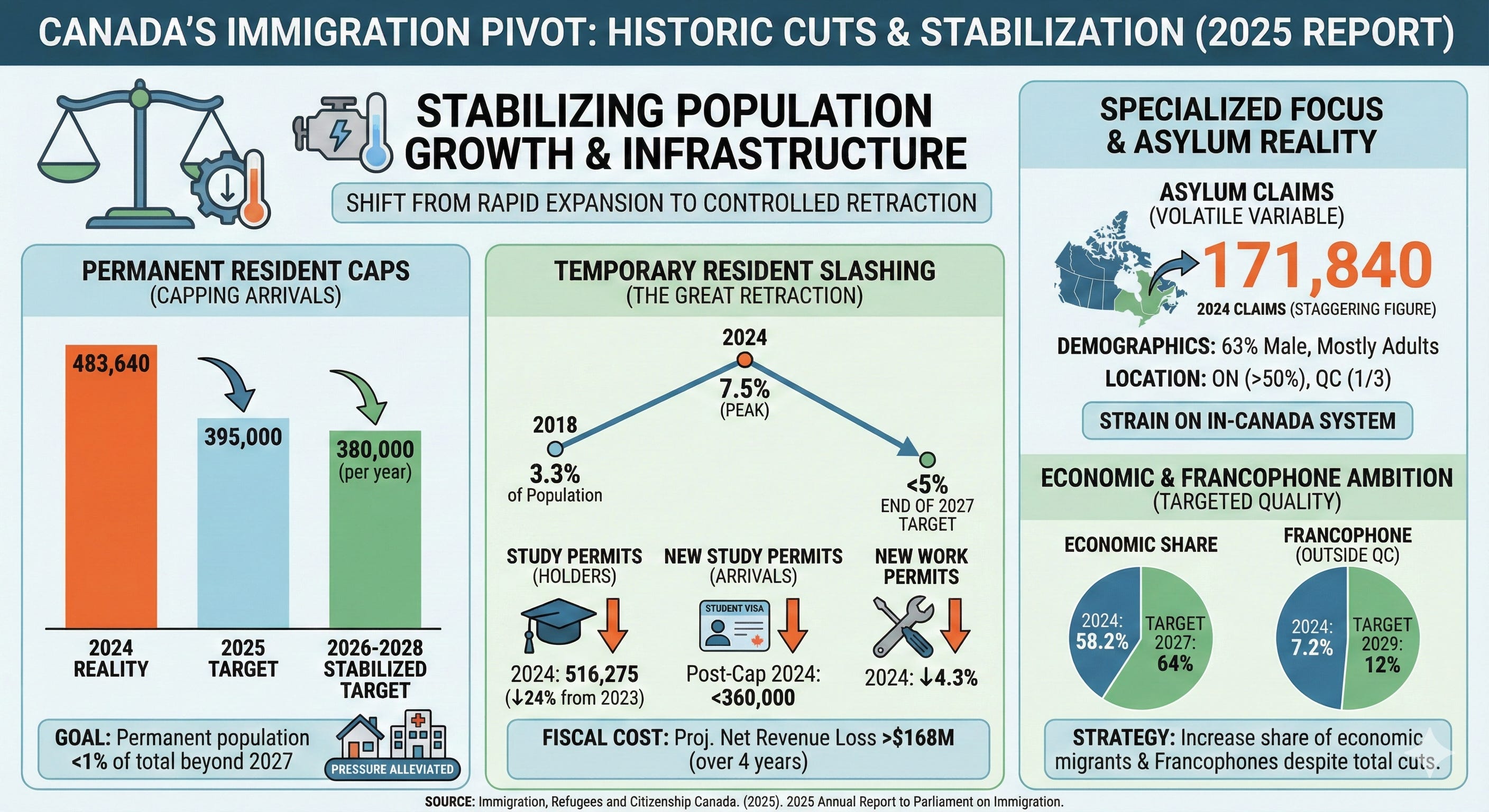
For decades, the Canadian immigration system was likened to a well-oiled engine, selecting the best and brightest to fuel the economy. However, the 2025 report reveals that the engine had begun to rattle under its own speed. In 2024, Canada admitted 483,640 permanent residents, a figure consistent with previous ambitious targets. Yet, the accompanying surge in temporary residents—students, workers, and visitors—had pushed the population growth rate to levels the country’s infrastructure could no longer support.
The report explicitly states that the system had become “harder to manage” and “less functional.” The pace of arrivals exceeded the country’s capacity to absorb them. In a dramatic pivot, the government has announced that the 2026-2028 Immigration Levels Plan will stabilize permanent resident admission targets at 380,000 per year for three years. This is a significant reduction from the 2025 target of 395,000 and the 2024 reality of nearly half a million newcomers.
This reduction is not merely a pause; it is a recalibration. The government aims to bring the permanent resident population to less than one percent of the total population beyond 2027. It is a calculated gamble that a smaller, more targeted intake will yield better economic outcomes without breaking the social contract that relies on accessible public services.
The End of the Unlimited Guest List
While the reduction in permanent residents makes headlines, the true surgical strikes are happening within the temporary resident programs. The report details a massive contraction in the number of international students and temporary foreign workers, groups that had comprised the bulk of the recent population explosion.
In 2018, temporary residents made up just 3.3 percent of Canada’s population. By 2024, that figure had more than doubled to 7.5 percent. The government has now set a hard target to reduce this volume to less than 5 percent by the end of 2027. The mechanisms for this reduction are already in motion and biting hard.
The international student program, once a lucrative revenue stream for post-secondary institutions, has faced a severe clampdown. In 2024, the number of individuals holding study permits dropped to 516,275, a 24 percent decrease from the previous year. The intake cap introduced in January 2024 has effectively throttled the flow of new arrivals, with new study permit holders entering Canada dropping to fewer than 360,000.
Similarly, the labor market is seeing a tightening of the taps. The number of individuals issued new work permits fell by 4.3 percent in 2024. The government acknowledges the role temporary workers play in specific sectors but is moving away from a model that relies on a broad, unlimited supply of temporary labor. The fiscal cost of this policy is tangible; the government projects a net revenue loss of over $168 million over four years due to the reduction in application fees. It is a price Ottawa is willing to pay to regain control.
The Asylum Reality Check
Amidst the planned reductions in economic and student migration, the report highlights a volatile variable that resists easy management: asylum claims. In 2024, Canada received 171,840 asylum claims, a staggering figure that underscores the global displacement crisis. These are individuals arriving at ports of entry and inland offices, often fleeing persecution and conflict.
The demographic breakdown of these claimants paints a complex picture. The majority, 63 percent, are male, and the vast majority are adults. They come from a diverse array of 187 countries, with Ontario absorbing over half of all claims and Quebec taking in a third. The report emphasizes that while Canada remains committed to its humanitarian obligations, the sheer volume of claims places immense strain on the “In-Canada Asylum System.”
To address the reality of those already here, the government is proposing a one-time initiative to recognize eligible Protected Persons as permanent residents over the next two years. This measure acknowledges that many of these individuals cannot safely return to their countries of origin and aims to accelerate their integration. It is a pragmatic concession that clearing the backlog requires granting status rather than attempting mass deportations that are legally and logistically impossible.
Economic Selection Remains King
Despite the overall cuts, the composition of Canada’s immigration remains heavily skewed toward economic utility. The report confirms that economic immigration accounted for 58.2 percent of all admissions in 2024. The strategy moving forward is to increase this share even further, aiming for 64 percent of admissions to be economic migrants by 2027, even as the total numbers fall.
The tool of choice for this economic sorting is the Express Entry system, which has become increasingly sophisticated. Through “Category-Based Selection,” the government is hand-picking candidates with specific skills needed in the Canadian economy. In 2024, rounds of invitations targeted French-language proficiency, healthcare, STEM occupations, trades, transport, and agriculture.
This targeted approach allows the government to argue that while they are cutting numbers, they are improving the “quality” of the intake relative to labor market needs. The focus is shifting from raw population growth to productivity growth. Regional programs like the Provincial Nominee Program and the Atlantic Immigration Program continue to play a crucial role, ensuring that newcomers are not solely concentrated in Toronto and Vancouver but are distributed to communities with specific labor shortages.
The Francophone Ambition
One of the few areas seeing aggressive expansion rather than contraction is Francophone immigration outside of Quebec. The report highlights a concerted effort to restore and increase the demographic weight of Francophone minority communities. In 2024, the government surpassed its target, with French-speaking permanent residents accounting for 7.2 percent of admissions outside Quebec.
This is not an accidental success but the result of deliberate policy engineering. The government has committed to a target of 12 percent Francophone admissions outside Quebec by 2029. This ambition is supported by specific funding for Francophone communities and pilot programs designed to attract French-speaking students and workers to regions where their language skills are a vital cultural asset.
Stabilizing the Future
The 2025 Annual Report serves as a dividing line between two eras of Canadian immigration policy. The years of expansion at all costs are over. The plan for 2026-2028 is one of stabilization and retrenchment. By capping permanent residents at 380,000 and slashing temporary resident volumes, the government is attempting to engineer a “soft landing” for a population boom that threatened to spiral out of control.
The report frames this not as a closing of Canada’s doors, but as a restoration of integrity. It argues that for the system to work—for newcomers to succeed and for Canadians to maintain confidence in their institutions—growth must be sustainable. The coming years will test whether this calibrated reduction can alleviate the pressure on Canada’s creaking infrastructure without stalling the economic engine that relies on the very people who are now being turned away.
Source Documents
Immigration, Refugees and Citizenship Canada. (2025). 2025 Annual Report to Parliament on Immigration.