


Tuesday, September 23rd, was a busy day for parliamentary committees, with officials facing pointed questions about everything from criminal organizations exploiting the student visa system to the profound lack of access to family doctors for military veterans. The discussions paint a picture of critical systems under immense strain.
Reading time: 5 minutes.
IMMIGRATION
Officials Face Grilling Over Crime Rings Exploiting Student Visa Program
Driving the news: At the Standing Committee on Citizenship and Immigration, senior department officials were questioned about how an international criminal organization is using loopholes in the student permit program to operate in Canada.
Catch-up: The questioning was prompted by a recent Radio-Canada report on an “African mafia” that has generated over half a billion dollars through auto theft, identity theft, and other scams, using the student visa system to bring members into the country. Members of Parliament specifically asked why the department’s screening processes failed to detect these individuals.
The Big Picture: The international student program has grown dramatically in recent years, creating challenges for community resources and program integrity. In response, the department implemented several reforms in 2024, including a cap on study permits, mandatory verification of acceptance letters, and increased financial requirements for students.
Why it matters: The department’s response was to highlight the shared responsibility between the federal government, which issues visas, and the provinces and learning institutions, which recruit students. This deflection drew criticism from committee members who argued that border control and visa issuance are exclusive federal responsibilities. The situation highlights a significant national security vulnerability and risks damaging the reputation of Canada’s legitimate educational institutions.
VETERANS AFFAIRS
Veterans Ombud: Lack of Family Doctors is Top Concern for Vets
Driving the news: In a briefing to the Standing Committee on Veterans Affairs, Colonel (Retired) Nishika Jardine, the Veterans Ombud, stated that access to a family doctor is the number one concern she hears from the veteran community.
Catch-up: Serving members of the Canadian Armed Forces receive their health care from the military medical system. Upon release, they enter the provincial system and are left on their own to find a primary care provider.
The Big Picture: Many veterans cannot find a doctor. Some who do find that their doctor is unwilling to complete the required Veterans Affairs Canada (VAC) paperwork, which they describe as onerous. This creates a significant barrier to care.
Why it matters: Without a family doctor, veterans cannot get prescriptions refilled or receive the diagnoses necessary to submit a disability claim to VAC. This friction with the system leads to what Colonel Jardine describes as a feeling of “institutional betrayal.” Veterans who expected to be cared for after their service instead find themselves in a battle with bureaucracy, eroding trust in the very department meant to support them.
HEALTH
Health Committee Prioritizes Study on Foreign-Trained Doctor Integration
Driving the news: The Standing Committee on Health passed a motion to prioritize a study on the barriers preventing internationally educated health professionals from integrating into the Canadian healthcare system.
Catch-up: The motion highlighted that 6.5 million Canadians do not have a family doctor, with a national shortage of approximately 23,000 family doctors and 60,000 registered nurses.
The Big Picture: The motion also noted that over 80,000 internationally educated healthcare professionals currently in Canada are not working in their field.
Why it matters: The study connects directly to the critical shortages impacting all Canadians, including the veterans mentioned in the ACVA committee. While the country struggles with a massive healthcare human resources gap, a large pool of trained and available talent is being underutilized. The committee’s study will seek to identify why this is happening and recommend federal policy solutions.
On The Docket
IRCC officials report that reforms to the international student program are showing early results, with a 21% reduction in the number of study permit holders in Canada as of July 2025 compared to the end of 2023.
The Veterans Ombud is advocating for legislative changes to provide government-funded mental health treatment for veterans’ family members in their own right, independent of the veteran’s own treatment plan.
The Standing Committee on Health also approved future studies on antimicrobial resistance and ensuring Canada’s “pharmaceutical sovereignty” to secure access to essential medicines.
In Their Own Words
The Veterans Ombud on “Institutional Betrayal”
“They see their buddies getting their disability benefits and treatment benefits, but for them, somehow, they run into some friction, so for them, that friction equals betrayal and now it’s a fight to the death. It’s a battle.”
Why it matters: This statement from Colonel (Retired) Nishika Jardine captures the profound psychological impact of bureaucratic hurdles on veterans. What may seem like a simple administrative delay to the department can feel like a deep personal betrayal to a veteran, transforming the process of seeking help into an adversarial conflict and destroying trust.
Also Noteworthy
IRCC officials identified India as one of the top countries where immigration fraud is identified.
A verbal notice of motion was given at the CIMM committee to summon the president of Conestoga College to testify.
The Veterans Ombud noted that countries like Germany and Norway look to Canada as a model for how it provides benefits to veterans.
Officials are promoting Bill C-2 as a key tool to combat immigration fraud by allowing greater information sharing between government departments.
The Minister of Health has been invited to appear before the health committee no later than October 10, 2025, to discuss her mandate.
The Data Brief
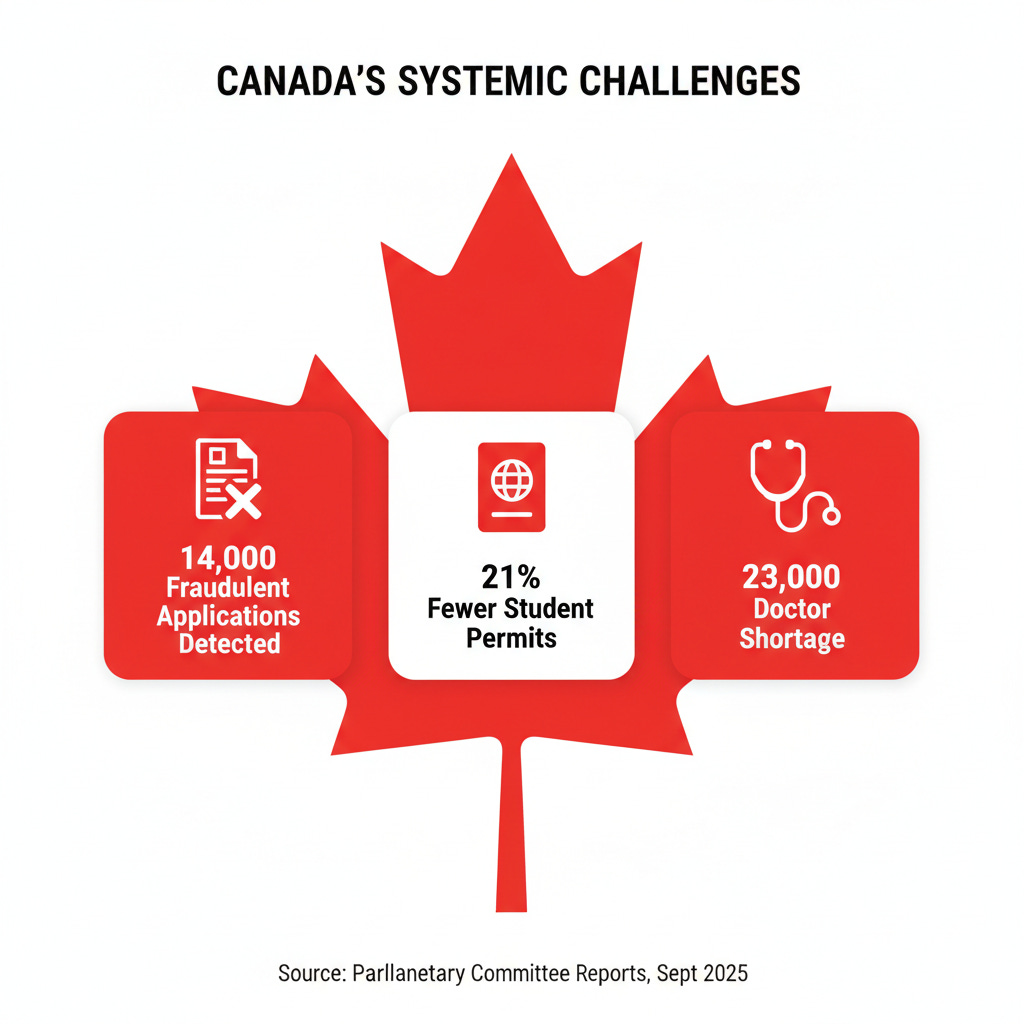
14,000: The number of potentially fraudulent letters of acceptance identified by IRCC’s new verification system since its implementation.
21%: The reduction in the number of study permit holders in Canada from the end of 2023 to July 31, 2025, following the introduction of a cap.
23,000: The estimated current shortage of family doctors across Canada, according to a motion passed at the Standing Committee on Health.
Sources:
House of Commons. (2025, September 23). Standing Committee on Citizenship and Immigration, Evidence, Number 003. 45th Parliament, 1st Session.
House of Commons. (2025, September 23). Standing Committee on Health, Evidence, Number 002. 45th Parliament, 1st Session.
House of Commons. (2025, September 23). Standing Committee on Veterans Affairs, Evidence, Number 003. 45th Parliament, 1st Session.
The gross incompetence at the highest level of our country is astounding. It is no surprise why costs are rising at the same time that services and results are going in the opposite direction. Maddening.