


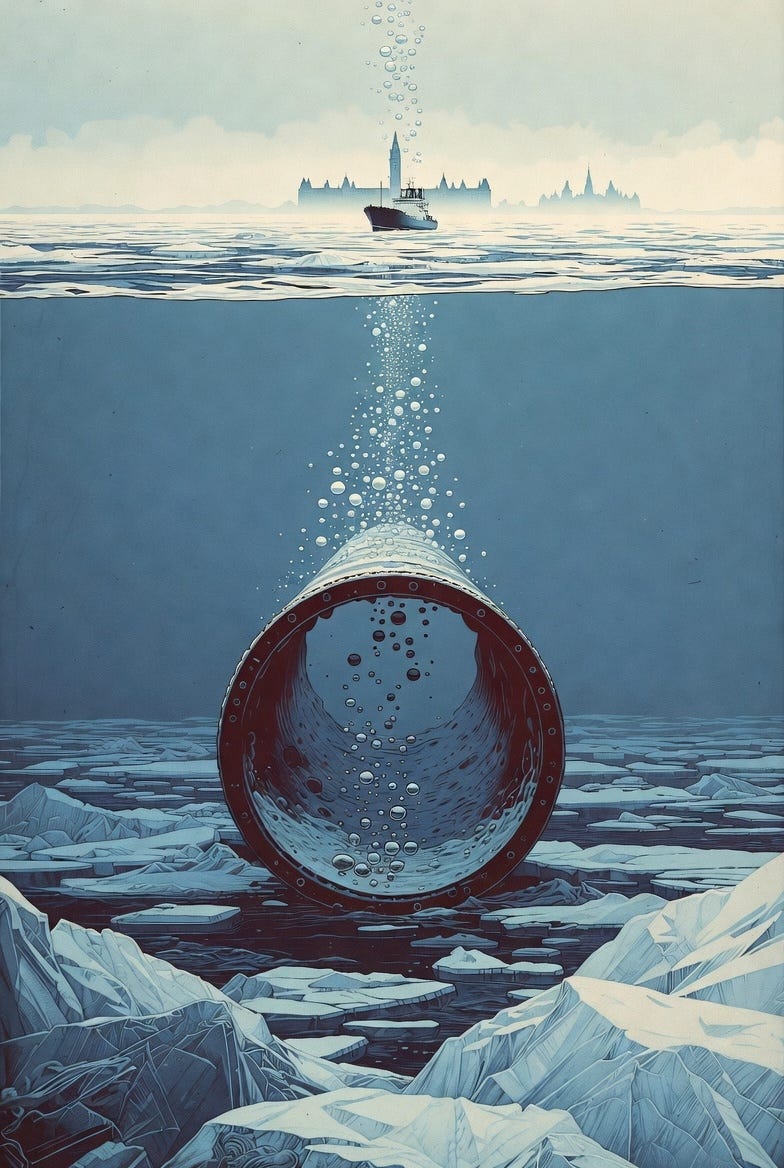
The Chill of Commerce
Canada’s winters don’t just bite—they choke trade. In 1963, as the St. Lawrence Seaway hummed with promise, engineers at the National Research Council (NRC) grappled with a stark reality: ice-clogged harbors and lanes threatened the nation’s economic arteries. Shipping delays cost millions. Docking facilities ground to halts. The fix? Pump warmer substratum water to the surface, melting ice from below.
This wasn’t sci-fi. It built on small-scale successes in harbors. But scaling up—for vast shipping lanes—demanded big thinking. Could mechanical pumps handle depths up to 600 feet? Or would an air-bubbler system, injecting compressed air to lighten the water column, prove smarter? The NRC’s preliminary math laid it bare. What does this mean for policy? It spotlights early federal bets on innovation to tame nature, echoing today’s push for resilient infrastructure amid climate shifts.
Pumps vs. Bubbles: The Power Crunch
Picture two setups (see the diagram in the original): a submerged electric pump churning water upward, or a tube fed with air bubbles that buoy the flow like a natural elevator.
For pumps, the head was minimal—no lift above water surface, just velocity (5 or 10 feet per second) plus friction in tubes from 2 to 16 feet wide. Assuming 85% motor efficiency and 80% pump efficiency, power needs scaled brutally with depth. At 600 feet in a 16-foot tube:
5 ft/sec: 86.5 horsepower.
10 ft/sec: 690 horsepower.
Bubblers flipped the script. Air lifts the mix by slashing density—think specific gravity dropping as bubbles expand. The analysis borrowed from 1917 air-lift pump theory, assuming isothermal air expansion. Zero lift meant a simple ratio: air volume to water volume equaled (friction head + velocity head) divided by submergence, tweaked for pressure logs.
Results? Bubbles won handily.
How does this play out? Larger tubes slashed relative power—bubbles especially shone at scale, hinting at simpler, cheaper ops. But caveats loomed: friction factors for bubbly water? Unproven. Entry losses? Ignored. The memo urged tests. Still, it screamed advantage: bubblers could cut energy 30-40%, freeing budgets for more lanes.
Policy Ripples Then and Now
Back in ‘63, this was Diefenbaker-era grit—federal labs fueling national dreams like the Seaway, which opened just four years prior. The NRC’s work wasn’t flashy; it was pragmatic, probing how to extend ice-free seasons without massive capital sinks. Success here could mean policy wins: longer shipping windows, lower costs for grain exports, stronger claims on northern waters.
Fast-forward to 2025. Arctic melting accelerates—routes like the Northwest Passage beckon, but ice persists in choke points. Ottawa’s pouring billions into polar security (think $2.7B for coast guard icebreakers). Yet this memo whispers efficiency: Why not revisit bubblers for hybrid systems? Pair them with renewables—hydro or wind-powered compressors—and you’ve got low-carbon de-icing. What if it trims emissions while bolstering sovereignty? Trudeau’s net-zero push demands such audits of old ideas. Experimental verification, as urged then, feels urgent now. How might it reshape federal funding for Transport Canada or Indigenous-led northern projects?
The simplicity sold it: fewer moving parts, less maintenance. In a politics of fiscal restraint, that’s gold.
The Verdict from the Vault
Bottom line? At tested velocities, bubblers edged pumps on power—up to 30% savings—and promised easier deployment. Doubling speed in deep water spiked needs eightfold for pumps, fivefold for bubbles. But theory’s crudity begged real-world proof.
This memo, raw and unedited, captures Canada’s inventive spine. It asks: In chasing green growth, are we reinventing wheels—or bubbling up forgotten fixes?
What forgotten tech from your corner of Canadian policy deserves a second look? Hit reply—let’s unpack it.
Sources
Levy, G. G., & Faucher, G. (1963). *Pumping power requirements for de-icing of shipping lanes* (Laboratory Memorandum No. NRC-ENG-35). National Research Council Canada, Division of Mechanical Engineering, Engine Laboratory. https://doi.org/10.4224/40003814
Amazing read 👏