


Somewhere in the South Atlantic in early April, someone on the MV Hondius got sick.
It wasn’t immediately obvious what it was. The MV Hondius is a Dutch-flagged expedition cruise ship, the kind that carries adventurous passengers to remote coastlines, the sort of voyage where a fever might be chalked up to seasickness or the cold. But within days, the situation sharpened into something officials recognized as genuinely dangerous. By May 2, 2026, the World Health Organization had been notified. Three people were dead. The culprit was the Andes virus, a rare strain of hantavirus, and the only form known to pass directly between human beings.
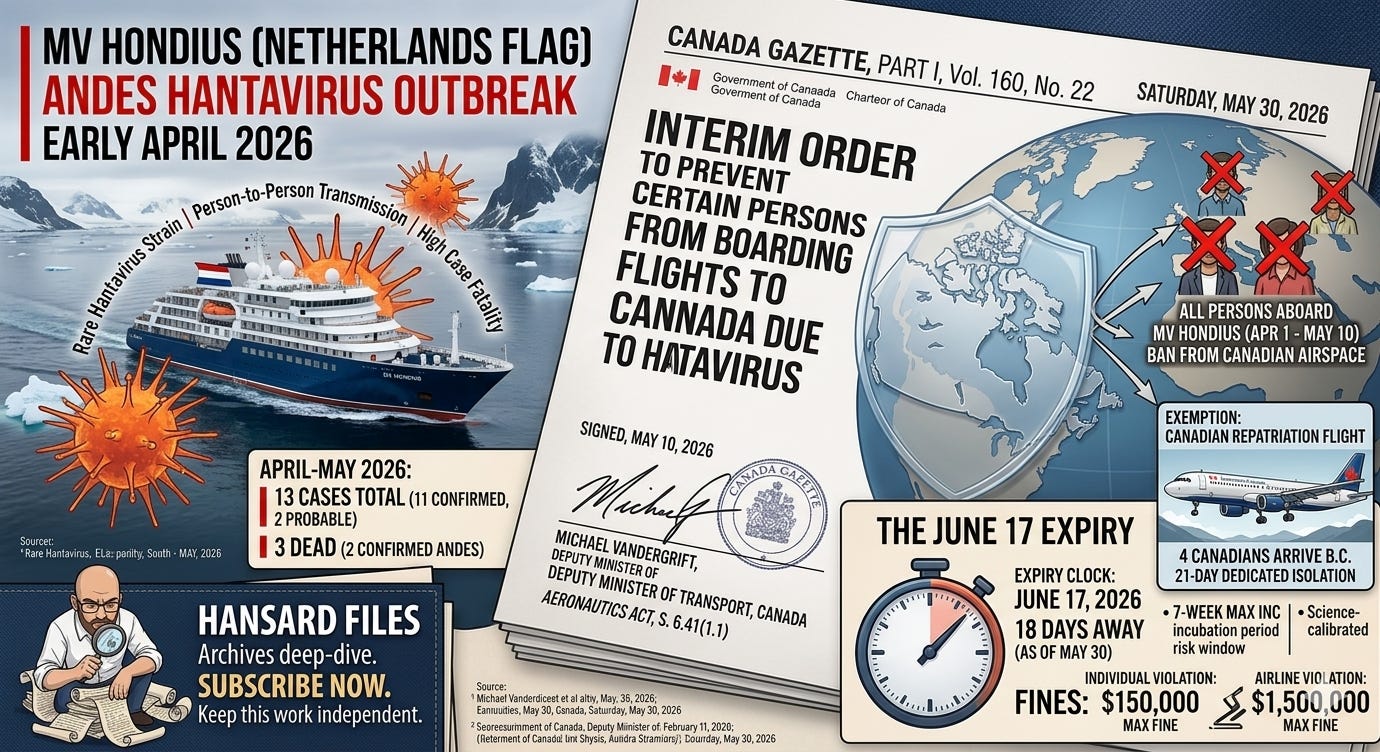
What happened next, from a public health standpoint, was a global scramble. What happened in a quiet government office in Ottawa, on May 10, was different. That day, Deputy Minister of Transport Michael Vandergrift signed the Interim Order to Prevent Certain Persons from Boarding Flights to Canada Due to Hantavirus, invoking emergency authority under the Aeronautics Act to close Canadian airspace to every person who had been aboard the MV Hondius at any point since April 1.
That order appeared in Canada Gazette, Part I, Vol. 160, No. 22 on May 30, 2026. It expires June 17.
The Tool Canada Used
Most Canadians have never heard of an interim order under the Aeronautics Act. They’re uncommon instruments, invoked when a threat to aviation safety or public safety is assessed as significant and immediate. The ordinary regulatory process, which involves consultation, publication, and a waiting period, takes months. This didn’t. Under subsection 6.41(1.1) of the Aeronautics Act, the Deputy Minister can act unilaterally when the urgency demands it. Consultation still happens, but after the fact, and quickly.
Canada used this same authority during COVID-19 to restrict inbound flights, mandate negative tests, and impose quarantine requirements. The legal muscle is the same. The scale here is far smaller. But the Andes virus warranted it.
The reasons aren’t hard to find. Hantavirus pulmonary syndrome has a case fatality rate historically estimated between 20 and 50 percent. There is no licensed vaccine. There is no specific antiviral treatment. And Andes virus, unlike virtually every other hantavirus strain in existence, can move from person to person under close-contact conditions. The incubation window runs from one to seven weeks. Passengers who felt fine when they disembarked in Tenerife might not fall ill for another month.
What the Order Actually Does
The language of the interim order is precise. Air carriers holding Canadian aviation documents are prohibited from permitting anyone who was aboard the MV Hondius between April 1 and May 10 to board any flight to a Canadian aerodrome. The passengers themselves face a parallel prohibition: they cannot board any direct or indirect flight to Canada.
There are two exceptions. Flights chartered by the Government of Canada are exempt. Flights authorized by the Government of Canada and chartered by another party or state are also exempt. The government, in other words, reserved its own ability to bring Canadians home on its own terms. It did exactly that. On May 10, four Canadian passengers arrived safely in British Columbia on a government-organized repatriation flight, transferred to dedicated accommodations and placed into a minimum 21-day isolation period.
Violations are not trivial. An individual who defies the order faces a maximum penalty of $150,000. An airline that knowingly permits a prohibited person to board faces a maximum of $1,500,000. The Aeronautics Tribunal reviews contested notices.
What Canada Knew
By the time Vandergrift signed the order, the picture had clarified substantially. WHO had confirmed the Andes virus identification on May 6. The working hypothesis, per WHO, was that the first case contracted the infection on land before boarding. Once aboard, in the confined environment of an expedition vessel, transmission followed. The epidemiological curve was still widening.
As of May 26, 13 cases had been reported in total, including 11 confirmed and 2 probable, with the case count still evolving due to the virus’s long incubation period. Three people died, including two confirmed Andes virus deaths. European Centre for Disease Prevention and ControlWikipedia
Canada’s Public Health Agency had assessed the risk to the general population as low. But “low risk to the general population” and “low risk from specific, identifiable individuals with direct exposure to a lethal pathogen” are different calculations. The interim order is about the second category. It’s surgical.
The June 17 Expiry
The interim order expires June 17, 2026. That date matters. The Andes virus incubation period maxes out at roughly seven weeks. The last passengers disembarked from the Hondius in Tenerife around May 10. Seven weeks from then is late June. The June 17 expiry sits right at the edge of the plausible risk window, calibrated to the science rather than political convenience.
Whether Transport Canada will extend it, convert it into a standard regulation, or let it lapse without incident depends on what the next few weeks bring. As of late May, new cases continued to surface periodically, including a confirmed case in a crew member who disembarked in Tenerife. The outbreak is not over. HantavirusMap
What is already established is that Canada moved quickly, used a blunt but lawful instrument, carved out a pathway to bring its own citizens home safely, and published the legal basis for all of it in the official record. The Gazette notice is short. The legal implications are not.
Why It Matters to You
Canada’s interim order authority under the Aeronautics Act is a power most Canadians will never think about unless it gets used. This is the second time in recent memory that it’s been deployed for a public health purpose. The first time, it touched millions of people. This time, it touches perhaps a few hundred. But the machinery is identical.
The question worth sitting with isn’t whether this particular order was justified. Most observers, and most evidence, would say it was. The question is what it means that Canada has a fast, executive-level instrument that can shut an identifiable group of human beings out of the country within days of a health official’s signature. It’s a power calibrated for exactly this kind of situation. It will be used again.
The expiry clock is ticking. June 17 is eighteen days away.
Hansard Files spends weeks in the archives so you don’t have to. If stories like this matter to you, subscribe to keep this work independent.
Source Documents
King’s Printer for Canada. (2026, May 30). Canada Gazette, Part I, Vol. 160, No. 22. Ottawa: Government of Canada.
Department of Transport. (2026, May 10). Interim Order to Prevent Certain Persons from Boarding Flights to Canada Due to Hantavirus. Signed by Michael Vandergrift, Deputy Minister of Transport.
Public Health Agency of Canada. (2026, May 10). Media update on Andes hantavirus situation. Canada.ca.
European Centre for Disease Prevention and Control. (2026, May 26). Andes hantavirus outbreak in cruise ship. ECDC Surveillance and Updates.
World Health Organization. (2026, May 13). Hantavirus cluster linked to cruise ship travel, Multi-country. Disease Outbreak News, DON601.
I am unsure of whether you are in favour of what was done or not. It sounds like a reasonable action in response to a difficult situation. As you pointed out, our citizens were repatriated under controlled conditions and quarantined safely. Hopefully they will pass safely through the quarantine. Hopefully the aircraft was successfully cleaned as well and those proving care for the passengers did so in a secure manner.