


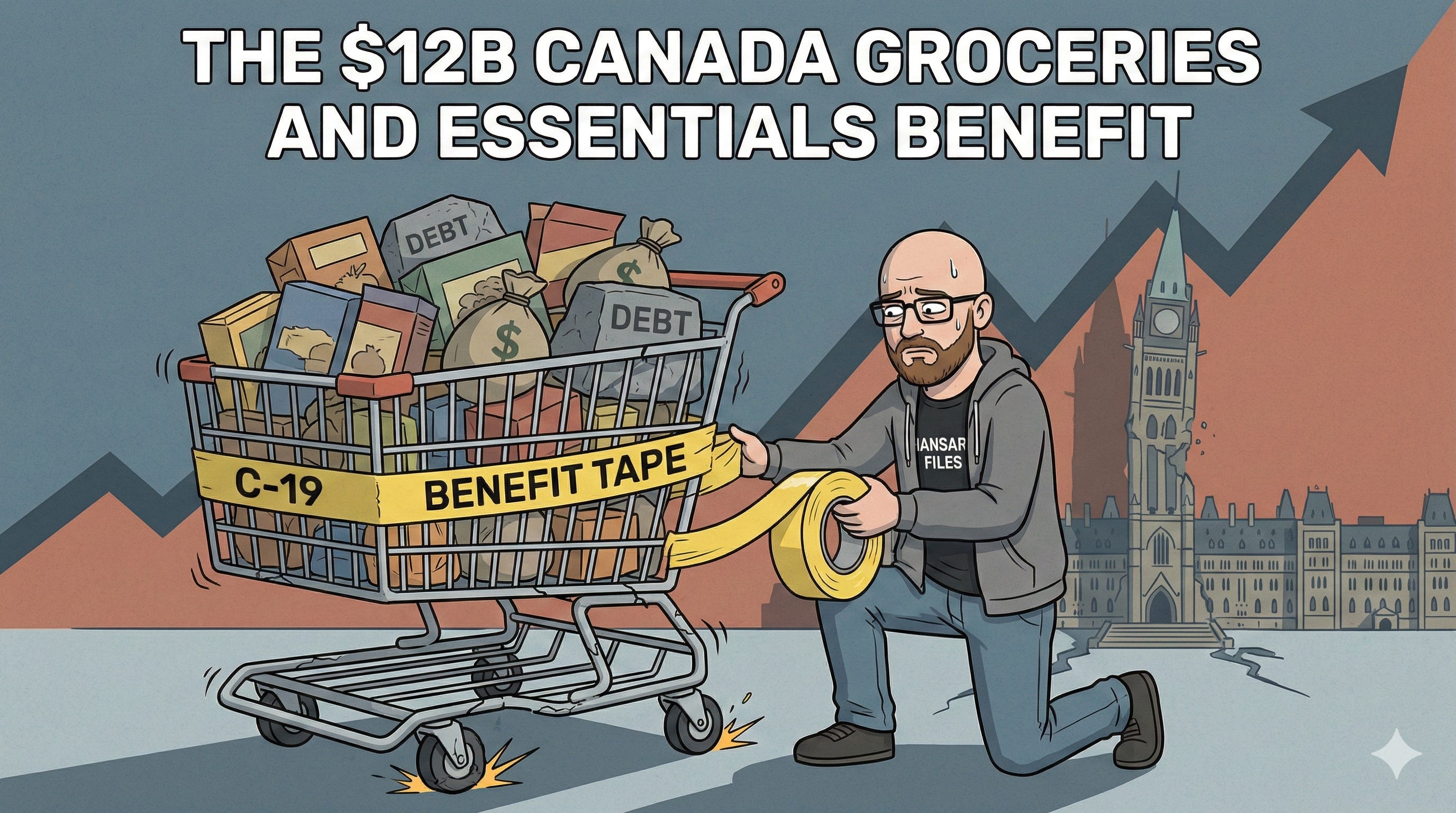
The atmosphere inside the Red Chamber on the afternoon of February 10, 2026, was thick with the weight of a national crisis. Food banks across the country were reporting nearly 2.2 million visits in a single month, a staggering figure that laid bare the agonizing reality of food inflation. Children represented one third of those waiting in line for basic sustenance. In response to this mounting desperation, the newly minted government of Prime Minister Mark Carney introduced the Canada Groceries and Essentials Benefit. It was pitched as a massive financial intervention designed to inject billions directly into the pockets of struggling households. Yet, what was presented as an urgent lifeline quickly became the epicenter of a fierce ideological war over fiscal responsibility, economic stagnation, and the sheer cost of keeping Canadians afloat.
The Anatomy of the Canada Groceries and Essentials Benefit
Rising to sponsor Bill C-19 in the Senate, Senator Victor Boudreau laid out the mechanics of the government’s ambitious plan. The intent of the legislation was singular and focused. It aimed to deliver targeted relief to those who truly needed it most by building upon the existing architecture of the Goods and Services Tax credit.
Starting in the spring of 2026, the legislation would help more than 12 million low-income and modest-income Canadians meet their basic daily needs. The financial relief would be delivered in two distinct phases. First, a one-time top-up would be paid out no later than June 2026. This would be equal to a 50 percent increase in the annual 2025-2026 GST credit amount, instantly injecting $3.1 billion into the economy. Second, the baseline value of the Canada Groceries and Essentials Benefit would increase by 25 percent for five consecutive years starting in July 2026. Over the half-decade lifespan of the program, this secondary measure would deliver an additional $8.6 billion in support.
The practical impact for Canadians was explicitly quantified. A single senior earning a net income of $25,000 would receive a one-time top-up of $267 alongside a longer-term increase of $136 for the benefit year, bringing their total relief to $402. A couple with two children earning a net income of $40,000 would receive a top-up of $533 and a sustained increase of $272, amounting to an $805 boost.
Senator Boudreau defended the measure as the fastest, most effective way to help citizens weather an affordability storm driven by global supply chain disruptions, protectionist tariffs, and the lingering economic scars of global conflicts. He noted that professional economists viewed the GST credit mechanism as the ideal vehicle for economic stimulus because it satisfied three critical criteria. It was targeted, it was timely, and it was theoretically temporary.
The Missing Billions and the Budget Gap
However, the opposition was quick to scrutinize the sheer scale of the expenditure and the chaotic nature of its rollout. Senator Denise Batters rose to question the shifting mathematics behind the program. When Prime Minister Carney first announced the initiative on January 26, he estimated the cost at roughly $9 billion. Days later, the independent Parliamentary Budget Officer evaluated the measure and published a cost estimate of $12.4 billion. Meanwhile, the Department of Finance briefed the Senate that the total cost would sit at $11.7 billion.
Senator Boudreau explained the discrepancy as a matter of accounting timelines. The Department of Finance did not calculate the last quarter payment of the final fiscal year, whereas the Parliamentary Budget Officer included it, accounting for a $600 million difference.
But the shifting numbers were only part of the problem. Senator Batters pointed out a glaring oversight in the government’s fiscal planning. The Carney government had finally tabled Budget 2025 on November 4, 2025, after a lengthy delay. Yet, a massive $12 billion social program was completely absent from that comprehensive 405-page document. The opposition argued that bringing forward a massive financial commitment just three months after the official budget revealed a government governing by ad hoc reactions rather than disciplined fiscal strategy.
The Productivity Crisis and the Opposition’s Fury
The debate intensified when Senator Leo Housakos, the Leader of the Opposition in the Senate, launched a blistering critique of the government’s entire macroeconomic record. He acknowledged that the opposition would ultimately support the bill because Canadians were desperate for relief, but he refused to accept the narrative that the government was successfully managing the economy.
Quoting the 2026 edition of Canada’s Food Price Report, Senator Housakos noted that the average family of four was expected to spend $17,572 on groceries in 2026. That figure represented an astonishing $5,000 increase from pre-pandemic costs in 2019.
Senator Housakos argued that the root causes of this inflation were not entirely global. He pointed the finger directly at a decade of domestic fiscal mismanagement. He cited spiraling national debt, systemic deficits, and a severely weakened Canadian dollar that forced businesses to spend 135 Canadian dollars to purchase 100 dollars’ worth of American imported goods.
The most damning indictment centered on Canada’s catastrophic decline in productivity. Senator Housakos presented a grim scoreboard of national decline to the chamber. Canada’s GDP per capita had fallen from 94 percent of the American level in 1981 to just 78 percent. Labor productivity hovered at $74.70 per hour worked compared to $97 in the United States. Investment in machinery and equipment per worker had collapsed from 60 percent of the American level in 2008 to a dismal 41 percent today.
“These are not abstract statistics,” Senator Housakos declared on the Senate floor. “They are the scoreboard of national decline. In practical terms, this productivity crisis is why Canadians feel like life is getting harder even when they are working just as hard.”
He criticized Prime Minister Carney for delivering polished speeches at the World Economic Forum in Davos while failing to execute tangible domestic strategies. Senator Housakos framed the Canada Groceries and Essentials Benefit not as a solution, but as the fourth temporary band-aid applied since 2022, following similar rebate measures in Bills C-30, C-46, and C-78.
A Temporary Bridge or a Permanent Fixture?
The core tension surrounding the legislation was whether a five-year, multi-billion-dollar program could truly be considered temporary. Senator Clément Gignac, an economist, intervened to express support for the targeted nature of the tax measure. He argued it was vastly superior to broad, untargeted GST holidays that had been criticized as political gimmicks. Gignac agreed that the new benefit was the most significant tax measure introduced since the pandemic.
However, the opposition warned of the political reality of social entitlements. Senator Housakos argued that relief without underlying economic reform breeds a permanent dependency on government cheques. While the bill explicitly stated that the 25 percent increase in the GST tax credit was strictly for a five-year window, the political mechanics of Ottawa suggested otherwise. The opposition guaranteed that no matter who held power in 2031, rolling back a popular financial entitlement for 12.6 million voters would be political suicide. Thus, a supposedly temporary bridge was highly likely to become a permanent structural cost baked into the national debt.
Experts outside the chamber echoed these concerns. Professor Sylvain Charlebois of Dalhousie University warned that injecting billions of dollars directly into consumer hands could inadvertently backfire. Without addressing supply chain efficiency and market competition, flooding the demand side with cash could theoretically allow grocers to raise retail prices even further, neutralizing the intended relief.
The Finance Minister Faces the Chamber
The debate reached its climax on the evening of February 12, 2026. The Senate suspended its regular proceedings and resolved into a Committee of the Whole to directly question the Honourable François-Philippe Champagne, Minister of Finance and National Revenue.
The session opened under a dark cloud. The nation was reeling from a horrific school shooting in Tumbler Ridge, British Columbia, which had claimed nine young lives just two days prior. Minister Champagne began his testimony by acknowledging the tragedy, honoring the victims, and expressing the profound grief shared by the entire parliament.
Pivoting to the legislation, the Minister defended the Canada Groceries and Essentials Benefit as a necessary shield against unprecedented global volatility. “Some would say we live in a more uncertain world than at any time since 1945 or 1989,” Minister Champagne told the senators. He argued that the government was executing a long-term vision to build a resilient economy while simultaneously addressing the immediate, crushing needs of Canadian workers.
Minister Champagne cited a recent Bank of Canada report indicating that the majority of recent food price increases were driven by higher import costs rather than domestic pressures. He framed the $12 billion benefit as a pragmatic offset. Since 2020, excess inflation had cost the average household $782. The new benefit was mathematically calibrated to essentially refund that lost capital to the most vulnerable citizens.
When pressed by the opposition on the exploding national deficit, which Budget 2025 had already projected at $78.3 billion before this new program was even introduced, Minister Champagne held his ground. He framed the expenditure not as reckless borrowing, but as an unavoidable moral imperative.
“When you are in government, you have to make choices,” the Finance Minister stated firmly. “This is a choice we are making. We are choosing Canadians.”
Ultimately, the Senate recognized the desperate reality facing millions of citizens at the grocery checkout line. The bill passed its second reading. But as the financial machinery of the state prepared to disburse another wave of billions, the lingering questions remained unanswered. Whether this massive injection of capital will serve as a bridge to a recovered economy, or simply act as another heavy anchor dragging down the nation’s fiscal future, is a verdict that only time will deliver.
Hansard Files digs through dense parliamentary archives to uncover the high-stakes stories shaping our nation. Subscribe to support independent, uncompromising investigative journalism.
Source Documents
Senate of Canada. (2026, February 10). Debates of the Senate, Volume 154, Issue 49.
Senate of Canada. (2026, February 11). Debates of the Senate, Volume 154, Issue 50.
Senate of Canada. (2026, February 12). Debates of the Senate, Volume 154, Issue 51.
Sylvain Charlebois thinks we should increase the sales of raw milk to cut costs. One way to eliminate some of the poors. I hope to never, ever see the name of the charlatan quoted again.
The sad part is how many people need this kind of help. The sadder part is the inevitable "knock on" effect of this benefit will be more inflation.