


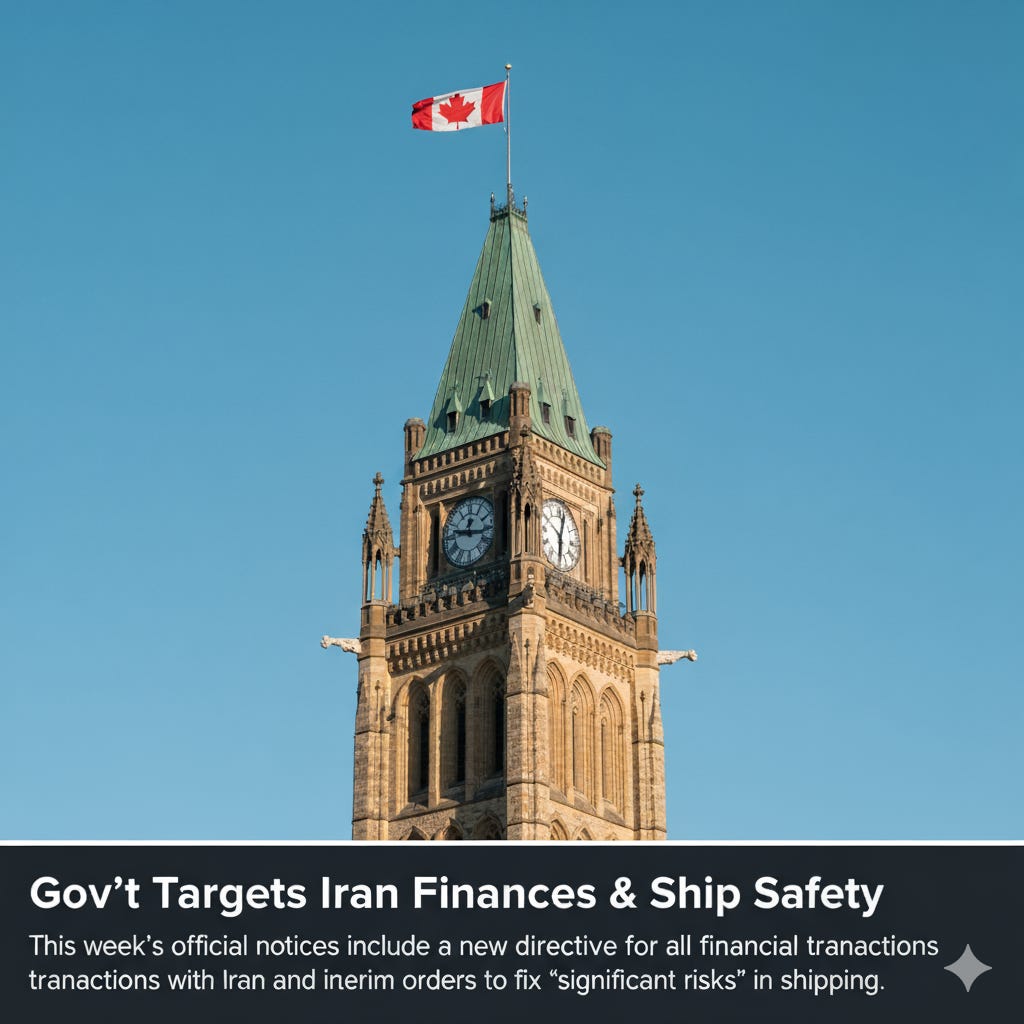
Why is the government worried about Iran and ship safety?
The Canada Gazette is the federal government’s official newspaper. It is where new orders, regulations, and appointments are formally published. While it is often dense, this week’s edition (Vol. 159, No. 46) contains several significant moves that impact national security, finance, and marine safety.
Here is a breakdown of what you need to know from the November 15, 2025, publication.
New Directive Targets All Iran-Linked Financial Transactions
The most significant item is a new directive from the Minister of Finance, François-Philippe Champagne, concerning the Islamic Republic of Iran.
This “Directive on Financial Transactions Associated with the Islamic Republic of Iran” is not a routine update. The Gazette notice provides two key reasons for it:
International Call to Action: The Financial Action Task Force (FATF), an international body of which Canada is a member, has called on members to take measures. The notice states this is on the grounds that Iran’s “anti-money laundering or anti-terrorist financing measures are ineffective or insufficient.”
Systemic Risk: The Minister of Finance is of the opinion that there is a risk of “sanctions evasion.” This, in turn, “could have an adverse impact on the integrity of the Canadian financial system or a reputational risk to that system.”
To safeguard that integrity, the directive mandates new, stricter rules for all persons or entities covered by Canada’s Proceeds of Crime (Money Laundering) and Terrorist Financing Act.
Effective immediately, these financial entities must:
Treat as High-Risk: Treat every financial transaction “originating from or bound for Iran, regardless of its amount,” as a high-risk transaction.
Verify Identity: Verify the identity of any person or entity requesting or benefiting from such a transaction.
Perform Due Diligence: Exercise “customer due diligence” with a particular focus on sanctions evasion. This includes “ascertaining the source of funds or virtual currency, the purpose of the transaction and the beneficial ownership or control of any entity” involved.
Keep Records: Maintain a record of all such transactions, regardless of amount.
Report Everything: Report all such transactions to “the Centre” (this refers to FINTRAC, Canada’s financial intelligence unit).
This new order repeals and replaces a previous directive on Iran from 2020.
Transport Minister Issues “Urgent” Orders on Ship Safety
The Gazette also includes three “Interim Orders” from the Minister of Transport, Steven MacKinnon.
All three orders are issued under the Pilotage Act and use identical, stark language: the Minister believes the order is “required to deal with an urgent issue related to the provision of pilotage services that poses a significant risk to safety, human health or the environment.”
“Pilotage” is the act of a licensed local expert (a pilot) boarding a large vessel to guide it through difficult or congested waters. These orders change the rules for when and how this is done in several key regions.
Pacific Pilotage Authority: This order (Interim Order No. 2) repeals a 2024 order and suspends part of the General Pilotage Regulations. It replaces them with a detailed new schedule setting out when compulsory pilotage can be “waived.”
Emergency Waivers: Waivers are permitted for ships in distress, needing a medical evacuation, engaged in rescue operations, or seeking refuge.
Experience Waivers: For non-emergencies, ships under 10,000 gross tonnage can apply for waivers in specific coastal “Areas.” However, the ship’s deck watch officers must meet new, strict experience requirements, such as completing 5, 6, or 10 return voyages in that specific area with a licensed pilot.
Dangerous Goods: Ships “carrying dangerous goods” in the Second Narrows Traffic Control Zone have their own waiver requirements, including six completed return voyages.
Summerside, PEI & Placentia Bay, NL: Two other orders (No. 4 and No. 5) repeal 2024 orders for these two Atlantic regions.
They redefine the “compulsory pilotage area” for each port.
They create a new path for certification. An applicant for a pilotage certificate can now bypass the standard “experience at sea” qualifications if they “successfully completed a familiarization program” established by the Atlantic Pilotage Authority that provides an “equivalent degree of experience.”
What Else? New Bank, Deregistered Associations, and Appointments
Finally, the Gazette contains several other notices of public interest:
New Bank: The Office of the Superintendent of Financial Institutions (OSFI) has issued an order authorizing “Questbank” to “commence and carry on business,” effective November 1, 2025.
Elections Canada: The Chief Electoral Officer is deregistering two registered electoral district associations, effective November 30, 2025: the “Durham Region PPC Association” and the “Milton PPC Association.”
CRA & Charities: The Canada Revenue Agency is revoking the registration of two charities for failure to meet Income Tax Act requirements: “Herut Canada Charitable Foundation” and “Lightcity Church.” A separate, much longer list of charities are also having their status revoked at their own “voluntary” request.
Appointments: The government announced several high-level appointments, including Mark Schaan as the Associate Deputy Minister of Innovation, Science and Economic Development, and Douglas Guzman as the Chief Executive Officer of the Defence Investment Agency.
Did any of these notices surprise you? Share your thoughts in the comments.
Sources
Canada Gazette, Part I, Vol. 159, No. 46 (November 15, 2025)