


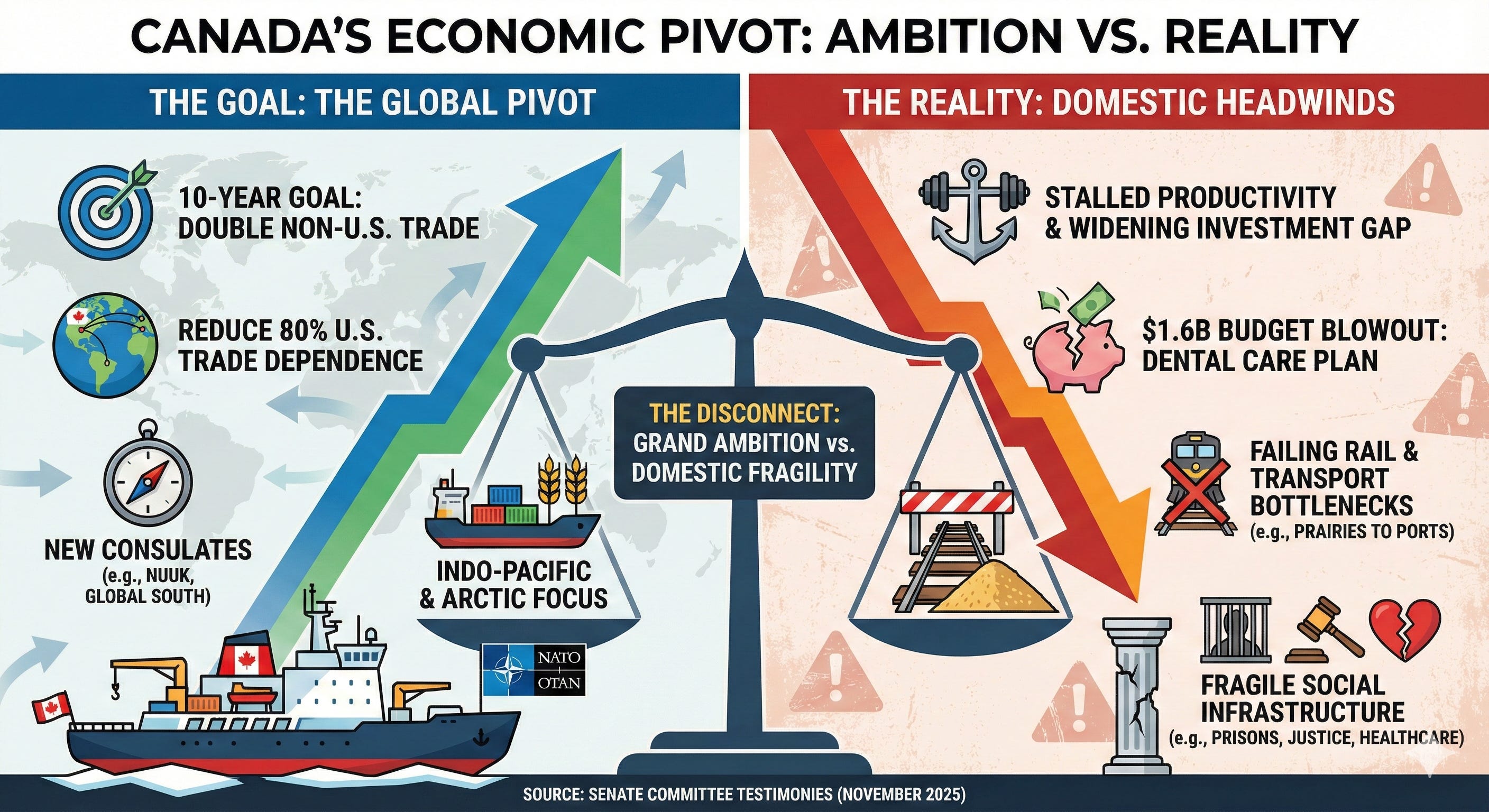
The warning was delivered not with a shout, but with a stark, mathematical precision. Seated before the Senate Committee on Foreign Affairs and International Trade, Minister Anita Anand laid bare a statistic that keeps Ottawa up at night: Canada is 80% dependent on a single economy—the United States. In a world of fracturing alliances and rising American protectionism, that number is no longer a safety net; it is a noose.
“We need to recognize that the world has changed,” Anand told the committee, her voice steady but the implication grave. “Many of Canada’s strengths... have become our vulnerabilities”.
What followed was the unveiling of a high-stakes national gamble. The government has set a hard deadline: within ten years, Canada intends to double its trade with non-U.S. partners. It is a massive geopolitical pivot, one that envisions Canadian icebreakers patrolling the Arctic alongside NATO allies, Canadian wheat feeding the Indo-Pacific, and new consulates springing up from Nuuk to the Global South.
But as Senate committees across Parliament Hill scrutinized the fine print of this grand strategy, a disconnect emerged. While Ottawa looks to the horizon, the domestic machinery required to support such a pivot is flashing red. From a massive $1.6 billion budget blowout in the new dental care plan to a productivity crisis that has business leaders sounding the alarm, the testimony paints a picture of a nation reaching for global economic sovereignty while struggling to keep its own house in order.
The Productivity Doom Loop
While Minister Anand mapped out a future of diversified trade, the Senate Committee on Banking, Commerce and the Economy was hearing a much darker assessment of the present. Witnesses from Canada’s leading business associations described an economy that is losing the ability to compete, regardless of who buys the goods.
Stephen Tapp, Chief Economist at the Canadian Chamber of Commerce, delivered a sobering reality check. He warned that Canada’s productivity growth has stalled, leaving the country increasingly poorer relative to its southern neighbor. The “investment gap” per worker between Canada and the U.S. is widening, meaning American workers are backed by more capital, better technology, and stronger machinery than their Canadian counterparts.
The implications for Anand’s trade pivot are devastating. You cannot double exports to Asia or Europe if you cannot produce goods competitively. Mathew Wilson of Canadian Manufacturers & Exporters (CME) reinforced this, noting that while the government signs trade deals, the domestic regulatory burden is strangling the very companies expected to use them.
Simultaneously, the Competition Bureau is fighting its own war to keep markets fair. Commissioner Matthew Boswell appeared before the same committee to defend the new Competition Act amendments, arguing that without stronger enforcement against monopolies, the Canadian economy will remain sclerotic and expensive. The message was clear: without a radical shift in domestic policy—tax incentives, regulatory reform, and capital investment—the 10-year trade goal will remain a fantasy. Canada is trying to run a marathon with a sprained ankle.
The Billion-Dollar Toothache
If the economy is struggling to generate wealth, the government is having no trouble spending it. The Senate Committee on National Finance was dealing with an immediate fiscal hemorrhage. Ryan Higgs, the Chief Financial Officer for Health Canada, appeared before the committee to explain a staggering variance in the supplementary estimates.
The Canadian Dental Care Plan—a cornerstone of the government’s domestic policy—requires an immediate injection of $1.6 billion.
The cause? Desperation. “Projections indicate that demand will be higher this year, as many Canadians have forgone dental care given the cost,” Higgs explained. The system is flooded. Millions of Canadians who had been living with untreated pain are rushing to use the new coverage, blowing past initial budget forecasts.
This shortfall highlights the fragility of the federal ledger. At the same time Health Canada is asking for billions to fix teeth, the Canada Revenue Agency (CRA) is scraping for every dollar it can find. Hugo Pagé, the CRA’s Chief Financial Officer, requested $72 million specifically to hunt down tax evaders and “non-filers with a high likelihood of tax owing”. Meanwhile, the Main Estimates review hinted at the sheer scale of the federal machinery, with billions more allocated to sustain core operations across departments. The juxtaposition is jarring: the government is engaged in a high-speed chase for revenue on one end while trying to plug a massive expense leak on the other.
The Wheat and the Rails
The disconnect between Canada’s global ambitions and its domestic reality is perhaps sharpest on the prairies. Leif Carlson of Cereals Canada testified before the Agriculture and Forestry Committee that the country produces far more food than it can eat—exporting 70% of its wheat and nearly all of its canola and pulses. Canada is a food superpower.
But being a superpower requires logistics, and Canada’s logistics are failing.
“The main bottlenecks... relate to access to transportation,” Carlson said. The vast distances between the prairies and the Port of Vancouver mean that Canadian farmers are entirely beholden to the railways. When rail service falters—whether due to strikes, weather, or capacity issues—that “economic sovereignty” rots in the silo.
Moreover, the dream of domestic processing remains elusive. Senator Toni Varone pointed out a painful irony: Canada grows the world’s best durum wheat, exports it to Italy, and then imports the finished pasta back at a premium. “Why can’t we be world-class competitors in that space?” he asked. The answer from Carlson was blunt: Brand power and proximity to markets matter, and Canada is simply too far away and too unknown to compete with “Made in Italy” without massive changes.
The Human Deficit
Beyond the ledger sheets and trade diagrams, the committees uncovered deep cracks in Canada’s social and legal infrastructure. A nation that cannot protect its most vulnerable citizens faces a crisis of legitimacy, even as it seeks to project values abroad.
In the Committee on Legal and Constitutional Affairs, Dr. Ivan Zinger, the Correctional Investigator of Canada, testified on Bill S-230, which seeks to establish an Ombudsman for prisoners. He described a prison system that is “impervious to change,” where Indigenous and Black Canadians are grossly overrepresented and recommendations for reform are routinely ignored by the Correctional Service of Canada.
The frayed social safety net was further exposed in the Social Affairs committee. Witnesses testifying on Bill S-249 (Keily’s Law) spoke of the urgent need for a national strategy on intimate partner violence, prioritizing the safety of children in custody battles. Simultaneously, the committee examined Bill S-252, the Voluntary Blood Donations Act, debating the ethics of safeguarding Canada’s blood supply from profit-driven models. And on visual health, witnesses for Bill S-284 revealed that the government simply does not know how many Canadians are losing their sight because no one is counting. “We need a framework because we are flying blind,” one witness remarked.
Even the guardians of democracy are feeling the squeeze. The Legal Committee reviewed Bill S-231, aimed at protecting journalistic sources. In an era of disinformation, ensuring that whistleblowers can speak to the press without fear of state surveillance is critical, yet the testimony highlighted how fragile these protections currently are.
The Verdict
The picture emerging from these committee rooms is one of a nation in a dangerous transition. Minister Anand’s foreign policy is a necessary recognition of reality: the American era of free trade is ending, and Canada must find new friends, fast. From the Arctic consulate in Nuuk to the trade desks in Jakarta, the pivot is real.
But a pivot of this magnitude requires a robust, agile domestic foundation. Right now, that foundation is shaking. We are fighting to keep our dental care funded, struggling to get our harvest to the ocean, watching our productivity plummet relative to our competitors, and failing to implement basic human rights reforms in our prisons. The “80% problem” isn’t just about who buys our goods—it’s about whether we have the national capacity to stand on our own two feet when the Americans stop holding us up.
Source Documents
Standing Senate Committee on National Finance. (2025, November 26). Evidence.
Standing Senate Committee on Foreign Affairs and International Trade. (2025, November 27). Evidence.
Standing Senate Committee on Foreign Affairs and International Trade. (2025, November 27). Evidence (Bill S-257).
Standing Senate Committee on Agriculture and Forestry. (2025, November 27). Evidence.
Standing Senate Committee on Social Affairs, Science and Technology. (2025, November 21). Evidence (Bill S-284).
Standing Senate Committee on Social Affairs, Science and Technology. (2025, November 26). Evidence (Bill S-249).
Standing Senate Committee on Social Affairs, Science and Technology. (2025, November 27). Evidence (Bill S-252).
Standing Senate Committee on Social Affairs, Science and Technology. (2025, November 27). Evidence (Bill S-215).
Standing Senate Committee on Energy, the Environment and Natural Resources. (2025, November 27). Evidence.
Standing Senate Committee on Banking, Commerce and the Economy. (2025, November 27). Evidence.
Standing Senate Committee on Legal and Constitutional Affairs. (2025, November 27). Evidence (Bill S-230).
Standing Senate Committee on Legal and Constitutional Affairs. (2025, November 27). Evidence (Bill S-231).
Standing Senate Committee on Indigenous Peoples. (2025, November 26). Evidence.