


Darren Anderson was making a point that senators clearly weren’t expecting. The CEO of Vive Crop Protection had been invited to testify about agricultural technology, about the state of innovation in Canadian farming, about whether the country was keeping pace. What he offered instead was something closer to a warning.
“I would say that we are nine missed meals from anarchy,” he told the committee. “Food security is, ultimately, national security.”
The room on May 26, 2026, was one of several Agriculture Committee sessions that had begun to accumulate a kind of quiet dread. Witness after witness arriving with different briefs, different portfolios, different corners of the industry, and each one arriving at the same uncomfortable place: Canada grows food for the world and cannot adequately feed or protect itself.
The Cucumber Problem
Richard Leblanc runs Canadian ROOTS Farms Inc., an indoor agriculture company. He came to the committee not with a request for subsidy but with a diagnosis.
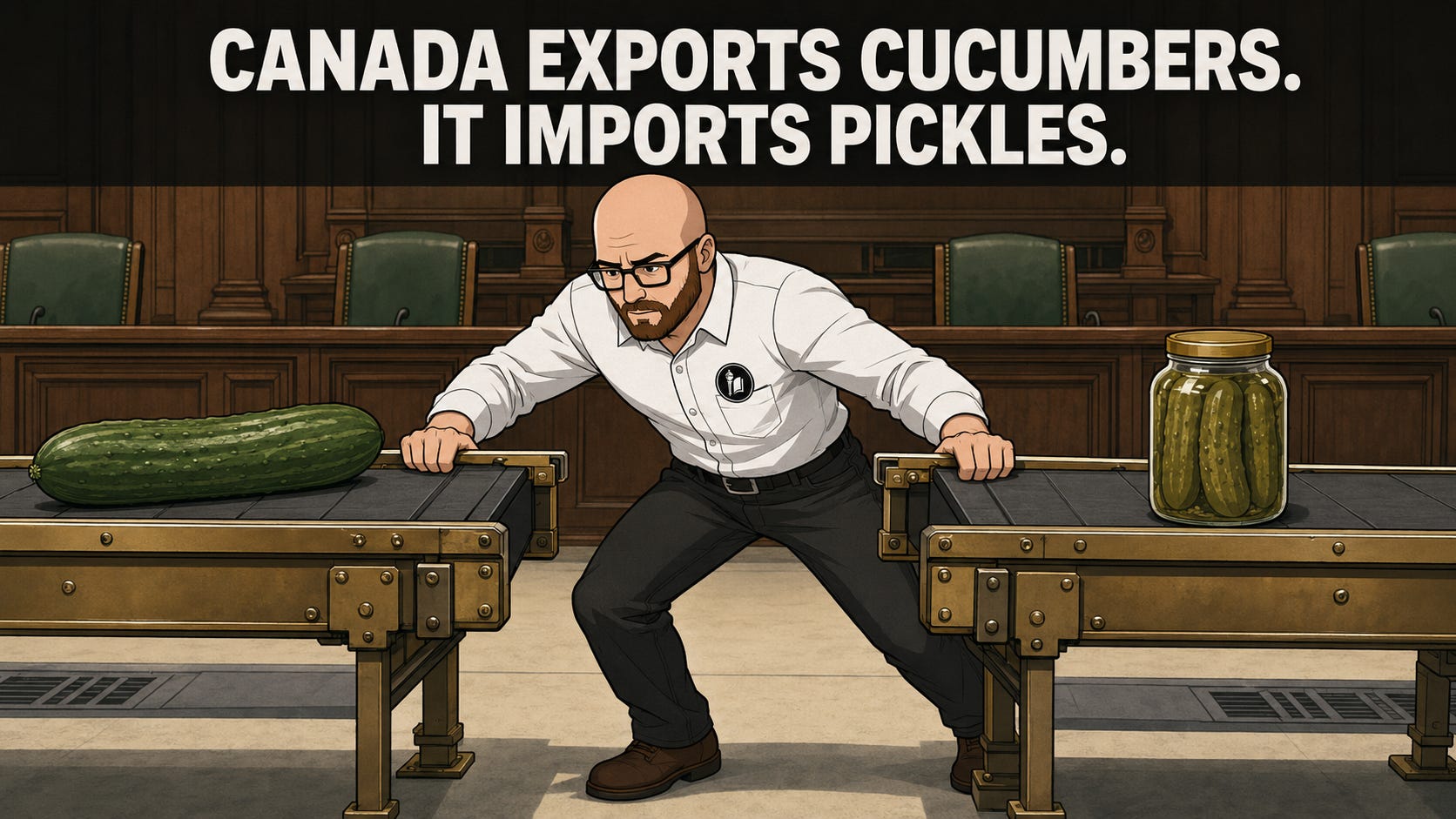
“We export cucumbers and import pickles,” he said, “the way we export lumber and buy back furniture. That is not sovereignty. That is vulnerability.”
The distinction Leblanc was drawing is not rhetorical. Senators heard testimony that Canada distinguishes between food “security” and food “sovereignty.” Security is about access to enough food. Sovereignty is about control over how that food is produced, processed, and distributed. Canada, witnesses argued, has increasingly achieved the first while surrendering the second.
The country exports raw agricultural commodities at scale and then reimports finished goods. Processing capacity, the middle stage of the chain where raw production becomes packaged value, has hollowed out. The strategic and economic implications, witnesses said, are significant.
Nine Meals from the Edge
The framing Anderson introduced, those nine missed meals before social order becomes precarious, is not original to him. It circulates among emergency planners and food system analysts. But hearing it introduced into a Senate committee as testimony, attributed to one of Canada’s most pressing national security vulnerabilities, gave it a different weight.
The numbers behind the concern are concrete. Canadian primary producers lost $3.5 billion in sales in 2022 because there were not enough workers to fill on-farm labour positions. That is not production capacity lost to drought or disease. It is capacity lost to systemic labour failure, harvests left incomplete, revenue simply absent from the chain.
Senators also heard that North America has zero fertilizer production capacity. None. The supply that Canadian farmers depend on is entirely sourced from overseas imports, a dependence that received fresh urgency in the context of trade tensions and supply chain disruptions that have defined the last several years.
The Indoor Alternative and the Capital Wall
Richard Leblanc’s company operates in controlled environment agriculture, a sector that proponents describe as the most promising technological response to Canadian food vulnerability. The efficiency numbers are striking. Controlled environment facilities can produce up to 35 times the output per acre compared to conventional field farming. Advanced building envelopes reduce winter heat loss by 70%. In a country with Canada’s climate and geography, those figures matter.
But Leblanc’s testimony was not primarily about the technology’s potential. It was about what is blocking it.
Start-up agri-tech companies cannot access federal loan programs. The requirement, witnesses said, is two to three years of audited revenue before a company qualifies for traditional financing. A company in its first year of operation, regardless of how promising its technology or how solid its business plan, simply cannot meet that bar. The sector calls it the “valley of death,” the gap between proof of concept and the point where revenue history exists to satisfy a lender.
This is not a small obstacle. Controlled environment agriculture is capital-intensive by definition. The infrastructure, climate control systems, growing platforms, and building envelopes represent substantial upfront costs. A company that cannot access early-stage capital cannot scale. A sector that cannot scale cannot contribute meaningfully to the food supply. The gap between the technology’s theoretical productivity gains and its actual deployment in Canada, witnesses argued, is largely a financing gap.
Northern Food: Infrastructure, Not Charity
The Agriculture Committee sessions in late May and early June 2026 gave particular attention to the northern dimension of Canada’s food vulnerability.
Janet Dean, representing the Territorial Agrifood Association, made the case directly. “True northern food security is strategic infrastructure for Canada. The future of Arctic sovereignty will not only be determined by what Canada defends in the North, but rather, by what Canada sustains in the North.”
Northern communities, senators heard, face food prices running two to three times higher than the southern Canadian average. Subsidies have been the primary policy response. Witnesses pushed back. Subsidies address the symptom. They said what was needed instead was actual strategic infrastructure: processing hubs, cold storage, systems that allow northern communities to participate in the food economy rather than remaining entirely dependent on southern supply chains.
The testimony also touched on traditional harvesting rights. Indigenous food systems in northern communities represent both cultural continuity and practical food sovereignty in the most direct sense. Protecting and enabling those systems, witnesses argued, is not separate from the infrastructure conversation. It is part of the same answer.
A Structural Argument the Committee Heard Repeatedly
Across the Agriculture Committee sessions, senators heard versions of the same structural critique. Canada has designed its agricultural policy around export volume rather than domestic resilience. The country grows more than it processes. It earns commodity revenue and foregoes value-added revenue. It subsidizes consumption in high-cost regions without building the capacity that would reduce costs structurally.
Darren Anderson, the CEO who opened with the anarchy warning, extended the argument. In a high-cost country, he told senators, the invisible costs matter as much as the visible ones. Regulatory friction, financing gaps, labour shortfalls: each one functions as a drag on productivity and investment. They compound.
The implicit ask from the Agriculture Committee witnesses was not for a single program fix. It was for a reorientation: from access to control, from export volume to domestic processing capacity, from subsidy to infrastructure. Whether senators, or the government, treat that argument as strategic or merely aspirational remained, at the close of these hearings, an open question.
Hansard Files spends weeks in the parliamentary record so you don’t have to. If stories like this matter to you, subscribe to keep this work independent.
Source Documents
Senate of Canada. (2026, May 26). Proceedings of the Standing Senate Committee on Agriculture and Forestry, Issue 9. Senate of Canada.
Senate of Canada. (2026, June 2). Proceedings of the Standing Senate Committee on Agriculture and Forestry, Issue 15. Senate of Canada.
The testimony you’ve surfaced here deserves a much wider audience than it will get through official channels. Canadians are living the consequences of these policy failures every time they shop, every time a rural community loses another processing facility, every time a northern family pays three times what southerners pay for the same food. This is the conversation we are not having nearly enough, and our future depends on having it. Outstanding work.
My favourite Bick’s garlic pickles! The iconic name brand found nowhere else in the world. Bought out by Americans years ago and production in Green Bay Wisconsin, using - wait for it - Canadian cucumbers! A shame for sure….