


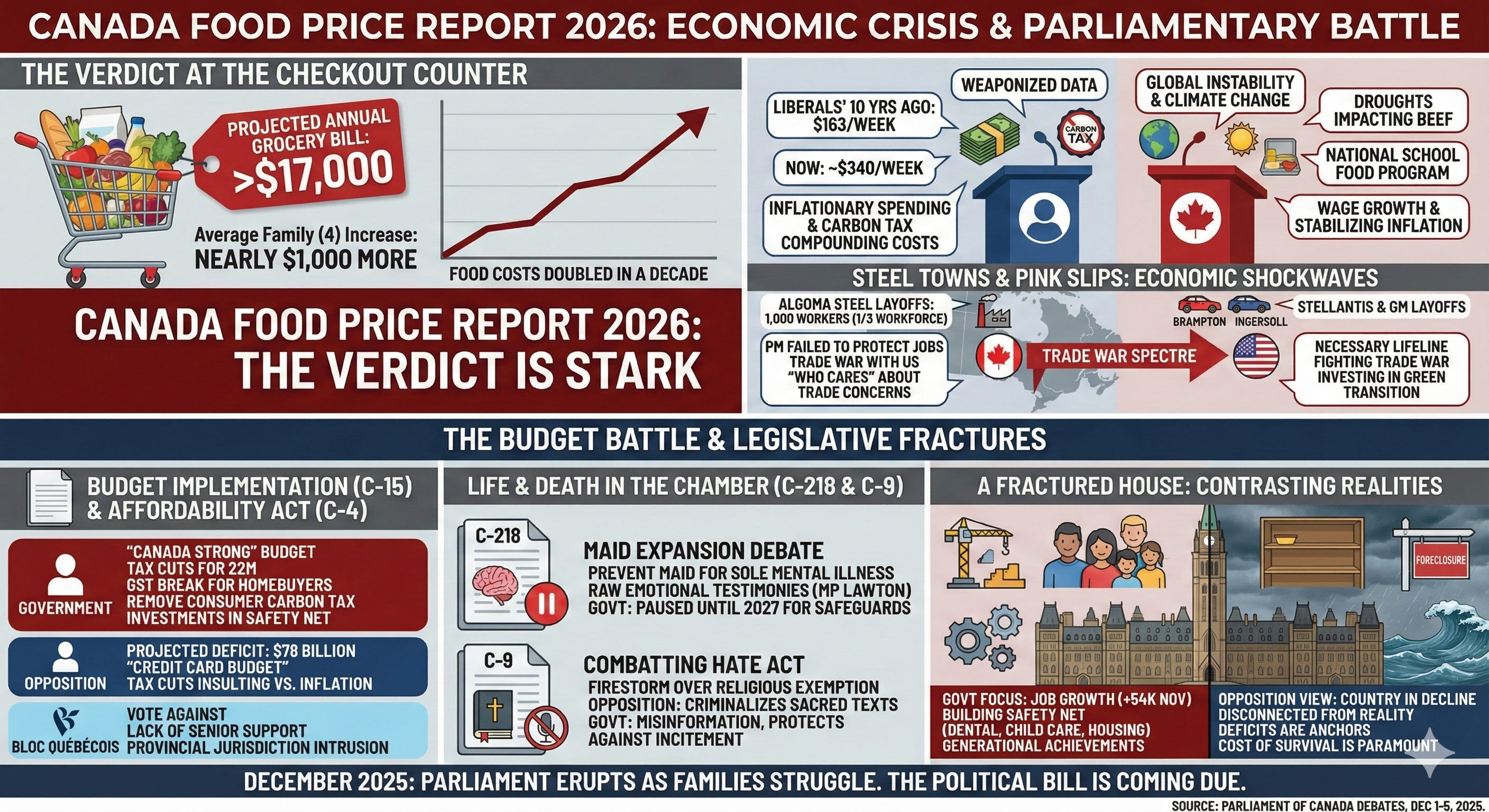
The promise was simple. Eight months prior to the chilly December winds rattling the windows of Parliament Hill, the Prime Minister had issued a challenge to the Canadian public. He asked to be judged by the prices at the grocery store. It was a gamble on economic stability, a wager that inflation would tame and supply chains would heal. But as the House of Commons convened for the first week of December 2025, that wager appeared to be collapsing. The Canada Food Price Report 2026 had just dropped, landing on the floor of the Commons with the weight of a gavel. The verdict was stark.
The report projected that the average family of four would pay nearly one thousand dollars more for food in the coming year. Total annual grocery bills were set to exceed seventeen thousand dollars. This was not merely a statistical fluctuation. It was a doubling of food costs in a single decade. For the opposition, the report was political ammunition. For the government, it was a complex crisis driven by global instability and climate change. For the Canadian public, it was the difference between a full cart and a skipped meal.
Inside the chamber, the atmosphere was thick with the anxiety of a nation stretched to its financial limit. The debates that unfolded over five days in early December were not polite policy discussions. They were battles over the basic mechanics of survival. From the price of ground beef to the shuttering of steel mills in Sault Ste. Marie, the proceedings painted a portrait of a G7 economy fighting to keep its footing while its citizens engaged in a daily struggle to afford their lives.
The Verdict at the Checkout Counter
Monday morning began with a sombre acknowledgment of World AIDS Day, but the goodwill evaporated the moment Question Period began. The Leader of the Opposition wasted no time in weaponizing the newly released food price data. He stood before a raucous bench, holding the government’s feet to the fire of their own rhetoric. He reminded the House that when the Liberals took office ten years prior, the weekly grocery bill for a family was one hundred and sixty-three dollars. The new data suggested that figure was climbing toward three hundred and forty dollars a week.
The government’s response was to pivot to the macro-economic picture. The Minister of Finance pointed to wage growth and stabilizing inflation rates, arguing that the global context was being ignored by critics. Government representatives cited climate change as a primary driver of food inflation, specifically droughts in the west impacting beef prices. They championed the National School Food Program as a direct intervention to help hungry children. But the opposition was relentless. They painted a picture of a government addicted to inflationary spending and an industrial carbon tax that they claimed was compounding costs at every stage of the supply chain, from the farm to the trucker to the grocery shelf.
The tension was not limited to food. The debate spilled rapidly into housing, where the numbers were equally grim. A report from the Parliamentary Budget Officer had landed, casting doubt on the efficacy of the government’s housing strategy. The opposition seized on the data, which suggested the new housing bureaucracy would only result in twenty-six thousand homes over five years. This was a fraction of the millions needed to restore affordability. The government pushed back, arguing the report ignored subsequent phases of investment that would yield over eighty thousand units. They pointed to thirteen billion dollars in affordable housing funding that the opposition had voted against.
Steel Towns and Pink Slips
While the cost of living dominated the theoretical debates, a very real economic shockwave hit the floor of the House on Tuesday. Algoma Steel in Sault Ste. Marie announced the layoff of one thousand workers. It was a devastating blow to a proud steel town, representing a cut of nearly one-third of the plant’s workforce. The news came on the heels of layoffs at Stellantis in Brampton and GM in Ingersoll. The spectre of a trade war with the United States loomed large over the proceedings.
The opposition accused the Prime Minister of failing to protect Canadian jobs in the face of aggressive American protectionism. They cited a recent comment where the Prime Minister reportedly dismissed trade concerns with a shrug and a “who cares,” a soundbite the Conservatives repeated with punishing frequency. They painted a picture of a government asleep at the wheel while the American administration siphoned jobs south of the border. They questioned how the government could hand four hundred million dollars to Algoma Steel without securing job guarantees for the workers.
The government’s defense was fierce. Ministers argued they were in the trenches of a trade war they did not start but were determined to win. They characterized the financial support for Algoma as a necessary lifeline that prevented the total collapse of the plant. Without that intervention, they argued, there would be no jobs left to fight for. They pointed to the capricious nature of the American administration and insisted that they were standing up for workers by investing in the transition to green steel and electric vehicles, even as the market wobbled.
The Budget Battle
Midweek, the focus shifted to the legislative machinery meant to address these crises. Bill C-15, the Budget Implementation Act, and Bill C-4, the Affordability Act, became the battlegrounds. The government touted Bill C-4 as a direct injection of relief, offering tax cuts for twenty-two million Canadians, a GST break for first-time homebuyers, and the removal of the consumer carbon tax. They framed it as a “Canada Strong” budget, designed to weather the storm of global uncertainty while investing in the social safety net.
The opposition, however, saw a different reality. They looked at a deficit projected to hit seventy-eight billion dollars and saw a mortgage on the future. They argued that the tax cuts were a drop in the bucket compared to the inflationary firestorm caused by government overspending. A tax cut of thirteen cents a day for a senior, they argued, was insulting when food prices were rising by thousands a year. They characterized the budget as a “credit card budget,” maxing out the nation’s finances with no plan to pay it back.
The Bloc Québécois added their own layer of resistance. They declared they would vote against the budget implementation, citing a lack of support for seniors aged sixty-five to seventy-four and a failure to compensate Quebec for the cost of the carbon tax rebate distributed in other provinces. They saw the budget as an intrusion into provincial jurisdiction and a failure to protect the distinct economic interests of Quebec, particularly in the forestry sector which was also bleeding jobs due to softwood lumber tariffs.
Life and Death in the Chamber
As the week wore on, the debates moved from the financial to the existential. On Friday, the House turned its attention to Private Member’s Business, specifically Bill C-218 and Bill C-9. These bills touched on the most sensitive nerves of the nation: how we die and how we speak.
Bill C-218 sought to prevent the expansion of Medical Assistance in Dying (MAID) to those whose sole underlying condition is mental illness. The debate was raw and emotional. Conservative MP Andrew Lawton silenced the chamber with a personal story of his own suicide attempt fifteen years prior. He argued that if the laws proposed for 2027 had been in place then, he might not be alive to speak. He contended that mental illness clouds judgment and that the state should not facilitate death for those in temporary despair.
The government responded with caution, emphasizing that the expansion of MAID was paused until 2027 to ensure safeguards were in place. They argued that the issue was complex and required balancing the rights of individuals with the need to protect the vulnerable. They insisted that blanket prohibitions ignored the suffering of those with enduring, irremediable conditions, while acknowledging the profound moral weight of the decision.
Simultaneously, a firestorm erupted over Bill C-9 and the “Combatting Hate Act.” The Liberals faced accusations of striking a secret deal with the Bloc Québécois to remove the religious exemption from hate speech laws. Critics argued this would criminalize the reading of sacred texts like the Bible or the Quran if they contained passages deemed offensive by modern standards. The government insisted this was misinformation, stating the bill was about protecting communities from incitement to violence and that religious freedom remained protected by the Charter. The debate became a proxy war for the broader cultural anxieties gripping the nation, with accusations of “cultural imperialism” and censorship flying across the aisle.
A Fractured House
By the time the House adjourned for the weekend, the divisions were deeper than ever. The government pointed to job growth—fifty-four thousand new jobs in November—as proof their plan was working. They argued they were building a safety net for Canadians facing a hostile global economy. They highlighted investments in dental care, child care, and housing as generational achievements that would pay dividends for decades.
The opposition saw a country in decline. They saw a government disconnected from the reality of food banks and foreclosure notices. They saw a Prime Minister more interested in international summits than domestic survival. To them, the deficits were not investments but anchors dragging the economy underwater.
As the lights dimmed in the chamber, the reality for Canadians remained unchanged. The price of celery was still up. The rent was still due. The notices of layoff in the steel and forestry towns were still real. The House of Commons had spent the week debating the cost of living, but for the families watching from home, the cost of survival was the only number that mattered. The forecast for 2026 was expensive, and the political bill was coming due.
Source Documents
Parliament of Canada. (2025, December 1). House of Commons Debates (Vol. 152, No. 064).
Parliament of Canada. (2025, December 2). House of Commons Debates (Vol. 152, No. 065).
Parliament of Canada. (2025, December 3). House of Commons Debates (Vol. 152, No. 066).
Parliament of Canada. (2025, December 4). House of Commons Debates (Vol. 152, No. 067).
Parliament of Canada. (2025, December 5). House of Commons Debates (Vol. 152, No. 068).
Throughout the continuing rhetoric, the overwhelming issues being affordability, declining economy, increasing divisions across Canada relating to numerous factors…I wonder why the current federal governing body never includes the previous federal governing body’s ABSOLUTELY DETRIMENTAL POLICIES.
Regardless of Trump and the Global Issues, Canada was “given away” and the economic policies encouraged the departure of businesses, entrepreneurs and investment.
The so called Liberals created a hostile environment.
The ONLY fiscal plan for over a decade was geared to climate change, social programs and immigration.
Where did the financial gain from related increasing climate policies/ taxes end up? Did the industries not retool? Did incentives to companies not reduce emissions?
Why were immigration policies NOT geared to economic/business requirements and growth. (Please don’t cite the hospitality sector during COVID. That was an excuse to import masses and displace Canadians.)
Our debt to GDP is completely out of control and detrimental with concern to future generations. (Now the IMF is warning Canada to reduce their debt escalation…as does the PMI critic).
Imagine, how the debt ( WE as taxpayers pay weekly +1B)
could be used to benefit Canadians and beneficial programs AND create a copacetic environment.
Imagine a responsible government that works (operative word) for Canadians not against them.
Ask the existing governing body what happened over the course of a decade…and still continues. Same old…same old.