


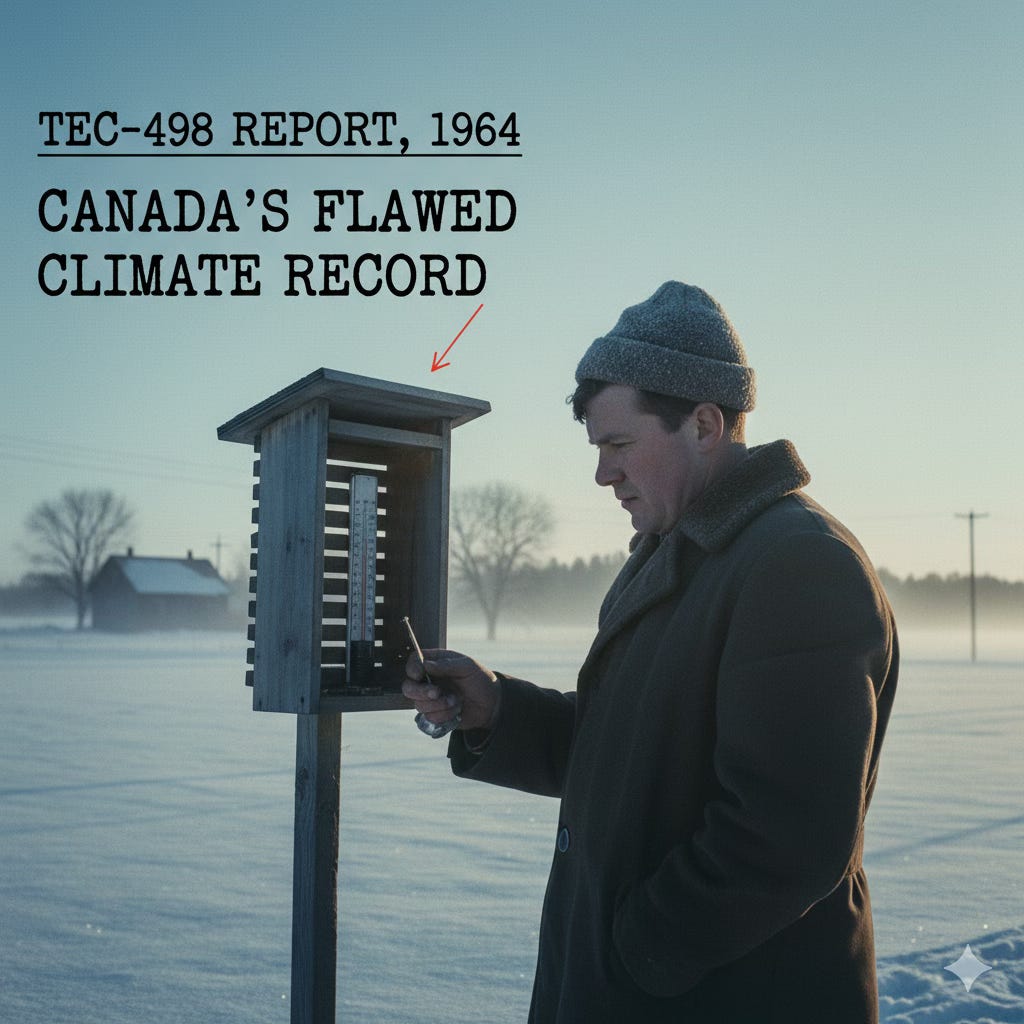
In 1964, the Department of Transport’s Meteorological Branch managed a network of approximately 2,000 cooperative weather stations. This vast network, staffed by volunteers, was the backbone of Canada’s climate tracking. But a technical circular from that year, TEC-498, revealed a fundamental flaw in the system, one that introduced “serious differences in temperature data” depending on when a volunteer looked at their thermometer. This report serves as a stark reminder that how data is collected is just as important as the data itself.
The Volunteer’s Dilemma
The core of the problem was a conflict between official procedure and human convenience.
Principal weather stations operated on a standardized “climatological day” ending at 0600 GMT. But the cooperative stations were staffed by volunteers who had to fit observations into their daily schedules.
Most volunteers who took twice-daily readings, typically around 0800 LST and 1700 LST, produced data that was largely comparable. The real issue, as the 1964 report details, came from the roughly one-third of observers who read their thermometers only once per day.
This wasn’t just a matter of taking fewer measurements. It fundamentally altered the 24-hour period being recorded, creating two distinct, systemic biases.
Two Flaws, Two Biases
The study analyzed data from ten stations across Canada, simulating what would happen if their (correct) twice-daily readings were replaced by a single daily observation. The results showed two different kinds of errors.
The Morning-Only Error
When an observer reads thermometers only in the morning, they credit the maximum temperature to the previous day and the minimum temperature to the current day.
The report found this procedure dramatically skewed the minimum temperature.
What does this actually mean? In simple terms, the thermometer was reset only in the morning. If the weather warmed up during the day, the minimum temperature recorded the next morning might be the low from 24 hours prior, not the true low for that day.
The result was a powerful cooling bias. This procedure “almost always decreased the monthly mean minimum”.
The Afternoon-Only Error
When an observer reads only in the afternoon, they credit both the maximum and minimum temperatures to the currentday.
This method fixed the minimum temperature problem but created a new one for the maximum temperature.
By resetting the maximum thermometer in the afternoon, the observer allowed a high temperature from the previousevening to “carry-over” if the weather turned cooler.
The result was a significant warming bias. The report found that with this method, “monthly mean maxima were higher in all cases”.
Measuring the Discrepancy
These were not small, rounding errors. The report shows the biases were large, predictable, and varied by season and location.
For morning-only readers, the cooling bias on minimums was most extreme during the transition and winter months (September to March).
Mean minimums were often “lower by one or more degrees” from October to March.
The data from Fredericton, N.B., showed a simulated February mean minimum that was a staggering 4.3 degrees celsius lower than the true mean.
This procedure also increased the number of bad readings. In winter, 15 or more days per month could, on average, record an incorrect minimum temperature.
For afternoon-only readers, the warming bias on maximums was a problem all year long.
At almost every station studied, the mean maximum was “increased considerably for nearly every month,” with differences greater than 1 degrees celsius occurring in ten to eleven months of the year.
The prairie stations (Vauxhall, Scott, and Morden) saw their simulated mean maximums in September increase by as much as 3.3 degrees celsius.
The report concluded that for an afternoon-only station, the probability of a maximum reading being “accurate” in winter could be as low as 35% to 50%.
The Data Brief
A 1964 Department of Transport report analyzed data (1959-1962) from ten Canadian weather stations to simulate the impact of once-daily versus twice-daily temperature readings.
The study found that the one-third of volunteer stations taking only one reading per day were introducing significant, systemic biases into Canada’s climate record.
Observations taken only in the morning “almost always decreased the monthly mean minimum,” particularly in winter, with errors as large as 4.3 degrees celsius in some months.
Observations taken only in the afternoon made “monthly mean maxima higher in all cases,” often by more than 1 degrees celsius throughout the year.
These errors are not random. They are predictable, directional biases tied directly to the specific procedures of volunteer observers.
The Bottom Line
The TEC-498 report is a case study in data integrity. It shows how a system designed for convenience, relying on volunteers fitting observations into their daily lives, risked the long-term viability of the data itself. The findings from 1964 are a crucial piece of context, reminding us that any historical analysis is only as strong as the methods used by the people who first wrote that history down.
Source Documents
Burrows, W. R. (1964). Differences in temperature data from ordinary climatological stations arising from once daily readings as compared to twice daily readings (Circular 3963, TEC-498). Department of Transport, Meteorological Branch.