


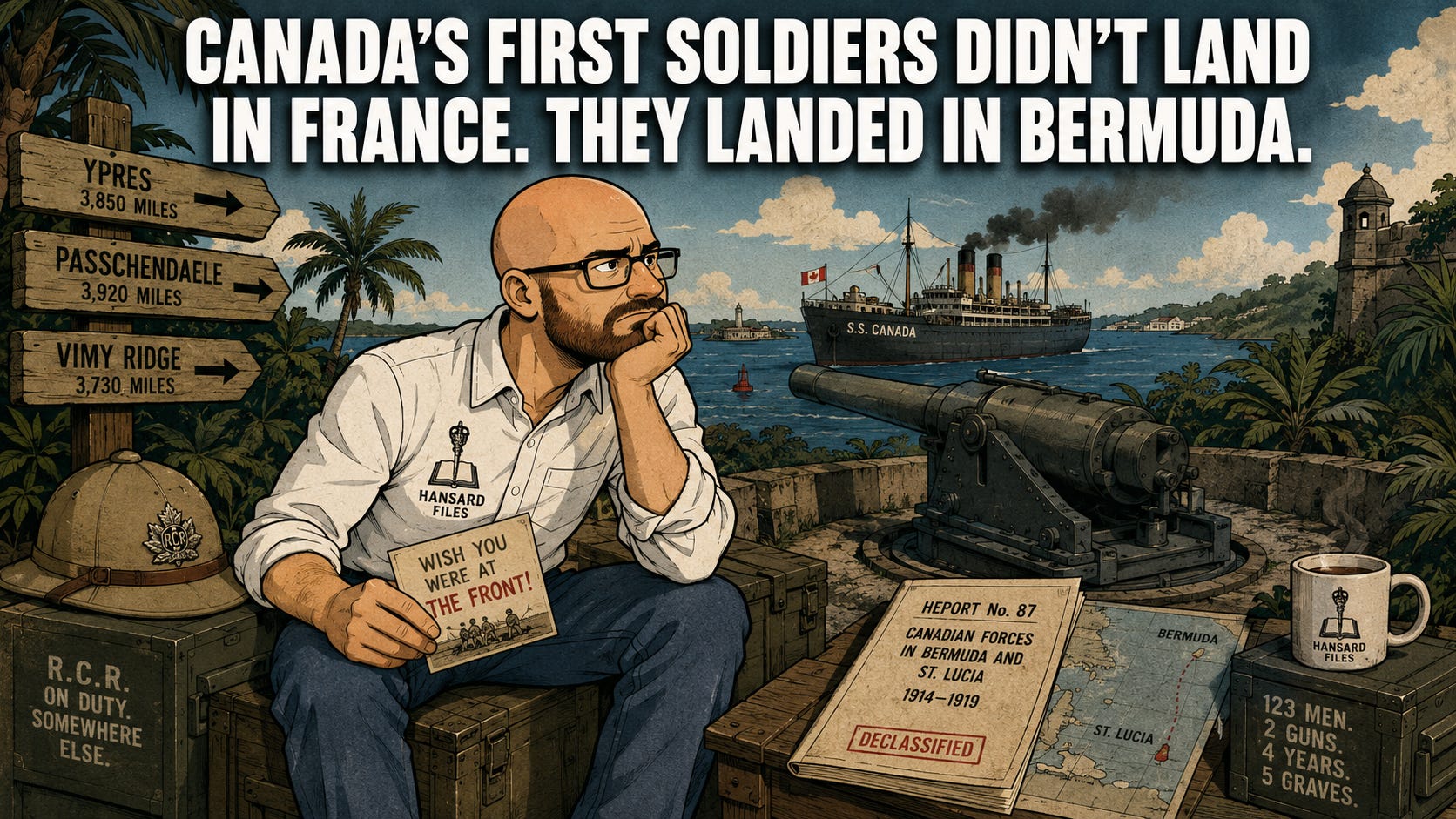
The ship left Halifax on September 11, 1914. Europe was already burning. Six weeks after the assassination in Sarajevo, the Western Front was being carved into the earth of Belgium and France, and tens of thousands of men were dying in the first frantic weeks of a war no one yet understood. Aboard the troopship Canada, escorted by H.M.C.S. Niobe, the men of the Royal Canadian Regiment watched the harbour shrink behind them. They had volunteered. They were heading overseas. They were ready.
They were headed to Bermuda.
It is one of the stranger footnotes in Canadian military history, and one of the least told. While the public story of the First World War focuses on Vimy Ridge and Passchendaele and the hundred days that broke the German Army, a quieter and more frustrated story was playing out in the Caribbean, where Canadian soldiers spent months and, in one case, years manning coastal guns and garrison posts in the tropical heat, watching the war they had signed up for proceed without them.
Report No. 87 from the Canadian Army Historical Section, compiled in 1959 by Captain J.A. Swettenham and signed by Colonel G.W.L. Nicholson, Director of the Historical Section, is a spare, precise document. Eight pages. Fourteen numbered paragraphs. But read carefully, it captures something the official battle histories don’t: the human cost of being needed somewhere other than where the fighting was.
“Evidently Someone Has Blundered”
The Royal Canadian Regiment arrived in Bermuda on September 14, 1914, replacing the 2nd Lincolnshire Regiment at Hamilton. They were, the report notes with quiet significance, “the only infantry in the Permanent Force,” and they had volunteered. The Historical Section recorded that it was hoped “such a move would in the near future be a step nearer the battlefield which was the desire of all ranks.”
It was not.
Before the garrison could even settle into its routines, a bureaucratic catastrophe surfaced. A contingent of 400 men from the Canadian Expeditionary Force had joined the battalion at Halifax, having volunteered from Valcartier camp to serve alongside the R.C.R. But when they arrived in Bermuda, it became evident these men had never been formally attested. No one had gotten their signatures. No one had completed the paperwork.
The men were now asked, in the Caribbean heat, to enlist for three years at Permanent Force rates of pay, which were lower than what CEF volunteers could expect. The men refused. The report records the Chief of the General Staff’s candid assessment of the situation: “if we give way altogether, we shall be a laughing stock; on the other hand we cannot retain the men against their will.” A second officer put it more bluntly. “The men should have been enlisted before sending them to Bermuda. Evidently someone has blundered.”
A message from Ottawa arrived ordering that anyone who refused to serve at Permanent Force rates be returned to Canada, where they could enlist in the CEF at Halifax. But the communication changed no minds. In the end, 386 men still refused. Canada was asked to charter a ship for their replacement.
The matter was eventually resolved not by negotiation but by the Privy Council, which sanctioned overseas rates of pay for all ranks of the R.C.R. from the date of embarkation. The Duke of Connaught, Governor General and Honorary Colonel of the Regiment, appears to have been useful in this resolution. With that, the mutinous paperwork crisis was quietly buried, and the battalion settled into guard duties and training.
The Waiting
By January 1915, the Commanding Officer of the R.C.R. was certifying in formal correspondence that “all ranks of the Royal Canadian Regiment have offered their services for Active Service abroad,” and requesting that the unit be sent to the front. The Chief of the General Staff supported the request. It went nowhere.
By the middle of 1915, the report notes with characteristic understatement, “there was some discontent in the unit because of continued garrison duty.”
That is a restrained way of describing what it must have felt like. These were professional soldiers. Canada’s only permanent infantry regiment. They had volunteered, survived a pay dispute, and spent months in Bermuda maintaining positions that no enemy was remotely likely to threaten, while the newspapers carried dispatches from Ypres and Neuve Chapelle and Hill 60. The Western Front was consuming men at a rate the world had never seen, and the R.C.R. was guarding Hamilton Harbour.
Relief finally came on August 12, 1915. The regiment was replaced by the 38th Battalion, C.E.F., raised in Ottawa, and the R.C.R. proceeded to England and from there to the Western Front, the battlefield that had been “the desire of all ranks” since the day they sailed.
Three Battalions, One Island
The 38th lasted less than a year. As early as February 1916, the garrison commander was reporting that the new battalion “showed excellent spirit, all ranks being anxious to get to the front,” and predicting they would be fit for active service during the first half of April. A bureaucratic consideration then intervened in Ottawa: both the R.C.R. and the 38th were English-speaking units. It was decided that a French-Canadian battalion should next garrison Bermuda.
The 57th Battalion, stationed at Quebec, volunteered but was badly under strength. The Chief of the General Staff was direct: “one thing is certain, the 57th ought not to be sent...until it is up to strength and efficient.” The 163rd Battalion, a French-speaking unit from Montreal with the required numbers, was asked instead. It accepted and took over from the 38th toward the end of May 1916.
Then, on November 27, 1916, the British re-assumed garrison duties. A battalion of the East Yorkshire Regiment arrived; the same ship that brought them took the 163rd Battalion to England, where it was broken up to reinforce French-Canadian battalions at the front. Two years of Canadian garrison duty in Bermuda, three rotating battalions, and one bureaucratic pay crisis. The island’s strategic contribution to the Allied cause was, in the terse language of the historical record, the release of a British regiment for service elsewhere.
123 Men and a Jungle
The St. Lucia deployment was quieter, stranger, and in some ways more remarkable. In April 1915, No. 6 Company of the Royal Canadian Garrison Artillery, totalling 123 all ranks, disembarked at Port Castries on the island of St. Lucia, one of the Windward Islands. They would remain there until May 1919. Four years.
The Canadians were not replacing a garrison. There wasn’t one. The two forts on either side of the harbour entrance to Port Castries had not been occupied since 1907. In the eight years since, the tropical climate had done what tropical climates do. The report is plain about what greeted the arriving artillerymen: “an almost impenetrable forest of tropical trees and vines had sprung up, so that extensive clearing was necessary before the positions could again be occupied.”
At the outbreak of war, there were no guns on the island at all. Four French 14-centimetre pieces were borrowed from Martinique, already mounted by French troops. The Canadians then mounted two British 6-inch guns brought from Bermuda between April and July 1915. That was the full armament for the remainder of the war. The men’s primary task: man these guns and wait.
Malaria complicated everything early on. The disease was prevalent in those first months. By 1918, the clearing of brush, the construction of drains, and the oiling of swamps had brought it under control. Progress measured in drainage ditches and mosquito abatement.
Gunners on the Water
The report preserves two details from St. Lucia that stop the reader cold, because they are so far outside what anyone pictures when they think of wartime artillery service.
The first involves a 70-ton steam pinnace. In the absence of naval personnel, No. 6 Company furnished an officer and crew for the S.S. Vigilant, procured from Trinidad, which arrived August 20, 1915. Their task was to board every ship entering or passing the harbour and ensure no contraband or “suspicious characters” were on board. A customs officer accompanied the army officer each time. Canadian artillerymen, running a naval inspection service, in the Caribbean, because no one else was available to do it.
The second detail is more remarkable still. From April 1917, the Vigilant and its army crew were assigned to mine sweeping. After five days of instruction from a visiting British naval officer, the entrance to Port Castries harbour was swept once a week for the remainder of the war. Canadian artillery gunners, trained on 14-centimetre coastal guns, sweeping for naval mines in the Windward Islands.
439 All Ranks, Five Graves
The average strength of the St. Lucia unit grew over time with gradual reinforcements and attached engineer, medical, and other services, reaching approximately 250 all ranks. In total, the report records, 439 all ranks saw service in St. Lucia. Five of them died of sickness.
Not enemy action. Sickness. In a posting that no one expected to be where the war was, the only casualties were the men who succumbed to the diseases of the tropics they had been sent to guard.
The Historical Section’s report, filed in October 1959 and declassified in 1972, is careful to note its own limitations. The reason for selecting the 38th Battalion to relieve the R.C.R. in Bermuda “cannot be established,” the authors concede in a footnote. All relevant files had been searched without success. There are gaps in this record, as there are in every record, the places where the paper trail simply ends and the full human story of the waiting disappears into the archive.
What survives is enough. In September 1914, Canada sent its only permanent infantry regiment to an island in the Atlantic, without properly attesting 400 of the men on the ship. In 1915, it sent 123 artillerymen to reoccupy jungle-reclaimed forts on a Caribbean island with no guns, no naval vessels, and malaria in the undergrowth. These men served, complained through the proper channels, swept harbours for mines they were not trained to find, and waited for a war that reached most of them eventually, or never reached them at all.
Canada’s first overseas soldiers in the First World War did not land in France. They landed in Bermuda. And for a long while, nobody wrote it down.
Hansard Files spends weeks in the archives so you don’t have to. If stories like this matter to you, subscribe to keep this work independent.
Source Documents
Swettenham, J.A. (Capt.), & Nicholson, G.W.L. (Col.). (1959, October 20). Report No. 87: Canadian Forces in Bermuda and St. Lucia, 1914–1919. Historical Section (G.S.), Army Headquarters, Directorate of History, National Defence Headquarters. Ottawa, Canada. [Declassified 1972, D2190-1 (SIRC) of 12 Jun 72.]
Fog of war is real.
That was a very interesting essay. When we think of WWI, we think of the action in Europe, and possibly east Africa (hello African Queen!), We rarely think of the places that had to be protected against possible invasion, even if that possibility was low.