


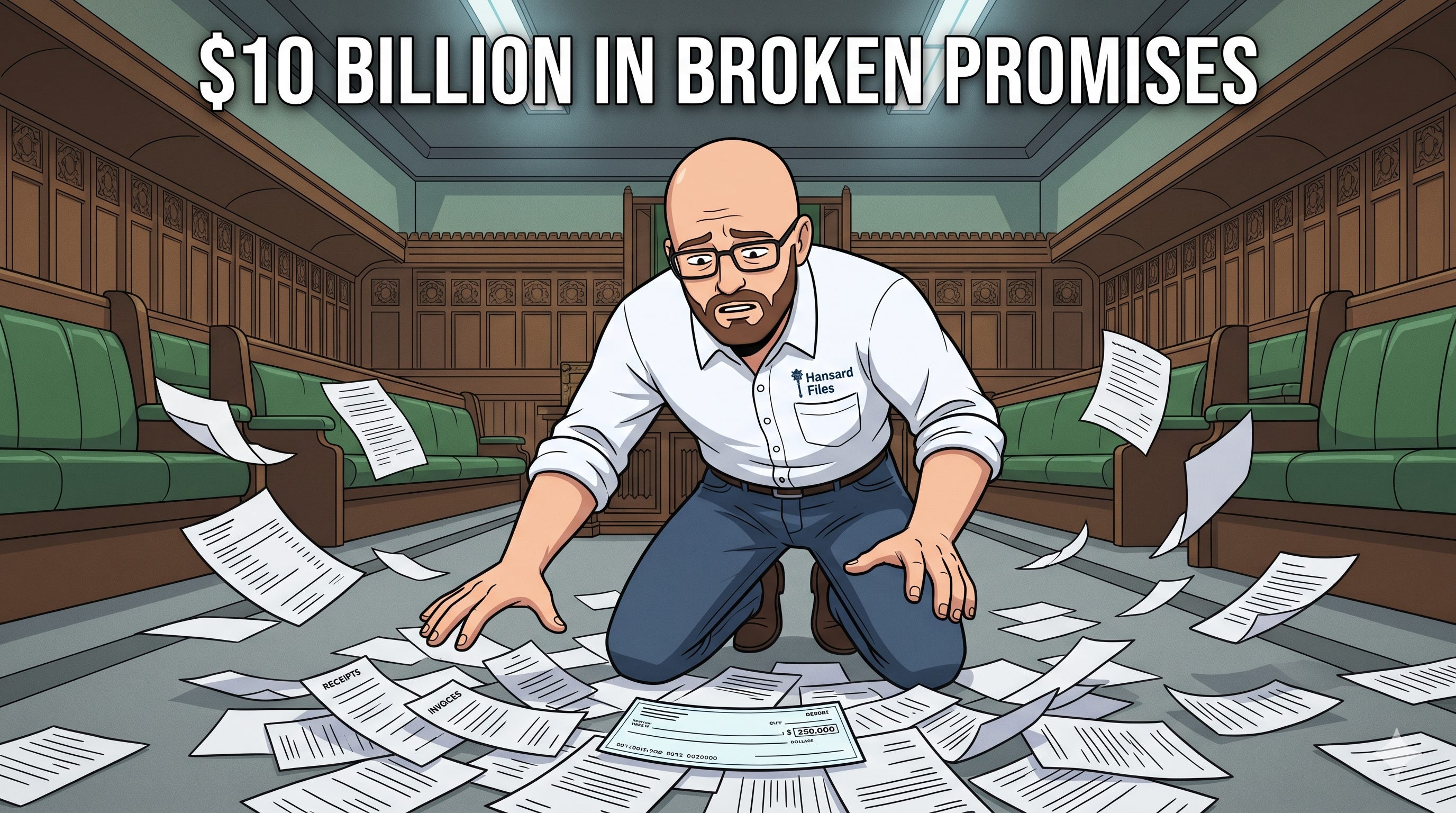
It started with a score of one out of ten.
That’s what Canada Health Infoway’s own performance review gave PrescribeIT, the e-prescribing platform that received $300 million in public funding over the better part of a decade. One out of ten. A system that, by the time it reached committee scrutiny in May 2026, had achieved a national adoption rate of less than five percent. In Quebec, the province where the need was supposedly most pressing, less than half a percent.
And yet, before the dismissal came, the man who ran it took home a $250,000 performance bonus.
Conservative MP Andréanne Larouche didn’t mince words before the Standing Committee on Health. “When you give a piece of software a score of one out of ten,” she told the committee, “you can’t say it’s a great success.”
The CEO, Michael Green, was eventually let go. Telus, the private telecommunications company, now holds roughly 85 percent of the intellectual property that Canadian taxpayers funded.
Welcome to the federal government’s software graveyard.
Three disasters, one pattern
PrescribeIT is just the newest casualty. Behind it stand two older monuments to the same failure: the Phoenix pay system and the Benefits Delivery Modernization program, known as BDM.
Phoenix launched in March 2016. It was supposed to save money by modernizing how the government paid its 290,000 employees. Within two years, it had created pay problems for close to 80 percent of the federal public service. People were overpaid, underpaid, and sometimes not paid at all. A decade later, the Standing Committee on Public Accounts heard from Arianne Reza, Deputy Minister of Public Services and Procurement Canada, that 88,000 cases more than a year old still sit unresolved. The total cost of the disaster, by any conservative accounting, has reached $4.2 billion.
The BDM program, designed to modernize the systems delivering Old Age Security, Employment Insurance, and the Canada Pension Plan, may ultimately cost more. The Cúram software platform that powers it was originally budgeted at $1.6 billion. The current estimate is $6.6 billion. That’s a $5 billion overrun on a system the Auditor General hasn’t finished reviewing yet; a full audit isn’t expected until 2027.
While committees debated, 86,000 seniors missed benefit payments they were owed.
Eric Lefebvre, a Conservative member of the Standing Committee on Human Resources, framed it plainly: “We’re talking about $5 billion in cost overruns. What’s irresponsible is to not shed light on the biggest financial scandal in the history of the country.”
The bonus that stopped the room
Of the three disasters, PrescribeIT generated the most visceral committee reaction, partly because of the scale of the public investment, and partly because of what happened immediately before the dismissal.
Michael Green had led Canada Health Infoway for years. The organization received federal funding to build a national digital health infrastructure. PrescribeIT was its flagship. When the program’s own internal review rated the software one out of ten, the board had a decision to make. They awarded Green $250,000.
He was dismissed shortly afterward.
Committee members demanded answers about what governance structure permitted a performance bonus against a one-out-of-ten rating. They also wanted to know about the intellectual property. When the federal government invests $300 million in building a platform, it is reasonable to expect the government to own what it built. Instead, TELUS holds 85 percent of the IP. The committee heard no satisfying explanation for how that arrangement came to be.
For context: PrescribeIT was supposed to reduce medication errors, cut pharmacy wait times, and streamline prescriptions across provinces. The five percent national adoption rate means it has done almost none of that at scale.
Learning from Phoenix, slowly
The Cúram situation is still developing, and so is the government’s response to Phoenix. Reza told the public accounts committee that the transition from Phoenix to a new platform called Dayforce is underway, and this time, the approach is different.
“We are taking one step at a time,” she said, “rather than doing what we did in the past with Phoenix: deploying the software across the entire government all at once.”
The new model uses what officials call a “vanguard” approach. A small number of departments transition first, problems get identified, corrections get made, and only then does the migration expand. It’s a sensible plan. It is also, by any measure, a plan that was obviously correct in 2016 and simply wasn’t followed.
The Office of the Auditor General first flagged the need to replace legacy benefit-delivery platforms back in 2010. Canada spent sixteen years preparing to act, then launched a pay system that cost $4.2 billion to fail. The BDM overrun is $5 billion and counting. PrescribeIT cost $300 million for adoption rates a parking garage would find embarrassing.
The running total across these three programs, conservatively, exceeds $10 billion.
What the committee rooms revealed
What emerged from weeks of hearings wasn’t just a story about software. It was a story about accountability gaps that compound with each iteration.
In the BDM case, opposition members spent committee time trying to compel the production of internal documents related to the Cúram overruns. The government side filibustered. The documents, as of the hearings, had not been fully produced. The OAG audit that would bring formal scrutiny to the full picture isn’t due until 2027.
In the PrescribeIT case, committee members asked pointed questions about the board’s decision-making, the IP agreement with Telus, and the performance bonus. The answers were incomplete.
In the Phoenix case, the backlog number of 88,000 open cases older than a year is considered progress. At peak, the system’s failure affected close to 230,000 employees. Progress is real. It is also, ten years in, devastatingly slow.
Across all three cases, the same structural problems appear: inadequate testing before deployment, insufficient oversight of vendor relationships, governance that permitted private companies to accumulate IP rights over publicly funded tools, and accountability mechanisms that consistently lagged behind the failures they were meant to catch.
The fourth attempt
Dayforce is now the government’s bet. If it works, it becomes the template. If it doesn’t, the pattern continues.
What’s different this time, officials say, is the phased approach, the vanguard model, and the explicit institutional memory of what Phoenix got wrong. Reza acknowledged the lessons directly. The committee didn’t push back hard on the plan itself. What members pressed on was whether the institutional will exists to actually follow through on the caution that everyone, in retrospect, agrees was missing in 2016.
That’s not a question the hearings answered.
What the hearings did establish is a clearer picture of the cumulative cost. Ten billion dollars, at minimum. Eighty-eight thousand backlogged pay files. Eighty-six thousand seniors who didn’t receive benefits on time. A platform rated one in ten, with a $250,000 bonus attached to the departure of the man who ran it. And a private telecommunications company holding most of the intellectual property a government built with public money.
Somewhere in all of that is the question worth sitting with. Not just how this happened, but who decided it was acceptable to let it happen again, and again, and again. The committees are asking. The Auditor General is coming. The answers, when they arrive, will belong to all of us.
Hansard Files spends weeks in the archives so you don’t have to. If stories like this matter to you, subscribe to keep this work independent.
Source documents
Canada. Parliament. House of Commons. Standing Committee on Public Accounts. (2026, May). Evidence. [XC16-1-2-451-38]
Canada. Parliament. House of Commons. Standing Committee on Health. (2026, May). Evidence. [XC62-1-2-451-33]
Canada. Parliament. House of Commons. Standing Committee on Human Resources, Skills and Social Development and the Status of Persons with Disabilities. (2026, May). Evidence. [XC67-1-2-451-34; XC67-1-2-451-36]
Have you ever read (or read about) the book, "The Phoenix Project: A Novel About IT, DevOps, and Helping Your Business Win"
Yes, it predates when the Phoenix payment system started, and there are rumours that the consultants involved used that name deliberately to reference that book.
What the Government has been asking for is wrong, and the technology providers that the politicians demand government agencies outsource to know that if they try to educate the government on the source of the flaws then they won't get hired for any projects.
The problem isn't the bureaucracy, but politicians who are ideologically tied to the idea of outsourcing to the private sector projects that should be handled internally using an entirely different model of IT infrastructure than political elites want to push.
I know the blame is always shifted away from the politicians and their ideological blinders, but that is where we need to be looking.
(I'm writing this as someone who tried to alert politicians on many areas of technology policy, only to constantly be reminded that misinformed politicians can't tell science from science fiction).
This barely scratches the surface. The GoC is an endless graveyard of failed IT projects - those that went way over budget, or failed to deliver the benefits that were promised, or never even made it to production.