



You probably interact with the Government of Canada more often than you think. If you have ever applied for a passport, received Employment Insurance, or contributed to the Canada Pension Plan, you have engaged with a massive system designed to support Canadians. This system, primarily run by Employment and Social Development Canada, operates on a scale that is difficult to comprehend, managing hundreds of billions of dollars and delivering services that millions of people depend on throughout their lives.
Behind the scenes, this essential social safety net is under immense pressure. It faces challenges from decades-old technology, shifting global economic winds, and persistent inequalities here at home. A look inside the government’s own briefing materials reveals a complex picture of a country navigating significant uncertainty.
The numbers tell a story about the Canada you live in today and the one your children might inherit. They show where we are succeeding and, more importantly, where the hidden cracks are forming. Understanding these challenges is the first step toward addressing them and building a more resilient future.
The Government's Social Programs Spend 6 Percent of the Entire Economy
When you think about the Canadian economy, you might think of industries like banking, oil and gas, or manufacturing. You should also think about your social safety net. In the 2023-2024 fiscal year, Employment and Social Development Canada spent $184.2 billion on its programs and services. To put that number in perspective, it represents about 6 percent of Canada's entire Gross Domestic Product.
An overwhelming majority of this money, 95.5 percent, went directly to Canadians through transfer payments. This includes foundational programs you know well:
Old Age Security (OAS): $76.1 billion
Canada Pension Plan (CPP): $60.8 billion
Employment Insurance (EI): $23.5 billion
This spending is not an abstract economic figure. It is the financial support that helps you through job loss, ensures income in retirement, and supports families raising children. The sheer scale of this operation shows how deeply government programs are integrated into the financial wellbeing of millions of Canadians.
Your Benefits Run on 60-Year-Old Technology
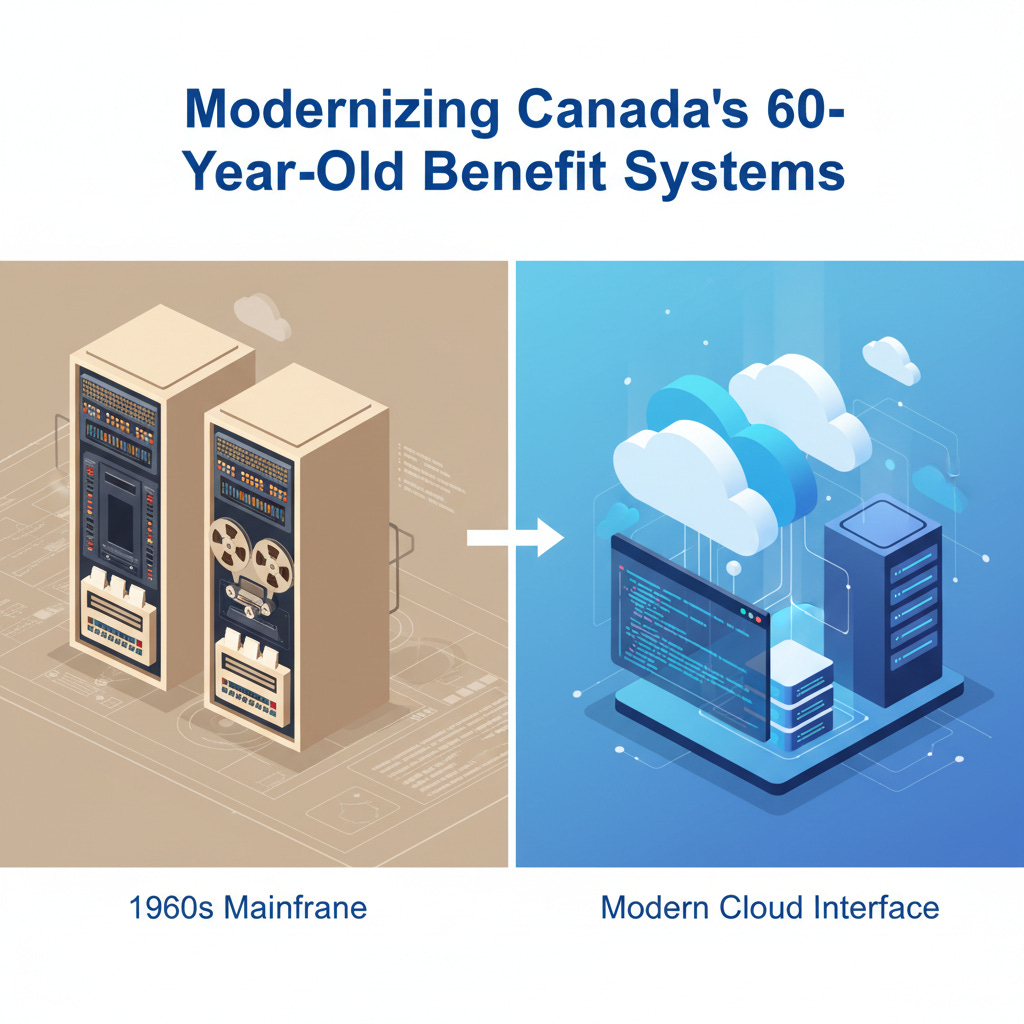
The systems that deliver your Old Age Security, Employment Insurance, and Canada Pension Plan are relics of a different era. The information technology systems for these core programs are 60, 50, and 20 years old, respectively. These outdated systems are complex, fragmented, and rely on old programming languages, which makes them prone to errors, fraud, and poor user experiences. The government records more than 400 system outages per year.
To make matters worse, these aging systems face a constant modern threat. In the 2023-2024 fiscal year alone, 6.6 billion malicious actions were blocked every day across Government of Canada networks.
The government has begun a massive, multi-year overhaul called the Benefits Delivery Modernization program. This project aims to move all these services onto a single, modern platform. The first phase, moving Old Age Security onto the new system, began in April 2025. The full project, which is expected to cost $6.6 billion over its lifetime, will not be complete until 2030. Until then, the government must continue to operate and maintain the legacy systems to ensure Canadians keep receiving their benefits without interruption.
Canada's Productivity Gap With the U.S. Is Turning into a Chasm
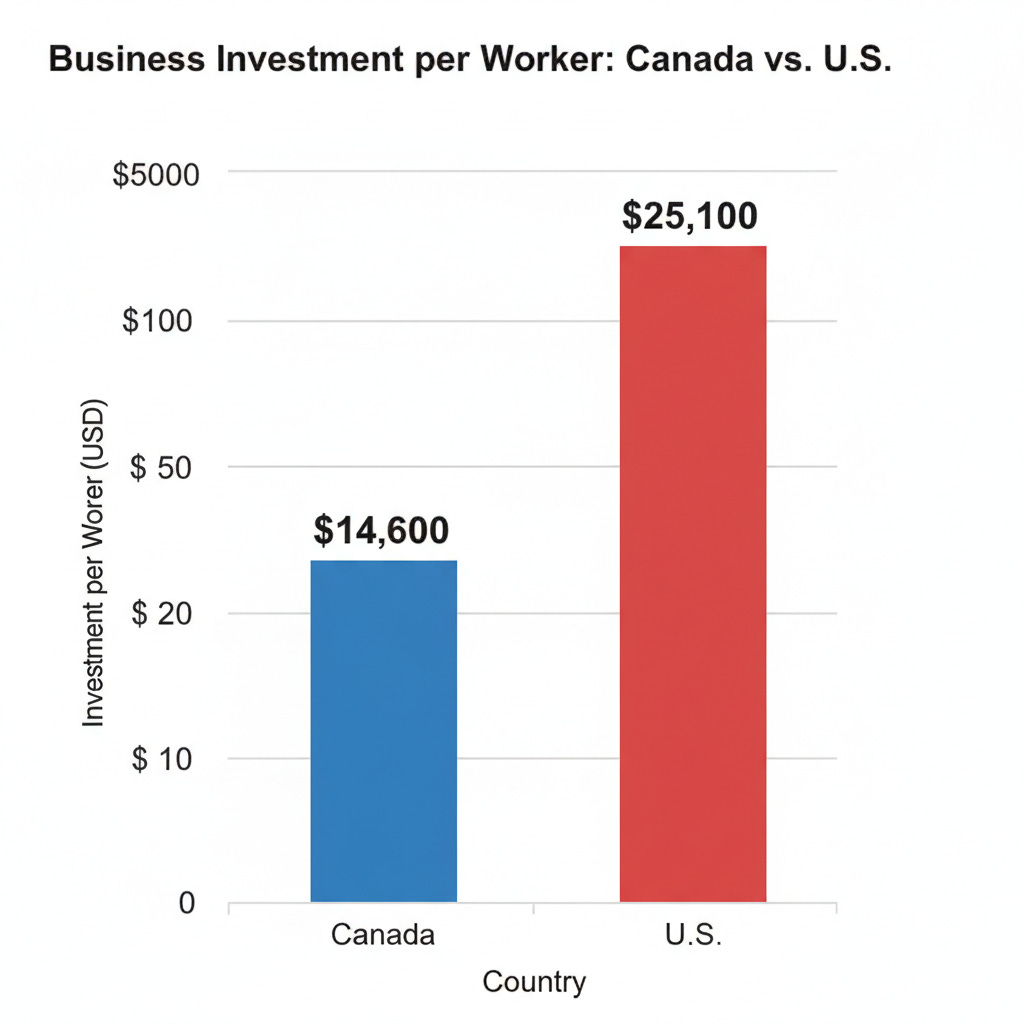
Canada's economic engine is lagging. A key measure of economic health is labour productivity, or the value produced per hour of work. While Canada and the United States had similar productivity growth from 1971 to 2000, a significant gap has opened since then. In 2000, Canada's annual labour productivity was 81.4 percent of the U.S. level. By 2023, it had fallen to just 67.7 percent.
A major reason for this is a severe lack of business investment. The tools, technology, and equipment that make workers more efficient are not being funded in Canada at the same rate as in the U.S.
In 2023, real business investment per worker in Canada was just $14,600.
In the U.S., it was $25,100, a difference of $10,500 for every worker.
This investment gap has more than doubled since 2015. Without competitive investment in new technology and equipment, Canadian businesses and workers will struggle to keep pace, which directly affects wages, economic growth, and the country's overall standard of living.
A Shocking Number of Single Canadians Live in Poverty
While government programs have successfully reduced poverty among some groups, others face extreme economic hardship. In 2023, seniors had the lowest poverty rate of any group at just 5.0 percent, a success story largely due to the public pensions they receive. At the other end of the spectrum, unattached individuals, or people not in an economic family, had a poverty rate of 25.7 percent.
This means more than one in four single Canadians live in poverty. This vulnerability is especially acute for those who are of working age but find themselves unemployed or in precarious work. In 2022, 47 percent of working-age Canadians living in poverty were employed, showing that a job is not always a guaranteed path out of financial hardship.
Income inequality is also growing. From 2019 to 2024, the highest-income households saw their annual disposable income increase by an average of $47,829. For households in the lowest income quintile, the average increase was just $4,877. This widening gap makes it harder for those at the bottom to achieve financial stability and upward social mobility.
U.S. Tariffs Pose a Serious Threat to the Economy
Global trade uncertainty, especially from the United States, presents a significant risk to Canada's economy. In 2025, the U.S. government imposed a series of tariffs on trading partners, including Canada, and the future of these measures is unknown. This is not a distant problem. In 2024, 8.8 percent of all Canadian workers were employed in industries that rely on U.S. demand for their exports.
The Bank of Canada has outlined two possible scenarios based on this trade uncertainty:
Scenario 1: Most tariffs are negotiated away, but uncertainty remains. This would cause Gross Domestic Product to stall briefly in 2025 before growing moderately.
Scenario 2: Additional U.S. tariffs trigger a long-lasting global trade war. This would cause Canada’s Gross Domestic Product to contract for four straight quarters, with the economy shrinking before a slow recovery in 2026.
The manufacturing sector is particularly vulnerable. Nearly 40 percent of its jobs rely on U.S. demand. In automotive manufacturing, that figure climbs to over 68 percent. The outcome of these trade disputes will have a direct impact on Canadian jobs and economic stability.
The data reveals a country at a crossroads. While Canada's social safety net provides critical support to millions, it is built on aging foundations and faces a barrage of modern challenges. From the productivity gap with our largest trading partner to inequalities at home, the pressures are mounting. As the government works to modernize its services and navigate global uncertainty, the key question remains: will these efforts be enough to maintain the quality of life that Canadians have come to expect?
Sources:
Government of Canada. (2025, September). Briefing materials for the Minister of Jobs and Families, May 2025. Employment and Social Development Canada.