


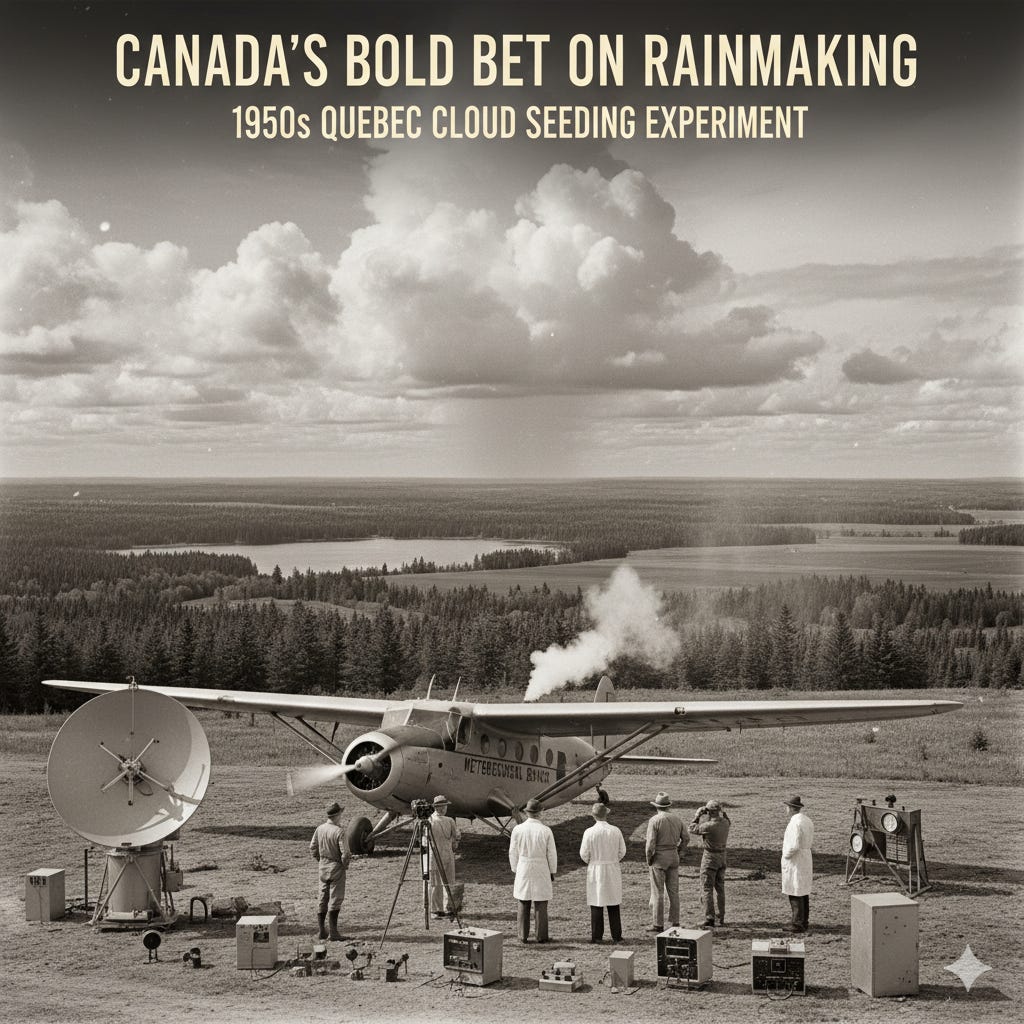
In the late 1950s, as droughts parched Canadian farms and forests, scientists dreamed of coaxing more rain from the sky. A government-led project in Quebec’s wilds fired silver iodide into storms to see if it could boost rainfall. What started as a hopeful hunch became a five-year push for hard facts on weather’s inner workings.
Project Roots and Goals
This effort grew from post-war buzz around weather tweaks. Back in 1946, lab tests with dry ice sparked global trials. Silver iodide soon stood out as a top pick for nudging clouds toward rain. But doubts lingered: Does it work in real storms? And how exactly?
The Precipitation Physics Project kicked off in 1959. It blended two pushes. First, dig into rain’s core processes—like how ice crystals form and grow in clouds. Second, run a fair test on seeding big weather fronts that dump much of Canada’s rain. These fronts roll across the land, often soaking flat Quebec terrain.
Why Quebec? Flat land made rain tallies easier. Plus, groups like pulp and paper firms wanted more water for mills and woods. The Meteorological Branch led, with help from the National Research Council, Forestry Department, and Ontario Lands and Forests. They met in 1958 after industry asked about ground generators. The result: A shared plan to chase truths, not quick fixes.
What does this mean for you? It shows early government steps to blend science with real needs, like steady water for jobs and crops.
Dual Design: Seeding Meets Science
The setup was clever. It tested seeding while probing clouds. For seeding, they used a crossover method with two zones, say Area A and B. On random days, seed A but not B. Next time, flip it. This curbs bias from wind or luck. An all-weather plane zipped silver iodide into storms at the right height and spot.
At the same time, they tracked cloud guts. The plane gauged pressure, heat, water loads, droplet sizes, even turbulence and ice buildup. Cameras snapped cloud shots. In the last year, they added ice nucleus counters to spot natural vs. added starters.
On ground, a thick web of rain gauges dotted each zone. Central spots logged wind, wet, sun. Radar scanned storms from afar. They tallied lightning flashes and ice nuclei too. All this fed a big picture: How do clouds birth rain? Does seeding shift the odds?
How did this play out? It aimed for stats that hold up. Five years to spot seeding gains, or decide if more time was needed. Cloud probes? An ongoing hunt for patterns in nature’s chaos.
Hurdles and Tweaks in Action
Tests like this face traps. Does the silver hit the sweet cloud spot? Does drift taint the no-seed zone? Picking matched areas matters too. The team knew: Skip these, and results flop.
They built in fixes. Random picks cut guesswork. Plane paths ensured clean delivery. Flat land helped gauge spread. Early runs taught tweaks—like better tools for droplet counts or nucleus grabs.
By 1963, data piled up: Flight logs of water paths, ground tallies of downpours. No big wins yet, but clues on ice vs. droplet clashes emerged. Debates raged: Does silver spark ice straight from vapor? Or freeze droplets on touch? Nature leans to the freeze path, they noted.
For Canadians, this underscores patience in science. Quick hype fades; steady digs build trust.
The Data Brief
Core Aim: Unpack rain’s physics while testing if silver iodide boosts storm rain by 10-20% in seeded zones.
Key Method: Randomized seeding of Quebec fronts via plane; crossover zones for fair compares.
Top Tools: Airborne droplet sizers, water meters; ground rain nets, radar, lightning counts.
Big Insight: Silver likely aids ice crystal growth where nature skimps on starters—key for cold clouds.
Implication: If proven, it could ease water woes for farms, forests; but needs more years for solid stats.
Your Takeaway: Government science here prioritized facts over flash, blending probes with policy hopes.
Conclusion
This Quebec quest reminds us: Weather bends to no easy will, but shared smarts can map its maze. In chasing rain’s riddles, Canada sowed seeds not just for clouds, but for a future where facts guide the forecast.
Source Documents
Holland, J. D., & Crozier, C. L. (1965). *Design and operation: Precipitation physics project* (Report No. TEC-588). Department of Transport, Meteorological Branch.