


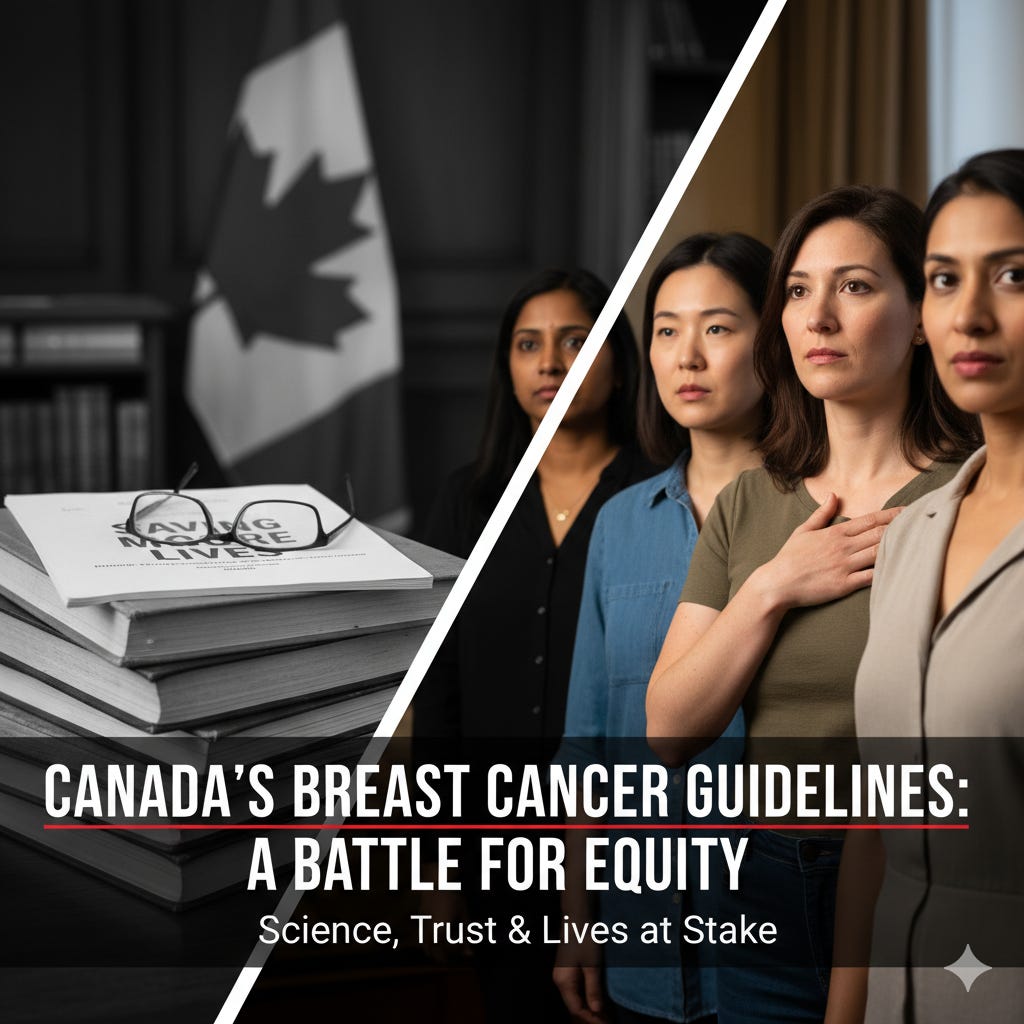
In December 2024, the House of Commons Standing Committee on Health released a report titled, “Saving More Lives.” It’s not just another government document; it’s a direct response to a simmering and now boiling national debate over when and how Canadian women should be screened for breast cancer. At the heart of the issue is a stark disagreement with the national guidelines developed by the Canadian Task Force on Preventive Health Care (Task Force), which continues to recommend against routine screening for women in their 40s. This report pulls back the curtain on the controversy, revealing significant concerns from doctors, scientists, and patients who argue the current guidance is outdated, inequitable, and potentially costing lives.
The Core of the Controversy
The central conflict revolves around the Task Force’s 2024 draft recommendations. Despite a rising incidence of breast cancer in women under 50 and moves by several provinces and the United States to lower the screening age to 40, the Task Force held its ground. It suggests against systematic screening for women aged 40 to 49, citing “very low certainty” evidence.
This position has been met with sharp criticism. The parliamentary committee heard from a wide range of stakeholders, including the Canadian Cancer Society and Dense Breasts Canada, who argue the recommendation is founded on outdated evidence. They believe the Task Force underestimates the life-saving benefits of early detection while overstating potential harms like overdiagnosis and the anxiety of recalls for further testing. The report frames this not just as a scientific disagreement, but as a critical public health issue that creates a patchwork of care across the country, where your access to screening depends on your postal code.
A Battle Over Evidence
At the root of the debate is a fundamental disagreement about what evidence should guide national policy. Critics argue the Task Force gives too much weight to randomized controlled trials (RCTs) from 40 to 60 years ago, which used obsolete technology like film mammography. The Committee heard testimony that experts advised against including these old trials, but the Task Force “dictated” their inclusion.
Old Trials vs. New Realities
The report highlights that newer, observational studies show a much greater reduction in breast cancer mortality—around 53% compared to the 15-20% found in the older RCTs. Critics feel the Task Force prioritizes the flawed, older studies over more current data that better reflects modern technology and treatments.
Furthermore, the report questions the interpretation of benefits and harms. The Task Force’s communication tools present risk in absolute numbers, which can minimize the perceived benefit. For example, stating screening saves “1 death for every 1,000 women” sounds less impactful than a “50% relative reduction in mortality.” Witnesses pointed out that this framing ignores other crucial benefits of early detection, such as less aggressive, less costly treatments and improved quality of life.
Equity and the “One-Size-Fits-All” Problem
A major theme in the report is the failure of the current guidelines to address the diverse needs of Canada’s population. The Committee heard that a one-size-fits-all approach is failing many women, particularly those from racialized communities.
Evidence presented shows that, compared to white women, racialized women are more likely to develop breast cancer at a younger age. Black women, for instance, are 40% more likely to die from breast cancer. The older trials the Task Force relies on were overwhelmingly composed of white participants, raising serious questions about whether the findings are applicable, beneficial, or safe for everyone in today’s Canada. Dr. Shiela Appavoo, Chair of the Coalition for Responsible Healthcare Guidelines, described this disregard for racial imbalances in research as a form of “systemic racism.”
The guidelines also fall short for women with dense breasts. Having dense breast tissue increases cancer risk and makes it harder to detect on a mammogram. Despite this, the Task Force advises against supplemental screening with ultrasound or MRI for these women, citing a lack of evidence—a position that advocacy groups and experts strongly contest.
Reforming the Task Force
The criticism extends beyond the breast cancer guidelines to the Task Force itself. The report details concerns about a lack of transparency, accountability, and timeliness in its processes. Witnesses described an opaque body with no requirement to monitor the impact of its guidelines and no clear structure for oversight.
Key issues raised include:
Lack of Expert Input: The Task Force is composed of primary care and prevention experts, not breast cancer specialists. While content experts are consulted, they do not get to vote on recommendations and must sign confidentiality agreements.
Perceived Bias: Some witnesses alleged the Task Force has a bias against screening, noting that its leadership had publicly stated the guideline needed no change even before the evidence review began.
Slow Updates: Guidelines are updated roughly every seven years, a pace that critics say fails to keep up with rapid advances in cancer detection and treatment.
In response to these deep-seated problems, the Committee’s primary recommendation is a call to action: that the Government of Canada work to rebuild the Task Force with a new structure emphasizing governance, transparency, and content-expert leadership.
The Data Brief
Core Recommendation: The Canadian Task Force on Preventive Health Care continues to recommend against routine breast cancer screening for women aged 40-49.
Rising Incidence: Evidence shows a rising incidence of breast cancer in Canadian women in their 20s, 30s, and 40s.
Racial Disparities: Compared to white women, women from other racial and ethnic groups are more likely to develop breast cancer at a younger age. Black women are 40% more likely to die from the disease.
The Evidence Debate: Critics argue the Task Force relies on 40-60-year-old studies using obsolete technology, while newer observational studies show a far greater mortality reduction from screening.
Committee’s Stance: The Standing Committee on Health has urged the Task Force to reverse its decision, lower the screening age, and undergo a fundamental structural reform to improve accountability and transparency.
Key Demands: The report issues 13 recommendations, including accelerating an external review of the Task Force, improving disaggregated data collection (by race, ethnicity, and breast density), funding high-risk screening programs, and increasing Canada Health Transfer payments to provinces to enhance screening capacity.
Precaution vs. Proaction: The Battle Over Canada’s Health Guidelines
The debate over breast cancer screening guidelines is more than a dispute over statistics; it’s a profound clash between two philosophies of public health. One prioritizes a rigid, methodical adherence to a narrow definition of high-quality evidence, even if that evidence is decades old. The other champions an adaptive, equitable approach that responds to new data, evolving technology, and the diverse realities of the population it serves. The Standing Committee’s report makes it clear that for many experts and patients, the current system’s caution has tipped into a failure of action. True prevention is not just about avoiding harm from screening, but about proactively seizing every reasonable opportunity to save a life.
Source Documents
Standing Committee on Health. (2024, December). Saving More Lives: Improving Guidance, Increasing Access and Achieving Better Outcomes in Breast Cancer Screening. House of Commons.