


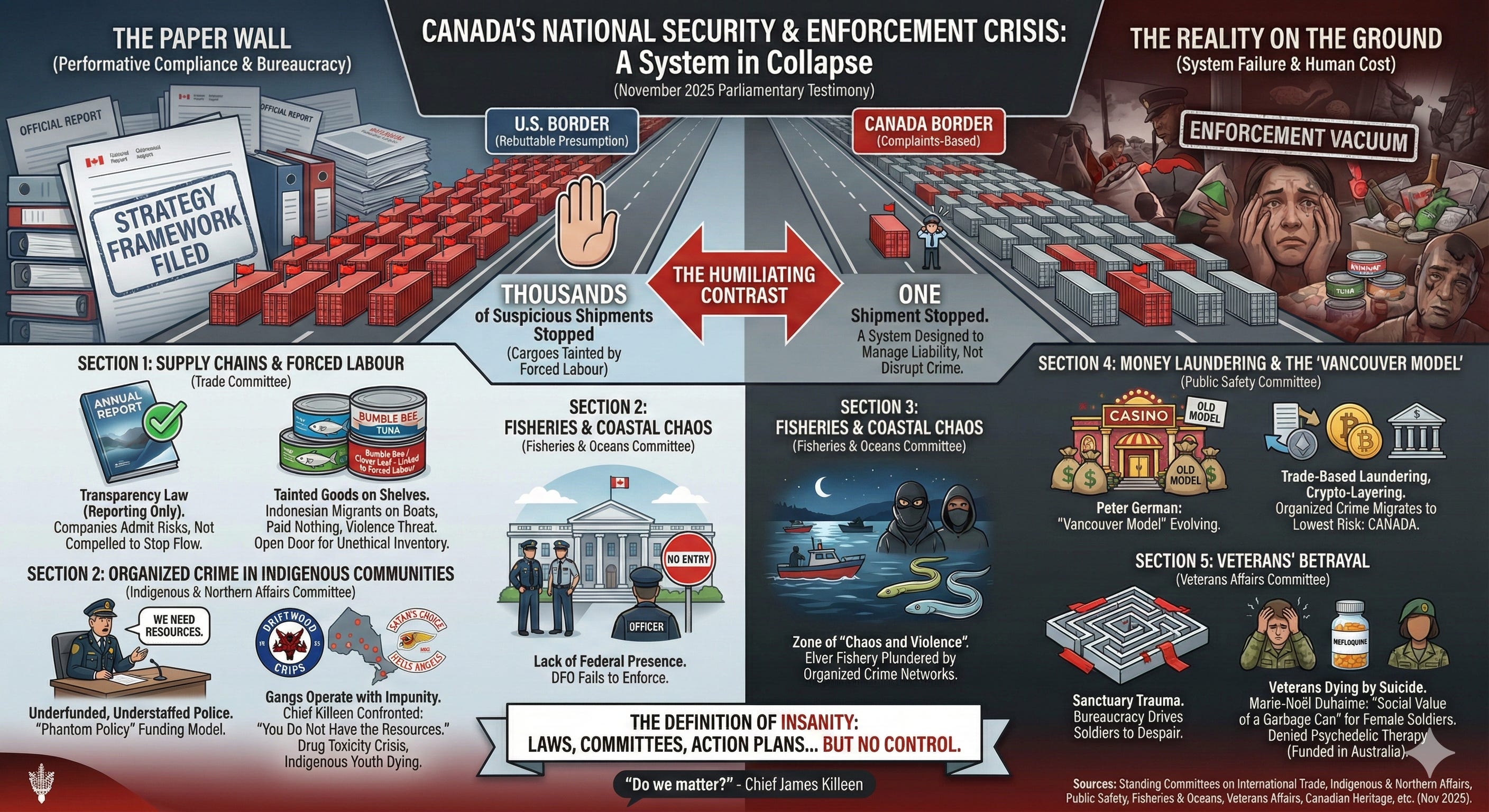
On the afternoon of November 20, 2025, inside the climate-controlled corridors of Parliament’s West Block, a statistic was read into the record that should have stopped the nation cold. The Standing Committee on International Trade was in session, dissecting the failure of Canada’s supply chain legislation, when the numbers were laid bare. Since the introduction of the new forced labour import ban, the United States Customs and Border Protection had stopped thousands of suspicious shipments—cargoes tainted by the misery of modern slavery.
Canada, by contrast, had stopped one.
Not one thousand. One.
This single, solitary interception is the perfect metaphor for a national crisis that played out across half a dozen committee rooms that week. While the trade committee heard how goods made by enslaved workers flow unimpeded into Canadian ports, the indigenous affairs committee listened to police chiefs describe how the “Driftwood Crips” and “Satan’s Choice” motorcycle gangs have set up unchecked operations in their communities. While public safety officials discussed the “Vancouver Model” of money laundering, veterans testified about a bureaucracy so broken it drives soldiers to suicide.
Taken together, the transcripts of these meetings paint a harrowing picture of a G7 nation that has effectively lost control of its perimeter, its economy, and its duty of care. It is a portrait of a state that excels at producing paperwork—strategies, frameworks, and reports—while the actual machinery of enforcement rusts into obsolescence.
The Paper Wall
The testimony before the trade committee was a masterclass in the difference between performative compliance and actual enforcement. Aidan Gilchrist-Blackwood of the Canadian Network on Corporate Accountability described the Fighting Against Forced Labour and Child Labour in Supply Chains Act as a transparency law, not a prevention law. It requires companies to file glossy annual reports admitting that risks exist, but it does not compel them to stop the flow of tainted goods. It is a system designed to manage liability, not to disrupt crime.
Stuart Trew of the Canadian Centre for Policy Alternatives connected the dots to the grocery aisle. He pointed to Bumble Bee Seafoods, a brand linked to Canada’s Clover Leaf, noting that their supply chains have been tied to fleets using forced labour—Indonesian migrants trapped on boats, paid nothing, working under the threat of violence. These cans sit on Canadian shelves today, imported legally because the law demands a report, not a clean conscience.
The contrast with the Americans is humiliating. The U.S. operates under a “rebuttable presumption” for goods from high-risk zones: prove it isn’t slavery, or we seize it. Canada operates on a “complaints-based” system that places the burden of proof on under-resourced border agents. The result is an open door. As witness Elizabeth Kwan put it, relying on a single employee to stop a shipment based on a hunch is a “ridiculous burden.” Without a mandatory due diligence law—one that forces companies to prove their supply chains are clean before goods cross the border—Canada has become the dumping ground for the world’s unethical inventory.
The Gangs of Manitoulin
If the trade committee exposed the economic cost of an open border, the Standing Committee on Indigenous and Northern Affairs exposed the human cost. On November 19, a delegation of indigenous police chiefs walked into the committee room to beg for the resources to fight a war they are currently losing.
Chief James Killeen of the United Chiefs and Councils of Manitoulin Anishnaabe Police Service did not mince words. He told the committee about a confrontation he had with a gang member in his own community. When asked why he was there, the gangster replied boldly: “I’ve been here for years. You didn’t know about me. I will continue to come here. You do not have the resources to be able to concentrate on me.”
This is not a theoretical threat. Killeen rattled off the names of the organizations operating with impunity in Northern Ontario: the Chester Le gang, the Driftwood Crips, the Five Point Generalz, the Hells Angels, the Outlaws, and the newly re-formed Satan’s Choice. These are sophisticated, transnational criminal organizations that have identified First Nations territories as soft targets—jurisdictions where the police are underfunded, understaffed, and legally hamstrung.
Chief Jeff Skye of the Anishinabek Police Service described a reality that would be unacceptable in any major Canadian city. His officers operate out of detachments that lack basic locker rooms. They have holding cells constructed of drywall—a material a determined detainee can punch through. They are fighting sophisticated organized crime with infrastructure that wouldn’t pass code for a suburban garage.
The “First Nations and Inuit Policing Program,” launched in 1991, was supposed to ensure equitable policing. Instead, Kai Liu of the Indigenous Police Chiefs of Ontario described it as a “phantom policy”—a set of discriminatory terms and conditions that the Auditor General has slammed for decades. The federal government has been dragged to court, lost human rights tribunals, and been ordered by the Supreme Court to fix the funding model. Yet, the chiefs testified that new, restrictive rules are set to be imposed in 2026, rules that would block them from carrying over unspent funds or accessing legal advice.
While Ottawa tinkers with funding formulas, the bodies pile up. The drug toxicity crisis, fuelled by the fentanyl and opioids brought in by these gangs, is killing indigenous youth at a catastrophic rate. “It is killing our people,” Chief Skye said, his voice heavy with the weight of thirty-four years in policing. “We simply do not have the resources... to tackle this crisis.”
Blood in the Water
The collapse of enforcement is not limited to the land. At the Standing Committee on Fisheries and Oceans, the testimony was equally dire. On the coasts, the lack of federal presence has created a vacuum filled by organized crime.
Witnesses described the elver (baby eel) fishery in the Maritimes as a zone of “chaos and violence.” Organized criminal networks have moved in, exploiting the high value of the catch and the low risk of arrest. Colin Sproul of the Unified Fisheries Conservation Alliance testified that despite years of warnings, the Department of Fisheries and Oceans has failed to enforce the law, leading to a situation where legitimate harvesters are threatened and the resource is plundered.
The connection between these disparate committees is the growing sophistication of the criminal element and the paralysis of the state. Peter German, a former RCMP deputy commissioner, appeared before the Public Safety committee to discuss money laundering. He described how the “Vancouver Model” has evolved. It is no longer just bags of cash in casinos; it is trade-based money laundering, crypto-layering, and the use of shell companies to scrub dirty money clean.
German warned that organized crime will always migrate to where the risk is lowest. Right now, that destination is Canada. Whether it is the export of stolen vehicles, the import of slave-made goods, or the trafficking of fentanyl, the criminal calculus is simple: the profits are massive, and the Canadian state is too slow, too fragmented, and too polite to stop you.
The Soul of the Soldier
Perhaps the most devastating indictment of the government’s failure to manage its responsibilities came from the Standing Committee on Veterans Affairs. Here, the subject was not crime, but the state’s abandonment of its own defenders.
Gordon Hurley, a retired special forces operator, described the moment he cut his wrists during training, only to lie about it to avoid ending his career. He spoke of “sanctuary trauma”—the profound psychological injury inflicted when the institution you served betrays you. He described a bureaucracy so labyrinthine and hostile that veterans are driven to despair simply trying to access the benefits they earned.
The committee heard from David Bona, a veteran who has survived three suicide attempts. He spoke of the link between the anti-malarial drug mefloquine and veteran suicides, a connection he claims the government refuses to adequately screen for. He described tracking down the families of the dead, connecting the dots between the drug and the “uncontrolled rages” that preceded the end.
But it was Marie-Noël Duhaime whose testimony sucked the air out of the room. A survivor of military sexual trauma, she spoke with a raw, poetic fury about the “social value of a garbage can” being higher than that of a female soldier. She described the “ultimate violence” of being trained to kill and then discarded, left to navigate a system that offered her a credit card limit but no healing for her soul.
Her testimony, disjointed and visceral, was a cry for help from a community that feels utterly forsaken. While the government debates budget lines, veterans are dying. Hurley pointed out that while Canada cuts funding for medical cannabis, Australia has moved to fund psychedelic-assisted psychotherapy for its veterans—a progressive, evidence-based intervention that Canada, trapped in its own red tape, refuses to touch.
The Vanishing Heritage
Even the nation’s cultural soul appears to be unguarded. At the Standing Committee on Canadian Heritage, officials were grilled about the “unaccounted for” status of over one hundred pieces of indigenous art from the national collection.
These were not posters or prints; they were significant cultural artifacts, purchased to support indigenous artists and then scattered across federal offices like office furniture. Now, they are gone—lost, stolen, or misplaced by a bureaucracy that didn’t think to keep a list. The visual of a Group of Seven painting disappearing from a minister’s wall without an inquiry was raised; the implication being that indigenous art was treated with a carelessness that borders on negligence. It is yet another example of a government that cannot keep track of its assets, whether they are shipping containers, firearms, or national treasures.
The Definition of Insanity
The thread running through all these hearings is a terrifying lack of capacity. Canada has laws. It has committees. It has “action plans.” But it does not have control.
In the trade committee, witnesses pleaded for a law that would force companies to do due diligence, rather than just reporting on their failure to do so. In the public safety committee, the OPP requested “lawful access” provisions to intercept encrypted communications, arguing that they are fighting 21st-century syndicates with 20th-century tools. In the indigenous affairs committee, chiefs asked for their police services to be recognized as “essential,” rather than treated as a discretionary program that can be sunsetted at any moment.
The disconnect between the Ottawa bubble and the reality on the ground is absolute. In the capital, success is measured by the passage of a bill or the signing of a funding agreement. On the ground, success is measured by whether the fentanyl stops coming in, whether the 911 call is answered, and whether the veteran survives the night.
By every metric that matters to the safety and security of the citizen, the system is blinking red. The border is porous. The ports are compromised. The police are outgunned. And the people who volunteered to stand on the wall are being left to crumble.
As the hearings concluded for the week, the question asked by Chief James Killeen lingered in the silence of the committee room. It was directed at the government, but it applies to the entire apparatus of the Canadian state:
“Do we matter?”
Based on the evidence of November 2025, the answer is far from clear.
Source Documents
Standing Committee on International Trade. (2025, November 20). Evidence, Meeting No. 14, 45th Parliament, 1st Session. House of Commons of Canada.
Standing Committee on Indigenous and Northern Affairs. (2025, November 19). Evidence, Meeting No. 12, 45th Parliament, 1st Session. House of Commons of Canada.
Standing Committee on Public Safety and National Security. (2025, November 18). Evidence, Meeting No. 13, 45th Parliament, 1st Session. House of Commons of Canada.
Standing Committee on Fisheries and Oceans. (2025, November 18). Evidence, Meeting No. 12, 45th Parliament, 1st Session. House of Commons of Canada.
Standing Committee on Fisheries and Oceans. (2025, November 20). Evidence, Meeting No. 13, 45th Parliament, 1st Session. House of Commons of Canada.
Standing Committee on Veterans Affairs. (2025, November 18). Evidence, Meeting No. 12, 45th Parliament, 1st Session. House of Commons of Canada.
Standing Committee on Canadian Heritage. (2025, November 19). Evidence, Meeting No. 14, 45th Parliament, 1st Session. House of Commons of Canada.
Standing Committee on International Trade. (2025, November 17). Evidence, Meeting No. 13, 45th Parliament, 1st Session. House of Commons of Canada.
Standing Committee on Government Operations and Estimates. (2025, November 6). Evidence, Meeting No. 14, 45th Parliament, 1st Session. House of Commons of Canada.
Standing Committee on Government Operations and Estimates. (2025, November 18). Evidence, Meeting No. 15, 45th Parliament, 1st Session. House of Commons of Canada.
Standing Committee on Science and Research. (2025, November 5). Evidence, Meeting No. 14, 45th Parliament, 1st Session. House of Commons of Canada.
Standing Committee on Science and Research. (2025, November 19). Evidence, Meeting No. 16, 45th Parliament, 1st Session. House of Commons of Canada.
Standing Committee on Human Resources, Skills and Social Development and the Status of Persons with Disabilities. (2025, November 18). Evidence, Meeting No. 15, 45th Parliament, 1st Session. House of Commons of Canada.
Standing Committee on Human Resources, Skills and Social Development and the Status of Persons with Disabilities. (2025, November 20). Evidence, Meeting No. 16, 45th Parliament, 1st Session. House of Commons of Canada.
Standing Committee on Public Accounts. (2025, November 18). Evidence, Meeting No. 15, 45th Parliament, 1st Session. House of Commons of Canada.
Standing Committee on the Status of Women. (2025, November 19). Evidence, Meeting No. 15, 45th Parliament, 1st Session. House of Commons of Canada.
Standing Committee on Agriculture and Agri-Food. (2025, November 20). Evidence, Meeting No. 15, 45th Parliament, 1st Session. House of Commons of Canada.
Standing Committee on Health. (2025, November 20). Evidence, Meeting No. 13, 45th Parliament, 1st Session. House of Commons of Canada.
Standing Committee on Natural Resources. (2025, November 6). Evidence, Meeting No. 12, 45th Parliament, 1st Session. House of Commons of Canada.
Standing Committee on Natural Resources. (2025, November 20). Evidence, Meeting No. 14, 45th Parliament, 1st Session. House of Commons of Canada.
Standing Committee on Procedure and House Affairs. (2025, November 20). Evidence, Meeting No. 13, 45th Parliament, 1st Session. House of Commons of Canada.
Standing Committee on Foreign Affairs and International Development. (2025, November 6). Evidence, Meeting No. 12, 45th Parliament, 1st Session. House of Commons of Canada.
Standing Committee on Natural Resources. (2025, October 27). Evidence, Meeting No. 009, 45th Parliament, 1st Session. House of Commons of Canada.
Standing Committee on Veterans Affairs. (2025, November 20). Evidence, Meeting No. 13, 45th Parliament, 1st Session. House of Commons of Canada.
Standing Committee on National Defence. (2025, November 18). Evidence, Meeting No. 13, 45th Parliament, 1st Session. House of Commons of Canada.
Despite the overall impression of deep concern this summary leaves me with, it also gives me hope because the first step towards repair is acknowledging there is a problem.