


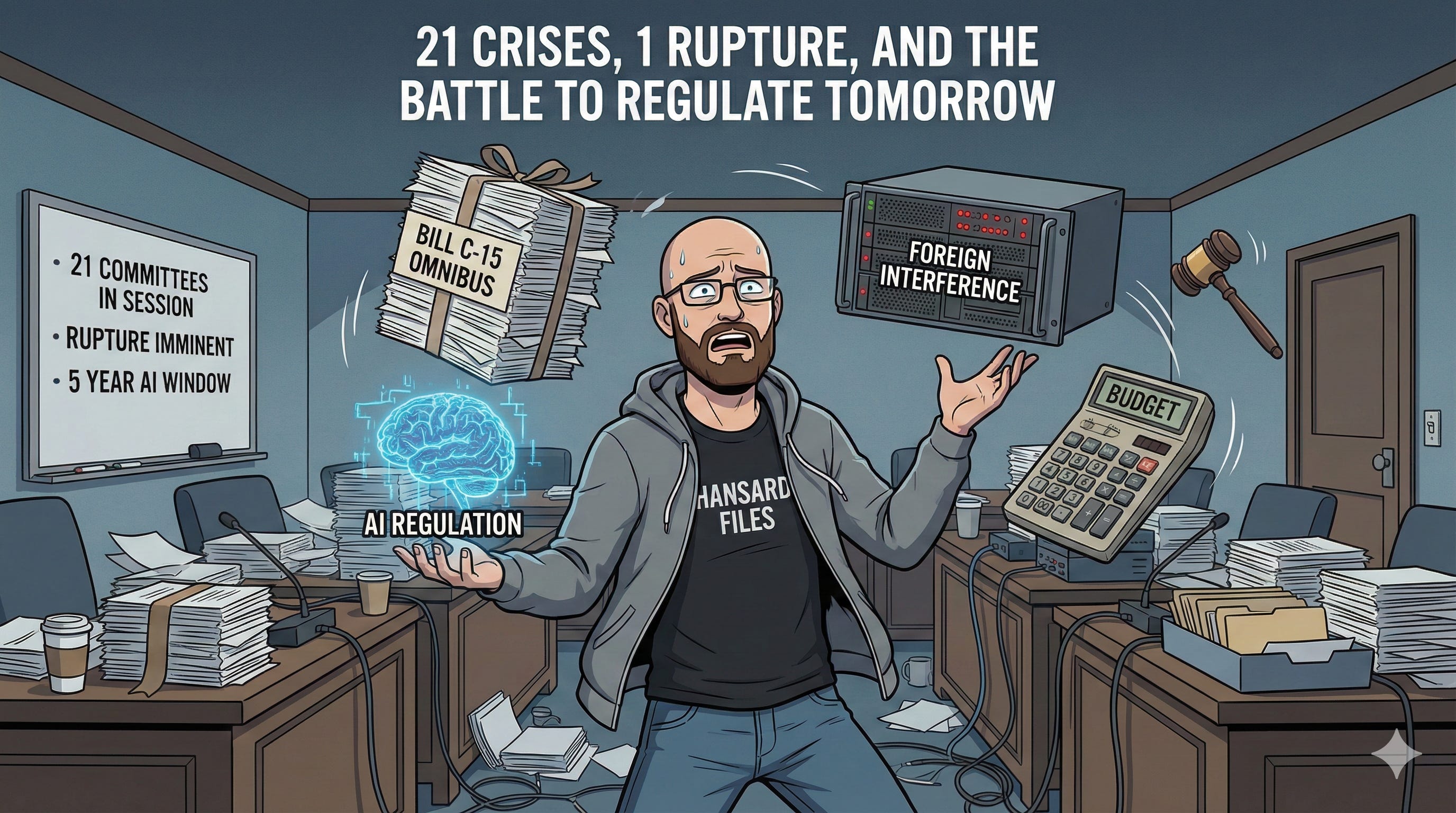
The first week of February 2026 arrived in Ottawa with a chilling sense of bureaucratic overload. In the span of a few days, twenty-one separate parliamentary committees convened across the capital, their mandates bleeding into one another like watercolor on wet paper. The sheer volume of legislative traffic revealed a government machinery straining under the weight of compounding national and global emergencies. If there is a single phrase to define this specific moment in parliamentary history, it was delivered by the Minister of Transport, Steven MacKinnon, to the Standing Committee on Finance. He stated that Canada is facing extraordinary threats to its economy and to the quality of life of its citizens. He noted that the Prime Minister had recently described this exact moment in history as a rupture.
At the very center of this rupture sits the dire need for Canada artificial intelligence regulation. Yet, as transcripts from the first week of February demonstrate, the existential threat of unregulated technology is just one of a dozen fires burning simultaneously within the walls of Parliament. Lawmakers are attempting to build the airplane while in freefall, scrambling to process massive omnibus spending packages, overhauls to the criminal justice system, and targeted studies on foreign interference. The result is a cinematic collision of priorities, where debates over human extinction share the daily docket with arguments over committee catering budgets and red tape reduction.
The Omnibus Behemoth of Bill C-15
Nothing illustrates the staggering complexity of the current legislative agenda quite like Bill C-15, a sprawling piece of legislation that seeks to implement provisions of the November 2025 budget. The bill is so massive that it has been carved up and distributed across multiple standing committees, each tasked with dissecting its own small slice of the legislative beast.
At the Standing Committee on Finance, Minister MacKinnon pitched the High-Speed Rail Network Act embedded within Bill C-15 as a necessary “Team Canada” approach to protect the economy and position the nation for the future. Meanwhile, just down the hall, the Standing Committee on Foreign Affairs and International Development was busy pulling apart clauses 460 to 462 of the exact same bill. Minister of Foreign Affairs Anita Anand appeared alongside the director general of sanctions and strategic export controls, signaling the heavy geopolitical stakes hidden within the budget implementation act.
The fragmentation did not stop there. The Standing Committee on Fisheries and Oceans gathered under Chair Patrick Weiler to commence their study of clauses 553 to 570. At the Standing Committee on Government Operations and Estimates, Chair Kelly McCauley led an inquiry into yet another dimension of Bill C-15, hearing from Jenelle Power, the Executive Director of the Red Tape Reduction Office at the Treasury Board Secretariat.
This is the reality of modern Canadian governance. An omnibus bill is no longer a single coherent policy document. It is a fragmented mosaic of national priorities, parsed out in sterile committee rooms where interpreters struggle against audio feedback to translate the dense, technical jargon of public administration. The compartmentalization of Bill C-15 means that very few lawmakers have the bandwidth to view the legislation in its entirety, leading to a profound vulnerability when it comes to long-term strategic oversight.
The Looming Specter of Canada Artificial Intelligence Regulation
While financial committees debated the mechanics of high-speed rail and budget implementation, a far more ominous conversation was unfolding at the Standing Committee on Access to Information, Privacy and Ethics. The subject was not infrastructure or taxation, but the survival of the human species.
Pursuant to a motion adopted the previous fall, the committee resumed its study on the challenges posed by artificial intelligence and its regulation. The witness list was a roster of the most sobering voices in global tech policy, including experts from the Future of Life Institute and researchers from the University of Montreal. Their testimony cut through the usual partisan bickering with a terrifying clarity. They warned that without immediate and aggressive intervention, humanity could be facing an unmanageable crisis within the next five years.
This testimony cast a dark shadow over the proceedings of the Standing Committee on Science and Research, which met later that week to scrutinize the mandates of the Minister of Industry and the newly minted Minister of Artificial Intelligence and Digital Innovation. The contrast was jarring. One committee was hearing detailed scenarios about the obsolescence of the human workforce and potential extinction-level events, while another was bogged down in the administrative semantics of departmental mandates. The push for Canada artificial intelligence regulation is trapped in this exact friction point, caught between the slow, methodical gears of parliamentary procedure and the blistering, exponential acceleration of technological advancement.
Digital Fortresses and Foreign Phantoms
The anxiety surrounding technology was not limited to theoretical algorithms. It was deeply rooted in the immediate, tangible threats to national security and democratic integrity. At the Standing Committee on Public Safety and National Security, lawmakers engaged in a tense, clause-by-clause consideration of Bill C-8. This critical legislation aims to overhaul the nation’s cyber security framework by amending the Telecommunications Act. Officials from the Department of Public Safety and Emergency Preparedness sat shoulder-to-shoulder with representatives from the Department of Industry, navigating the complex intersection of digital infrastructure and national defense.
Simultaneously, the Standing Committee on Procedure and House Affairs continued its relentless investigation into foreign election interference. Chair Chris Bittle presided over a hybrid meeting where the unspoken reality was clear to everyone in the room. The mechanisms of Canadian democracy are under active siege by external actors utilizing increasingly sophisticated digital tools. The walls of the nation are being tested not by standing armies, but by server farms and coordinated disinformation campaigns.
The digital threat matrix even permeated the Standing Committee on Canadian Heritage. Between approving a modest budget for ministerial catering, the committee was actively coordinating a study on the pernicious effects of influencers and social media content on children and adolescents. Later that same day, they were scheduled to hold a joint meeting with the Justice committee and experts on anti-Semitism, highlighting how digital platforms have become accelerators for real-world hatred and societal fracture.
Societal Fractures and the Justice System
As the technological landscape shifts dramatically underfoot, the traditional pillars of Canadian society are showing signs of immense strain. This tension was palpable at the Standing Committee on Justice and Human Rights, where lawmakers continued their rigorous study of Bill C-14. This legislation proposes significant amendments to the Criminal Code, the Youth Criminal Justice Act, and the National Defence Act, specifically targeting the highly contentious issues of bail and sentencing. The debate over who belongs in a cell and who belongs on the street is tearing at the fabric of public trust, forcing lawmakers to balance civil liberties against a growing public outcry for safety and accountability.
This societal reckoning extends far beyond the criminal justice system. The Standing Committee on the Status of Women, under the leadership of Chair Marilyn Gladu, resumed a challenging and vital study into the rise of anti-feminist ideology. In a similar vein, the Subcommittee on International Human Rights convened to receive a grim briefing on the escalating human rights situation in Iran, underscoring Canada’s ongoing struggle to project its democratic values onto an increasingly hostile global stage.
Back at home, the historical debts of the nation continue to demand attention. The Standing Committee on Indigenous and Northern Affairs authorized a hefty budget of over fifty thousand dollars to commence a study on federally recognized Indigenous communities that currently exist without land or modern treaties. It is a stark reminder that while the government races to regulate the technologies of the twenty-first century, it has yet to fully resolve the foundational injustices of the nineteenth.
The Administrative Grind Never Stops
Despite the overarching themes of technological peril and societal rupture, the everyday machinery of government must continue to turn. The transcripts from this single week in February paint a vivid picture of the relentless administrative grind.
At the Standing Committee on Official Languages, Minister Marc Miller faced questions regarding the use of French in government communications and federal institutions, a perennial and passionate debate in Canadian politics. The Standing Committee on Natural Resources gathered to evaluate the future of Canada’s energy sector, balancing economic imperatives against urgent climate goals. Meanwhile, the Standing Committee on International Trade focused on Bill C-13, calling upon representatives from the Canadian Meat Council and the Canadian Pork Council to untangle the complexities of international market access.
Even the most specific demographic concerns require dedicated legislative attention. The Standing Committee on Veterans Affairs met to discuss the systemic barriers to entrepreneurship among those who have served in the armed forces. At the Standing Committee on Human Resources, Skills and Social Development, the urgency of the moment was highlighted by Bloc Québécois MP Andréanne Larouche, who noted that journalists in Quebec were being inundated with calls from hundreds of desperate seniors. And at the Standing Committee on Citizenship and Immigration, lawmakers navigated the logistical hurdles of hybrid meetings while trying to address the backlog and complexities of the national immigration system.
A Parliament at the Breaking Point
To read through the parliamentary evidence of early February 2026 is to witness a government operating at its absolute maximum capacity. The twenty-one committees documented here are not merely debating policy. They are desperately trying to build a cohesive national strategy out of millions of disparate, highly technical fragments.
The historical rupture described by the Prime Minister is not a single event, but a simultaneous failure of multiple legacy systems. The criminal justice system requires reform through Bill C-14. The digital infrastructure requires fortification through Bill C-8. The budget requires massive omnibus implementation through Bill C-15. And looming above it all is the ticking clock of advanced technology, demanding a robust and immediate framework for artificial intelligence regulation before the window for human control closes permanently.
Parliament is fighting a war on twenty-one different fronts. The outcome of these simultaneous battles will determine not just the shape of the Canadian economy, but the fundamental security and survival of the society it governs.
Hansard Files digs through dense parliamentary archives to find the stories that matter most to your future. Subscribe today to support independent investigative journalism.
Source Documents
House of Commons Standing Committee on Access to Information, Privacy and Ethics. (2026, February 2). Evidence (No. 025).
House of Commons Standing Committee on Agriculture and Agri-Food. (2026, February 3). Evidence (No. 021).
House of Commons Standing Committee on Canadian Heritage. (2026, February 3). Evidence (No. 021).
House of Commons Standing Committee on Citizenship and Immigration. (2026, February 4). Evidence (No. 019).
House of Commons Standing Committee on Finance. (2026, February 2). Evidence (No. 020).
House of Commons Standing Committee on Fisheries and Oceans. (2026, February 2). Evidence (No. 021).
House of Commons Standing Committee on Foreign Affairs and International Development. (2026, February 3). Evidence (No. 020).
House of Commons Standing Committee on Government Operations and Estimates. (2026, February 3). Evidence (No. 024).
House of Commons Standing Committee on Health. (2026, February 3). Evidence (No. 019).
House of Commons Standing Committee on Human Resources, Skills and Social Development and the Status of Persons with Disabilities. (2026, February 5). Evidence (No. 023).
House of Commons Standing Committee on Indigenous and Northern Affairs. (2026, February 3). Evidence (No. 018).
House of Commons Standing Committee on International Trade. (2026, February 3). Evidence (No. 020).
House of Commons Standing Committee on Justice and Human Rights. (2026, February 2). Evidence (No. 016).
House of Commons Standing Committee on Natural Resources. (2026, February 3). Evidence (No. 021).
House of Commons Standing Committee on Official Languages. (2026, February 3). Evidence (No. 018).
House of Commons Standing Committee on Procedure and House Affairs. (2026, February 3). Evidence (No. 019).
House of Commons Standing Committee on Public Safety and National Security. (2026, February 10). Evidence (No. 023).
House of Commons Standing Committee on Science and Research. (2026, February 5). Evidence (No. 023).
House of Commons Standing Committee on the Status of Women. (2026, February 3). Evidence (No. 022).
House of Commons Standing Committee on Veterans Affairs. (2026, February 4). Evidence (No. 020).
Subcommittee on International Human Rights of the Standing Committee on Foreign Affairs and International Development. (2026, February 2). Evidence (No. 010).
So much attempt to look forward without reconciling with and fixing past mistakes. There are so many levels where Truth and Reconciliation processes are required.
As much as Canadian Institutions want to claim that TRC around Indigenous peoples has happened, that process hadn’t actually started as Canada hasn’t begun the “truth” part.
I spent 10+ years on the "Digital Copyright" policy trying to warn policy makers that it was a bad idea to protect digital communications platforms from competition -- which is the REAL meaning of "technological protection measures" as opposed to the myth that copyrighted content could come alive and "protect itself" (Harry Potter: Monster book of Monsters -- is fiction, not fact). The growth of the power of online media platforms, including social media platforms, really grew out of those policy mistakes.
Clarity that automated processes (whether security cameras or LLM’s) cannot result in exclusive rights such as copyright should have been put in place early in the 1990s, rather than following the USA’s corrupt National Information Infrastructure (NII) process – which for instance lead to the NII Copyright Protection Act of 1995. (which was policy-laundered through WIPO, and then later passed into Canadian law)
Most of the problems I see Canada's institutions facing today are self-inflicted, even though politicians want to continue to point elsewhere as the source.
"They are desperately trying to build a cohesive national strategy out of millions of disparate, highly technical fragments."