


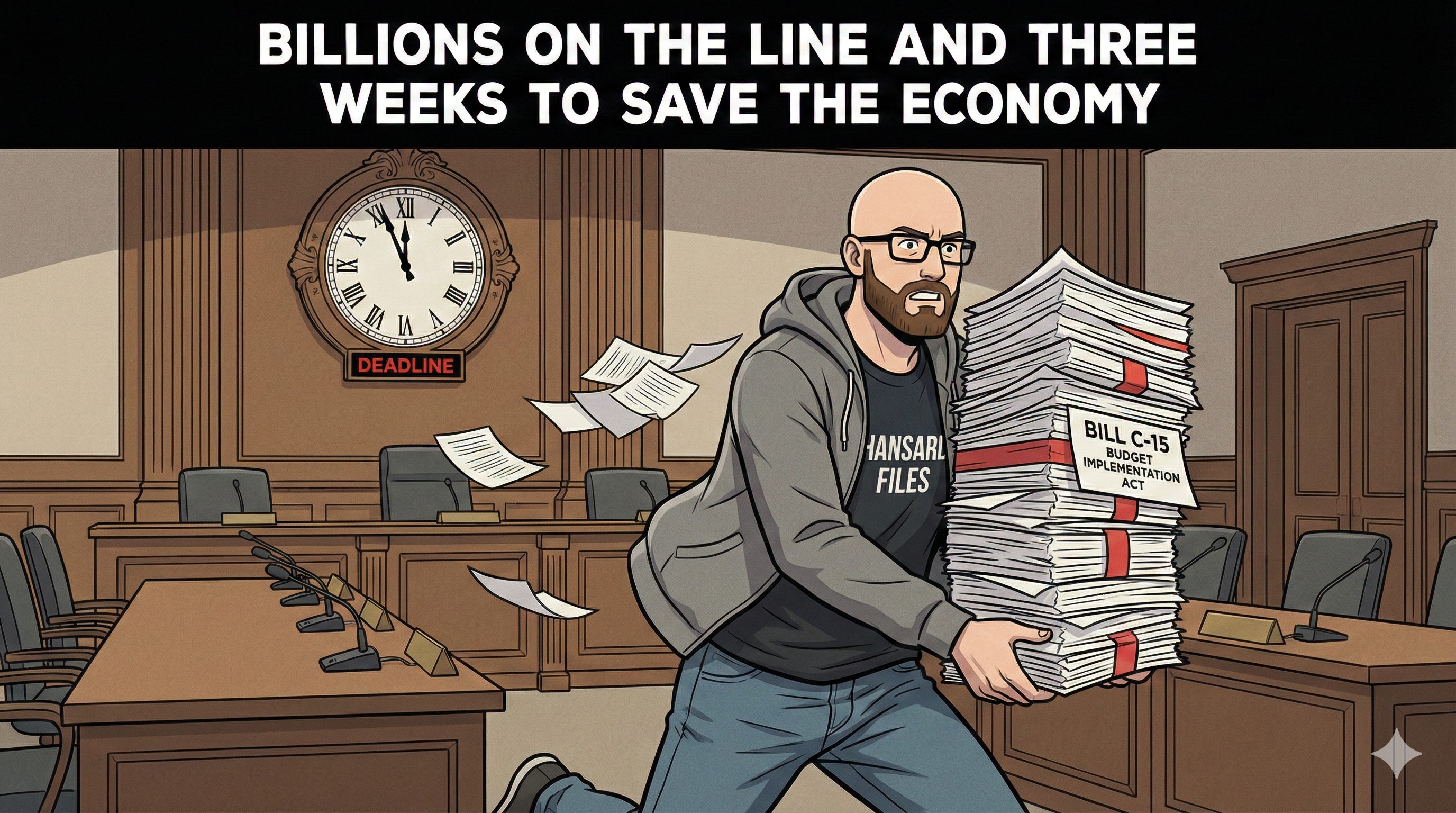
The heating vents in the Senate of Canada Building hummed against the December chill, but the real heat was in the committee rooms. It was late 2025, and Ottawa was in the grip of a legislative sprint that would determine the economic fate of the nation for the next decade. At the center of the storm was Bill C-15, the Budget Implementation Act 2025. This was not just a housekeeping bill. It was a massive omnibus legislation carrying the weight of a new political reality, pushing through reforms on everything from high-speed rail and crypto-currency to foreign labor and ocean science.
In the hallways, the pressure was palpable. The government was racing against the holiday break to secure Royal Assent. Inside Room W120 and its neighbors, senators were grilling witnesses who had come with dire warnings. The stakes were no longer theoretical. They were measured in billions of dollars, thousands of jobs, and the very sovereignty of the Canadian financial system.
The Six Hundred Billion Dollar Threat
The most chilling testimony came late on a Wednesday afternoon in the Banking, Commerce and the Economy committee. The room was tired, but the witnesses were wide awake to a threat that few Canadians had even considered.
Mark Maybank, the Managing Partner of Maverix Private Equity, sat before the senators and outlined a silent crisis bleeding the Canadian economy dry. The issue was stablecoins—digital currencies pegged to traditional assets like the US dollar. While Ottawa had debated regulation for years, the market had moved on. Maybank estimated that over 10 billion Canadian dollars had already flowed out of the country into US dollar-backed stablecoins.
The implication of this capital flight was catastrophic. If even five percent of Canadian deposits migrated to foreign stablecoins, Maybank warned, the country risked a contraction in domestic lending capacity of 675 billion dollars. That would mean fewer mortgages, fewer business loans, and a diminished demand for government bonds.
But the warning went deeper than immediate liquidity. It was about who owned the future. Maybank described a “patent cliff” looming in the mid-2030s. He revealed that global players held patents on the technology that facilitates stablecoin transactions, and many of these patents were valid in Canada until 2034 or 2035. Canadian innovators were effectively walking into a trap where they might find themselves sued out of existence by foreign patent holders once the market matured.
Jean Desgagné of Canada Stablecorp Inc. echoed the urgency. He told the committee that Canada was significantly behind other jurisdictions. The proposed “Stablecoin Act” within Bill C-15 was an attempt to catch up, but the witnesses made it clear that without a sovereign digital infrastructure—a Canadian-controlled blockchain—the country would remain vulnerable to the “regional spheres of influence” of the United States and China. The committee was left with a stark picture: pass the bill and build the infrastructure, or watch Canada’s financial sovereignty evaporate into the digital ether.
The High Speed Gamble
While the Banking committee stared down a digital abyss, the Transport and Communications committee was dissecting a physical gamble of equal magnitude. For years, Canadians had been promised “High Frequency Rail” in the Quebec City-Windsor corridor. But in February 2025, the script had flipped.
Vincent Robitaille, an Assistant Deputy Minister at Transport Canada, confirmed the pivot. The government had decided that High Frequency Rail offered poor value for money. The new plan was High Speed Rail—true bullet trains capable of cutting travel times in half. The project had been handed to a new entity called Alto, working in tandem with a private consortium named Cadence.
Martin Imbleau, the CEO of Alto, tried to sell the vision of a transformative network connecting Toronto, Ottawa, Montreal, and Quebec City. He spoke of 1,000 kilometers of dedicated electric track and a workforce that had already swelled to 500 people. But the senators were skeptical about the cost and the timeline.
The hearing revealed the immense complexity of the undertaking. The government was proposing a specialized “High-Speed Rail Network Act” within Bill C-15 to expedite land acquisition. The polite term was “land acquisition,” but the legal reality was expropriation. Linda Jenkyn from Public Services and Procurement Canada admitted that the current Expropriation Act was not designed for a linear infrastructure project of this scale. The new bill would grant powers to acquire land before impact assessments were even finished—a detail that raised eyebrows around the table.
Senators pressed on the financials. They asked about the “value capture” strategy—using real estate development around stations to subsidize the rails. The answers were vague enough to cause concern. The committee demanded written proof of profitability scenarios by December 23, wryly noting it would be their “Christmas present.” The tension in the room suggested that no one was quite sure if this mega-project would be an economic engine or a fiscal derailment.
The Labor Cliff
Across the precinct, the National Finance committee was hearing a different kind of desperation. This was not about future tech or bullet trains, but about the survival of the corner store and the local manufacturer.
Jasmin Guénette from the Canadian Federation of Independent Business brought the raw anxiety of Main Street into the Senate record. The focus was the Temporary Foreign Worker Program. For years, small businesses had relied on this program to fill gaps in the labor market. Now, facing expirations and policy shifts at the start of 2026, business owners were terrified.
Guénette described a “labor cliff.” Small business owners had spent time and money training these workers, only to face the prospect of losing them due to bureaucratic hard stops. The CFIB warned that without a “grandfather clause” to protect existing employees, businesses would be forced to cut shifts, cancel contracts, or close their doors entirely.
Christina Santini, also from the CFIB, layered on the financial reality. She dismantled the government’s “productivity super-deduction,” noting that 42 percent of their members had no funds to invest and thus couldn’t use it. She argued that a simple reduction in the small business tax rate from 9 percent to 6 percent would do more to save the economy than any complex new program. The disconnect between the high-level policy in Bill C-15 and the ground-level reality of payroll and permits was stark.
The Carbon Frontier
In the background of these economic battles, the Standing Senate Committee on Fisheries and Oceans was quietly examining a technology that sounded like science fiction but was rapidly becoming policy fact: ocean carbon sequestration.
Cynthia Handler from Natural Resources Canada explained that the “net” in “net-zero” was no longer just about cutting emissions. It was about active removal. The International Energy Agency’s latest report projected that global warming would exceed 1.5 degrees Celsius within the decade. To turn the ship around, the world would need to suck billions of tonnes of carbon out of the atmosphere.
The committee explored the frontier of “marine carbon dioxide removal.” This involved techniques like enhancing the alkalinity of the ocean to absorb more CO2. It was a field rife with scientific uncertainty and regulatory gaps. The witnesses described a “Wild West” scenario where entrepreneurs were moving faster than regulators. The government was scrambling to build a knowledge foundation before the industry took off, hoping to harness the ocean’s power without accidentally destroying its ecosystems.
The Race to Royal Assent
Binding these disparate narratives together was the ticking clock. It was December. The House of Commons was wrapping up. The Senate was the final hurdle. The sheer size of Bill C-15—covering everything from the Canada Infrastructure Bank’s 10 billion dollar capital increase to the intricacies of “open banking” accreditation—meant that thorough scrutiny was nearly impossible.
In the Banking committee, the fatigue was evident. The Chair, Senator Clément Gignac, had to apologize to witnesses from Innovation, Science and Economic Development Canada who had waited for three hours only to be sent home unheard. “Some things we can control, as Prime Minister Carney mentioned, and some things we cannot,” Gignac said, dropping a reference that firmly anchored the proceedings in this new political era.
The mention of Prime Minister Carney hung in the air, a reminder that the political leadership had shifted, yet the machinery of the state—the grinding, complex, essential work of the Budget Implementation Act—remained a beast that had to be fed.
As the hearings adjourned and the senators filed out into the Ottawa night, the questions remained unresolved. Would the stablecoin regulations be enough to stop the capital flight? Would the high-speed rail project bankrupt the ministry or build the nation? Would the small businesses survive the winter labor freeze?
Bill C-15 was a legislative leviathan, forcing the country to bet on unproven technologies and massive infrastructure projects while trying to plug the leaks in the traditional economy. The transcripts of December 2025 reveal a government and a Senate racing to lay the tracks for the future, hoping the train wouldn’t derail before it even left the station.
Source Documents
Standing Senate Committee on National Finance. (2025, December 9). Evidence (Issue 25). Senate of Canada.
Standing Senate Committee on National Finance. (2025, December 10). Evidence (Issue 27). Senate of Canada.
Standing Senate Committee on Energy, the Environment and Natural Resources. (2025, December 9). Evidence (Issue 17). Senate of Canada.
Standing Senate Committee on Banking, Commerce and the Economy. (2025, December 10). Evidence (Issue 20). Senate of Canada.
Standing Senate Committee on Transport and Communications. (2025, December 9). Evidence (Issue 16). Senate of Canada.
Standing Senate Committee on Fisheries and Oceans. (2025, November 18). Evidence (Issue 10). Senate of Canada.
Standing Senate Committee on Banking, Commerce and the Economy. (2025, December 3). Evidence (Issue 16). Senate of Canada.
I don't know which is worse; our feckless elected politicians or our ideologically warped bureaucracy?