


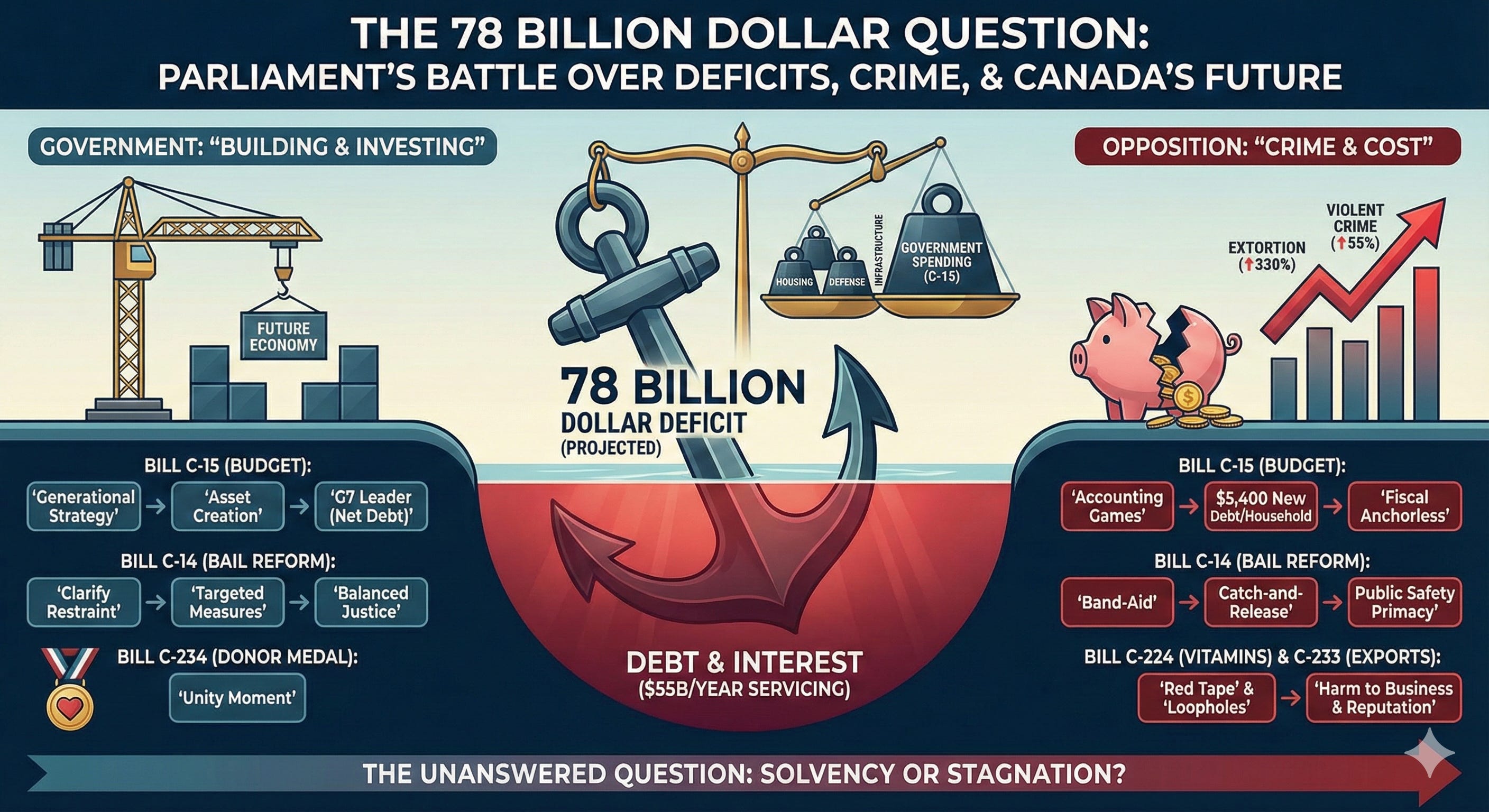
The figures on the page were red, deep and unignorable, but it was the silence between the numbers that caused the most friction in the House of Commons this week. As November 2025 settled over Ottawa, the new Liberal administration led by Prime Minister Mark Carney faced a dual crisis of confidence. On one front, a Parliamentary Budget Officer (PBO) report threatened to unravel the government’s fiscal credibility. On the other, a nation gripped by a 330% surge in extortion cases demanded immediate answers that dollars and cents alone could not provide.
The centerpiece of the week was Bill C-15, the Budget Implementation Act, No. 1. It was pitched by the government as a “generational” strategy to build housing, strengthen defense, and revitalize the economy. But beneath the glossy rhetoric of “building Canada strong” lay a staggering projection: a $78 billion deficit. It is a figure that eclipses every shortfall in Canadian history outside of the COVID-19 pandemic.
For the Conservative opposition, the budget was not a building plan. It was a crime scene.
The Accounting Games
The debate over Bill C-15 quickly turned into a forensic audit of the government’s accounting practices. At the heart of the controversy was a fundamental shift in how the Finance Department classifies spending. The government has sought to separate “operating expenses” from “capital investments,” arguing that borrowing to build assets like housing and infrastructure should be viewed differently than borrowing to keep the lights on.
The Parliamentary Budget Officer, however, was not convinced. In a report that circulated through the opposition benches like contraband, the PBO described the government’s definition of capital investment as “overly expansive.” By the watchdog’s calculations, the government had reclassified approximately $94 billion of spending as “investment” that, under standard international accounting practices, would simply be considered day-to-day costs.
Conservative MP Pat Kelly led the charge, dissecting the government’s logic with surgical precision. He accused the Liberals of “accounting trickery” designed to fool Canadians into thinking the books were balancing when, in reality, the operational deficit was ballooning. According to Kelly, the PBO gave the government only a 7.5% chance of meeting its own fiscal anchor of a declining deficit-to-GDP ratio.
“Fiscal anchors mean nothing if they are not attached to anything,” Kelly told the House. He compared the government to a sailor who brings a shiny new anchor on board only to throw it over the side without a chain.
The government pushed back. Parliamentary Secretary Ryan Turnbull defended the strategy as a necessary pivot in a world of shifting alliances and economic instability. He cited the International Monetary Fund and credit rating agencies, insisting that Canada still holds the lowest net debt-to-GDP ratio in the G7 and maintains a AAA credit rating. The government’s narrative was one of resilience: spending less on government operations to invest more in the structural spine of the nation—nuclear power at Darlington, high-speed rail in the Quebec City-Toronto corridor, and critical minerals in the North.
Yet, the opposition pointed to the immediate cost to families. The deficit, they argued, translates to roughly $5,400 in new debt for every Canadian household. With debt servicing costs now hitting $55 billion annually—more than the federal health transfer to the provinces—critics argued that tax dollars are being siphoned away from doctors and nurses to pay bondholders and bankers.
A Nation Living in Fear
While the economists debated ledger entries, a visceral fear was dominating the conversation in the corridors and constituency offices. The statistics read into the record were chilling. Since 2015, violent crime has risen 55%. Firearms offences are up 130%. But the statistic that sucked the air out of the room was extortion. It is up 330% nationally, and in suburbs like Surrey and Brampton, it has become a daily terror.
Conservative Leader Pierre Poilievre painted a grim picture of small business owners receiving threatening calls in the middle of the night, told to pay millions or watch their homes burn and their children suffer. He demanded an emergency debate on the extortion crisis, citing “radical open border policies” and “catch-and-release” bail laws as the fuel for this fire.
The government’s response was Bill C-14, the Bail and Sentencing Reform Act. The legislation proposes to clarify the “principle of restraint”—the legal concept that directs judges to release accused persons at the earliest opportunity—by stating explicitly that it does not require release. It also seeks to expand reverse-onus provisions for repeat violent offenders and crimes involving firearms.
For the Conservatives, Bill C-14 is a “band-aid on a bullet wound.” MP Dane Lloyd recounted the tragic murder of Bailey McCourt in Kelowna, killed by an estranged partner mere hours after being released on bail. Lloyd argued that unless the principle of restraint is repealed entirely and replaced with a “public safety primacy” clause, the revolving door of justice will continue to spin. He called for mandatory minimum sentences and a presumption of detention for serious violent offences.
The Liberals accused the Conservatives of playing politics with public safety. Parliamentary Secretary Kevin Lamoureux repeatedly challenged the opposition to pass Bill C-14 immediately to get it to committee, arguing that law enforcement and provincial premiers support the bill as a necessary step forward. He framed the Conservative delay as a fundraising tactic rather than a principled stand.
The debate revealed a profound philosophical chasm. The Liberals argue for a balanced justice system that respects constitutional rights while targeting specific high-risk behaviors. The Conservatives argue that the system has tilted so far toward the rights of the accused that the right of the public to be safe has been extinguished.
The Loophole in the Shield
As the debate over domestic safety raged, another bill sought to address Canada’s role in violence abroad. NDP MP Jenny Kwan championed Bill C-233, dubbed the “No More Loopholes Act.” The bill targets a specific exemption in Canada’s export control regime that allows military goods to flow permit-free to the United States.
Kwan’s argument was stark. She detailed how Canadian-made components—circuitry, sensors, explosives—are shipped to the U.S., integrated into weapons systems like the F-35 fighter jet, and then sold to nations like Israel and Saudi Arabia. She linked these exports directly to the bombardment of Gaza and conflicts in Yemen, arguing that Canada is “active participation in a deadly supply chain.”
The bill seeks to ensure that all military exports, regardless of destination, are subject to rigorous human rights assessments. “We cannot continue to call for peace while profiting from war crimes,” Kwan declared.
The government, represented by Parliamentary Secretary Robert Oliphant, pushed back gently but firmly. While acknowledging the moral intent of the bill, Oliphant warned of unintended consequences. He argued that ending the U.S. exemption would disrupt the highly integrated North American defense industry, potentially violate NATO obligations, and hinder the flow of equipment to allies like Ukraine. Conservative MP Michael Chong echoed these concerns, warning that the bill could lead to a “disintegration” of the defense sector and a mass exodus of jobs from Ontario and Quebec.
It was a debate that pitted moral absolutism against geopolitical pragmatism. For Kwan and the NDP, transparency is the foundation of sovereignty. For the Liberals and Conservatives, the U.S. defense relationship is a third rail that cannot be touched without catastrophic economic shocks.
The War on Vitamins
Amidst the heavy debates on deficits and war, a surprising battlefront opened up over vitamins and supplements. Conservative MP Blaine Calkins championed Bill C-224, a legislative attempt to protect natural health products (NHPs) from what he termed a bureaucratic “stranglehold.”
The conflict stems from recent government moves to regulate NHPs—vitamins, probiotics, herbal remedies—under the same framework as therapeutic drugs. Calkins argued this imposes crushing costs on small businesses and traditional Chinese medicine practitioners, threatening to wipe out an industry that 80% of Canadians rely on. He painted a picture of a government obsessed with control, imposing “cost recovery” fees that would drive products off shelves and businesses south of the border.
The Liberals countered that safety must come first. Parliamentary Secretary Kevin Lamoureux questioned whether the Conservatives believed there were “no concerns related to contamination,” citing recalls of supplements containing metal fibers. He argued that the “maple leaf” brand on Canadian products relies on a reputation for rigorous safety standards.
This debate, while seemingly niche, tapped into a broader vein of anti-bureaucratic sentiment. For the opposition, it was yet another example of a government that creates red tape in search of a problem, stifling consumer choice and entrepreneurship in the process.
A Moment of Unity
In a week defined by sharp elbows and sharper rhetoric, a rare moment of quiet unity emerged on Thursday evening. MP Ziad Aboultaif brought forward Bill C-234, the Living Donor Recognition Medal Act.
Aboultaif spoke from a place of profound personal experience. In 2003, he donated part of his liver to save his son’s life. He spoke not of policy or budgets, but of the 4,700 Canadians currently waiting for an organ transplant, and the heroes who step forward to give a part of themselves to save a stranger or a loved one.
The bill proposes a national medal to honor living organ donors—a tangible, non-monetary recognition of their sacrifice. Support came from all corners of the House. Liberal MP Ginette Petitpas Taylor shared stories of friends who received life-saving kidneys. NDP and Bloc members spoke of the need to change the culture around donation.
For an hour, the partisan noise fell away. There was no talk of deficits, no accusations of soft-on-crime policies, no debates over jurisdictional overreach. There was only a shared recognition of the highest form of human generosity.
The Bottom Line
As the House adjourned for the weekend, the temporary truce of the living donor debate faded, leaving the heavy weight of the budget implementation act hanging over Parliament. The government is betting everything on its “build big” strategy, banking on the idea that massive investments in infrastructure and housing will eventually outpace the crushing weight of debt servicing costs.
The opposition is betting that Canadians have run out of patience. They see a government that has doubled the debt, presided over a violent crime wave, and is now resorting to accounting gymnastics to hide the true state of the nation’s finances.
With the PBO’s warning of a “7.5% chance” of success ringing in the air, the question facing MPs is not just about the next fiscal year. It is about the solvency of the nation’s future. The deficit is $78 billion. The interest payments are $55 billion. And for millions of Canadians watching their grocery bills climb and their neighborhoods change, the math simply isn’t adding up.
Source Documents
Hansard. (2025, November 17). House of Commons Debates, 45th Parliament, 1st Session. Volume 152, No. 054.
Hansard. (2025, November 18). House of Commons Debates, 45th Parliament, 1st Session. Volume 152, No. 055.
Hansard. (2025, November 19). House of Commons Debates, 45th Parliament, 1st Session. Volume 152, No. 056.
Hansard. (2025, November 20). House of Commons Debates, 45th Parliament, 1st Session. Volume 152, No. 057.
Hansard. (2025, November 21). House of Commons Debates, 45th Parliament, 1st Session. Volume 152, No. 058.
Another side of the debate is that the federal government doesn’t need to collect taxes or borrow from our savings to fund government expenditures (private savings are a result of government deficit spending); and the federal government doesn’t technically “borrow” money from the central bank or commercial banks because banks create money when they create loans.
But the interest payments are definitely part of the problem because every dollar is basically created and “loaned” into existence on the basis of interest-bearing debt, which creates an artificial scarcity of money and transfers wealth to those who simply create money. Perhaps the Bank of Canada should provide interest-free financing to the federal government for productive purposes (to build infrastructure or provide services).