


When Parliament passes a law, you expect it to be final. The journey of a bill through the House of Commons and the Senate involves months, sometimes years, of debate, amendment, and intense scrutiny. Once a bill receives Royal Assent, we rightly assume its provisions become part of the legal fabric of the country. We trust that the text we debated is the text that now governs us. A recent exchange on the floor of the Senate, however, reveals a flaw in this basic assumption. It shows how the complexity of the legislative process can cause a key protection, passed by both houses of Parliament, to simply disappear from the law books, with no one in government noticing for two years.
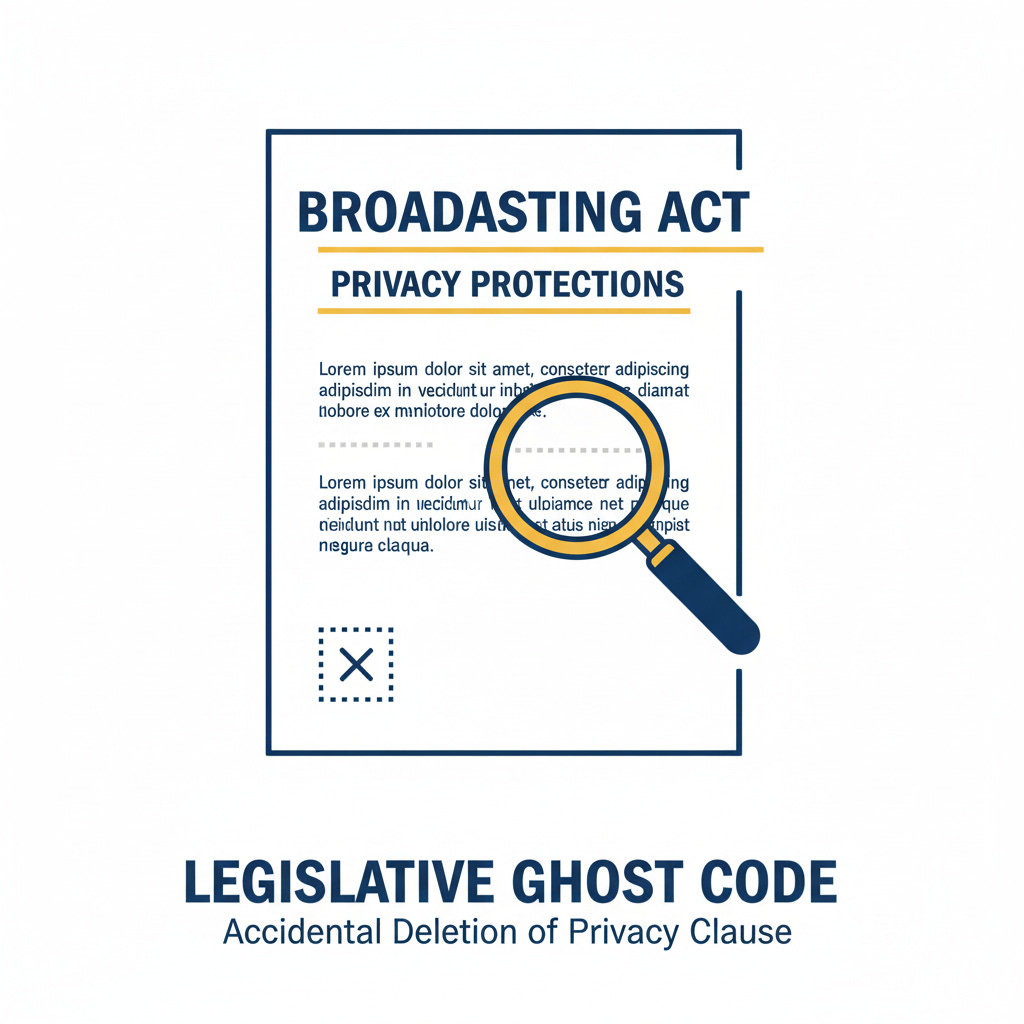
This isn’t a story about political intrigue or partisan fighting. It is a quieter, more concerning story about procedural failure. On September 24th, during the daily Question Period in the Senate, a senator rose to ask a startling question. She wanted to know what the government was doing to restore a privacy protection clause that had been stripped from the Broadcasting Act, not by a vote, but seemingly by accident. The government’s response confirmed the error, calling it an “inadvertent oversight.” This quiet admission points to a systemic vulnerability that should concern anyone who believes that the laws passed by Parliament ought to be the laws that are actually in force.
The Anatomy of a Mistake
The problem began with Bill C-11, the legislation to modernize the Broadcasting Act, which this chamber passed in 2023. During its review, the Senate amended the bill to include a specific clause to protect the data privacy of Canadians. This wasn’t a minor change. It was proposed by Canada’s Privacy Commissioner and accepted by the government of the day. The bill, with this amendment included, passed and became law. Case closed.
Or so everyone thought. In the September 24th Question Period, Senator Paula Simons revealed this was not the end of the story. She explained that the privacy provision had been unintentionally deleted during the passage of an entirely different piece of legislation, Bill C-13, which dealt with the Official Languages Act. For two years, a protection that parliamentarians and the public believed was law was not present in the act. The Government Representative in the Senate, Senator Pierre Moreau, acknowledged the situation, stating, “The government has recently been made aware of what appears to be an inadvertent oversight in a coordinating amendment and is looking into it”. This points to a critical question: how can a law be unwritten by mistake?
Legislative Ghost Code
Here’s the detail I find most revealing. The modern legislative process is not unlike writing complex software code. Each new bill is a new block of code, and sometimes it must interact with or change older blocks of code to ensure the entire system functions. These changes are often handled through “coordinating amendments,” small, technical clauses in one bill that adjust the wording in another. In this case, a coordinating amendment in the Official Languages bill appears to have overwritten the Senate’s privacy amendment in the Broadcasting Act.
This creates what we might call Legislative Ghost Code. This is a law, amendment, or protection that parliamentarians and the public believe exists, but which has been accidentally nullified or overwritten by a subsequent, seemingly unrelated, legislative change. This ghost code creates a dangerous gap between the laws we believe govern us and the laws actually on the books. It functions like a bug in the operating system of our democracy, one that lay dormant for two years until an external watchdog, Professor Michael Geist at the University of Ottawa, brought it to light.
I was shocked last month to learn that those privacy provisions have been stripped out of the Broadcasting Act by accident, we’re told, during debate in the other place over another bill, Bill C-13, which deals with official languages. Can you please tell us what steps the government is taking to put those privacy protections voted on by this chamber back into the Broadcasting Act?
This incident shows that our legal framework is not a static library of books, but a dynamic, digital document subject to errors. As legislation becomes more voluminous and interconnected, the potential for these mistakes grows. The principle this reveals is that complexity breeds error, and without a rigorous system of continuous oversight, the integrity of our laws is at risk.
The Enduring Role of Scrutiny
If the government department responsible for the bill missed this error, who is supposed to catch it? This episode provides a clear answer. The mistake was not found internally. It was identified by an academic expert, and it was brought to Parliament for public accountability by a senator. This sequence of events is a powerful validation of the Senate’s role as a chamber of sober second thought, a role that extends beyond simply reviewing bills before they pass. It includes post-legislative scrutiny, a long-term audit of the laws Parliament has created.
When Senator Simons asked what the government was doing to ensure the Senate’s work is not voided in the future, the Government Representative gave his assurance he would do everything he could to prevent a recurrence. While this is the correct response, the event itself underscores a fundamental principle of good governance. Accountability is not a one-time event that ends when a bill receives Royal Assent. It is a continuous process that requires persistent, independent scrutiny from the Senate, from academia, from the press, and from engaged citizens. Without that sustained attention, we risk more “Legislative Ghost Code” entering our legal system.
The Work Is Never Done
The integrity of our laws depends on more than just the political will to pass them. It requires a meticulous, and often thankless, process of ongoing review and maintenance. The quiet deletion of the privacy clause from the Broadcasting Act is more than a simple clerical error. It is a symptom of systemic complexity that threatens the principle of parliamentary supremacy. When the official text of a law does not reflect the decisions made by Parliament, the foundation of that supremacy begins to erode. We must ensure the code of our laws is free of ghosts. A law that is not accurately recorded is not a law at all, but merely a memory of a promise.
In Other News...
Beyond this deep dive, you can find more analysis and commentary on the On Hansard site.


Sources:
Senate of Canada. (2025, September 24). Debates of the Senate (Hansard), 1st Session, 45th Parliament, Volume 154, Issue 18. https://sencanada.ca/en/content/sen/chamber/451/debates/018db_2025-09-24-0