


The silence was the first thing to go.
If you stood on Yonge Street in Toronto or Ste-Catherine in Montreal on December 26, 1985, you would have heard something almost alien to the modern Canadian ear: quiet. The shutters were down. The “Open” signs were flipped. By law, commerce had stopped. For one more day, the nation held its breath, enforcing a “common pause” that kept the cash registers cold and millions of retail workers at home with their families.
Today, Boxing Day is a bloodsport. It is a spectacle of smashed windows, 5:00 a.m. lineups, and frantic consumption that generates billions in revenue. But this transition wasn’t an accident of culture; it was an act of parliament.
The transformation of Boxing Day retail laws from a shield for workers into a sword for retailers is one of the most significant—and overlooked—shifts in Canadian labor history. It culminated in Ontario’s Legislative Assembly in 1996 with the passage of Bill 95, a piece of legislation that promised “freedom of choice” but delivered a consumerist free-for-all that permanently altered the rhythm of the national holiday.
The Era of the “Common Pause”
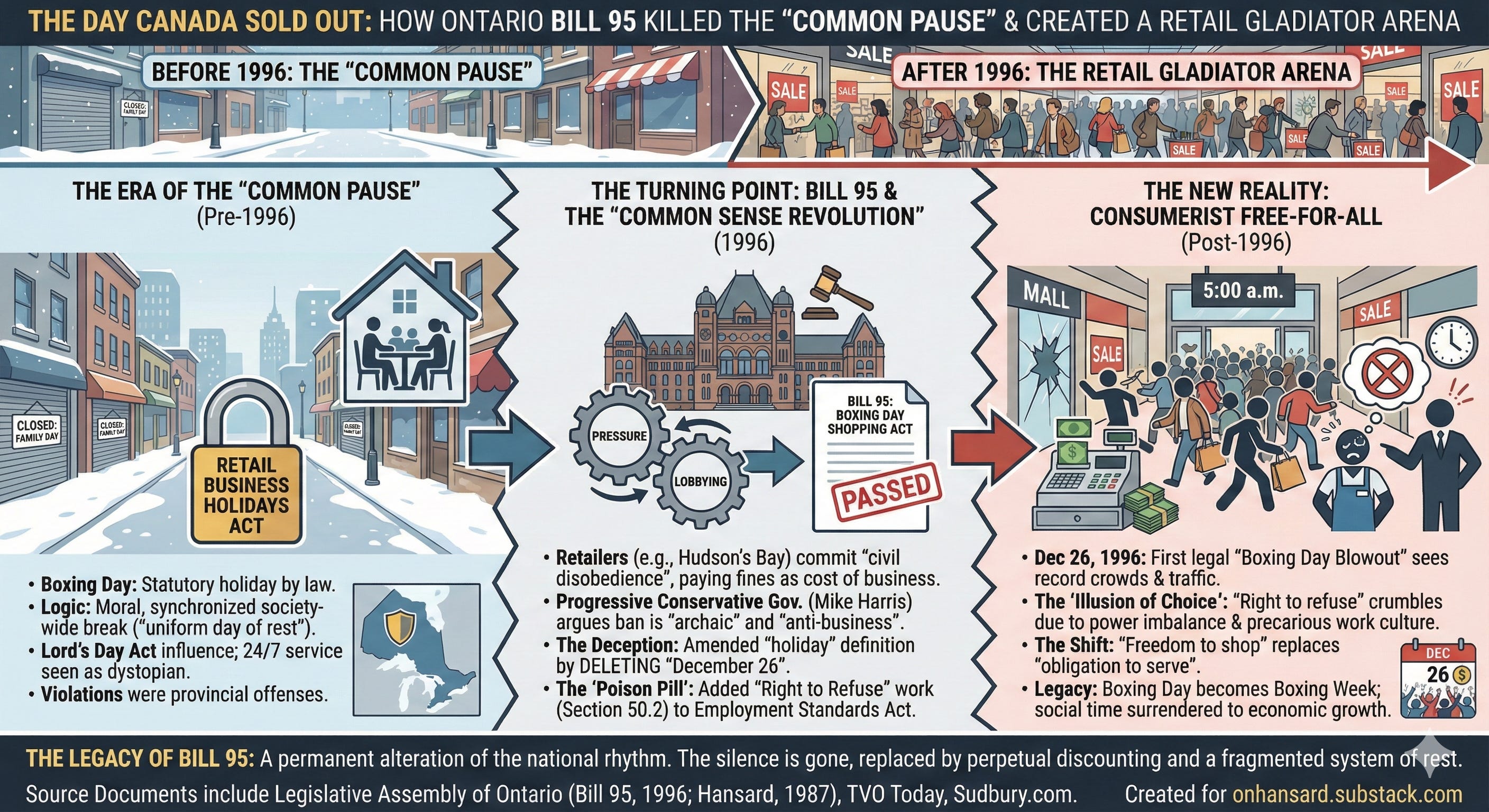
To understand the magnitude of Bill 95, you must first understand the world it destroyed. Through the 1970s and 80s, the Retail Business Holidays Act was the iron gatekeeper of Ontario commerce. It designated specific days, including Boxing Day, as statutory holidays where doing business was a provincial offense.
The logic was moral, not economic. The government argued that society required a synchronized break—a “uniform day of rest” where the pressures of the market could not intrude. It was a time when the Lord’s Day Act still cast a long shadow, and the idea of “24/7 service” was considered a dystopia, not a convenience.
But cracks were forming. In border towns like Windsor and Niagara Falls, Canadian retailers watched helplessly as potential customers drove across the bridge to Buffalo and Detroit, where American malls were open for business. By the early 1990s, the recession had made retailers desperate. They began to calculate the math of civil disobedience.
Major chains like Hudson’s Bay and electronics retailers started to test the electric fence. They would open their doors on Boxing Day, deliberately breaking the law. When the police arrived to issue fines—often capped at a manageable $10,000 or $50,000—the stores simply paid them out of the petty cash from their morning sales. The law had become a tariff, a mere cost of doing business.
The Mutiny of 1996
The dam broke in 1996. The Progressive Conservative government of Mike Harris, riding a wave of deregulation known as the “Common Sense Revolution,” targeted the Retail Business Holidays Act. They argued that the ban on Boxing Day shopping was archaic, a relic that punished Ontario businesses and treated adults like children.
Enter Bill 95: The Boxing Day Shopping Act, 1996.
The text of the bill was deceptively simple. It amended the definition of “holiday” in the existing Act by brutally excising “December 26.” With that deletion, the legal shield around the day evaporated.
However, the government knew this was a political minefield. Labor unions and religious groups were furious, predicting that the sanctity of the Christmas break would be cannibalized by profit. To quell the revolt, the drafters inserted a “poison pill” for employers—or so they claimed.
They amended the Employment Standards Act to include a “right to refuse.” Section 50.2 was rewritten to state that an employee could refuse an assignment of work on December 26. In theory, this meant that the malls could open, but the workers could choose to stay home.
It was a classic legislative sleight of hand: granting a right that was impossible to exercise.
The Illusion of Choice
The debate in the legislature was fierce. Opposition critics pointed out the obvious power imbalance. How could a part-time cashier, desperate for shifts in a precarious economy, look their manager in the eye and cite Section 50.2?
The transcript of the era reveals the skepticism. Critics argued that while the law said “refusal,” the culture of retail said “comply or vanish.” If a worker refused the Boxing Day shift, they might find their hours cut in January. The “freedom to shop” for the consumer became the “obligation to serve” for the worker.
Hansard records from the period show a government adamant that the market would self-regulate. They argued that overtime pay and the excitement of the sales would ensure a willing workforce. They painted a picture of a vibrant, booming economy where workers would happily trade a day of rest for time-and-a-half.
The bill passed. Royal Assent was granted. The gates were opened.
The First Morning After
December 26, 1996, marked the first legal “Boxing Day Blowout” in Ontario’s modern history. The results were immediate and staggering.
Shoppers, conditioned by years of cross-border envy, flooded the malls. The “quiet streets” were replaced by traffic jams stretching for kilometers around Yorkdale and the Eaton Centre. Retailers reported record-breaking profits in a single day, validating the government’s economic argument instantly.
But on the floor, the “right to refuse” crumbled as predicted. In the years that followed, the cultural expectation shifted rapidly. Working on Boxing Day went from being an anomaly to a requirement. Employment contracts were updated to normalize holiday work. The “common pause” was dead, replaced by a staggered, individualized system of days off that fragmented the collective rest of the community.
The Boxing Day Shopping Act did more than change store hours; it signaled the final victory of the consumer over the citizen. The protection of social time—time spent away from the market—was surrendered to the imperative of economic growth.
The Legacy of Bill 95
Today, the battles of 1996 seem like ancient history. We now live in the world Bill 95 created. Boxing Day has morphed further, bleeding into “Boxing Week” and “Pre-Boxing Day Sales,” diluting the event itself into a gray slurry of perpetual discounting.
Yet, the legacy of that legislative change remains in the Employment Standards Act. The “right to refuse” still exists on paper in Ontario, a ghost of the compromise made to pass the bill. But ask a retail worker today if they feel empowered to use it. The silence you hear in response is the only silence left on Boxing Day.
The passage of Bill 95 teaches us a brutal lesson about parliamentary power. A single deletion in a definition clause can alter the rhythm of a nation’s life. It took a century to build the tradition of the Boxing Day rest, and one vote to sell it off.
Source Documents
Legislative Assembly of Ontario. (1996). Bill 95, Boxing Day Shopping Act, 1996.
Legislative Assembly of Ontario. (1987, February 12). Official Report of Debates (Hansard).
TVO Today. (2018, December 27). Why Boxing Day shopping in Ontario used to be a really big deal.
Sudbury.com. (2024, December 27). Then & Now: Sudbury’s decades long fight for Boxing Day shopping.
UK Parliament. (2016, December 12). Retail Store Closure: Boxing Day - Hansard.
I wasn't pleased then, and can't say I've ever really made peace with the legislated changes. The switch from quality time with friends and family to pure consumerism served no one but retailers well. Now I don't think even retailers are well served. One doesn't see the same crowds flooding stores anymore now that the boxing day 'deals' have dried up except for true shopping addicts.
In the years since 1996 I went shopping on Boxing Day approximately zero times. Now I don’t shop in December either, except for food. Watching the scale of consumerism grow through the 1990s was truly alarming to me. Today’s “buy Canadian” movement is more to my liking - shopping for local food supports our actual neighbours, not multinational corporations.