


The House of Commons is currently debating a significant piece of cybersecurity legislation, Bill C-8, which aims to protect critical infrastructure. The debate reveals a fundamental tension between the need for national security and the protection of individual privacy, with opposition members raising stark warnings about potential government overreach.
This newsletter will take approximately 4 minutes to read.
NATIONAL SECURITY
Government Defends Sweeping New Cybersecurity Powers
Driving the news: The House of Commons held its second reading debate on Bill C-8, An Act respecting cyber security, which would grant the federal government new powers to protect Canada’s telecommunications systems.
Catch-up:
The bill is a response to growing cyber threats from state-sponsored actors, including China, Russia, Iran, and North Korea, which the government identifies as the greatest strategic threats to Canada.
It would allow the Minister of Industry, with cabinet direction, to order telecommunication service providers (like Rogers and Bell) to take specific actions, including removing equipment or even terminating services to a specific person.
Why it matters: The government argues these powers are essential to act quickly against urgent threats that could paralyze the country. However, opposition parties and civil liberties groups express grave concerns. Conservative MP Leslyn Lewis argued the bill could create a “digital prison,” allowing the government to cut off a person’s internet and phone services with secret orders, leaving no meaningful way for an individual to defend themselves. Her colleague, Dr. Matt Strauss, called the powers “Chinese Communist Party levels of government overreach.” The government maintains the bill includes safeguards for privacy and new transparency measures, but critics argue the language remains too broad and open to abuse.
IMMIGRATION
8% of International Students Potentially Non-Compliant, Officials Tell Committee
Driving the news: At a September 23rd meeting of the Standing Committee on Citizenship and Immigration, officials from IRCC revealed that recent data shows 8% of international students are “potentially non-compliant” with their study permit conditions.
The Big Picture:
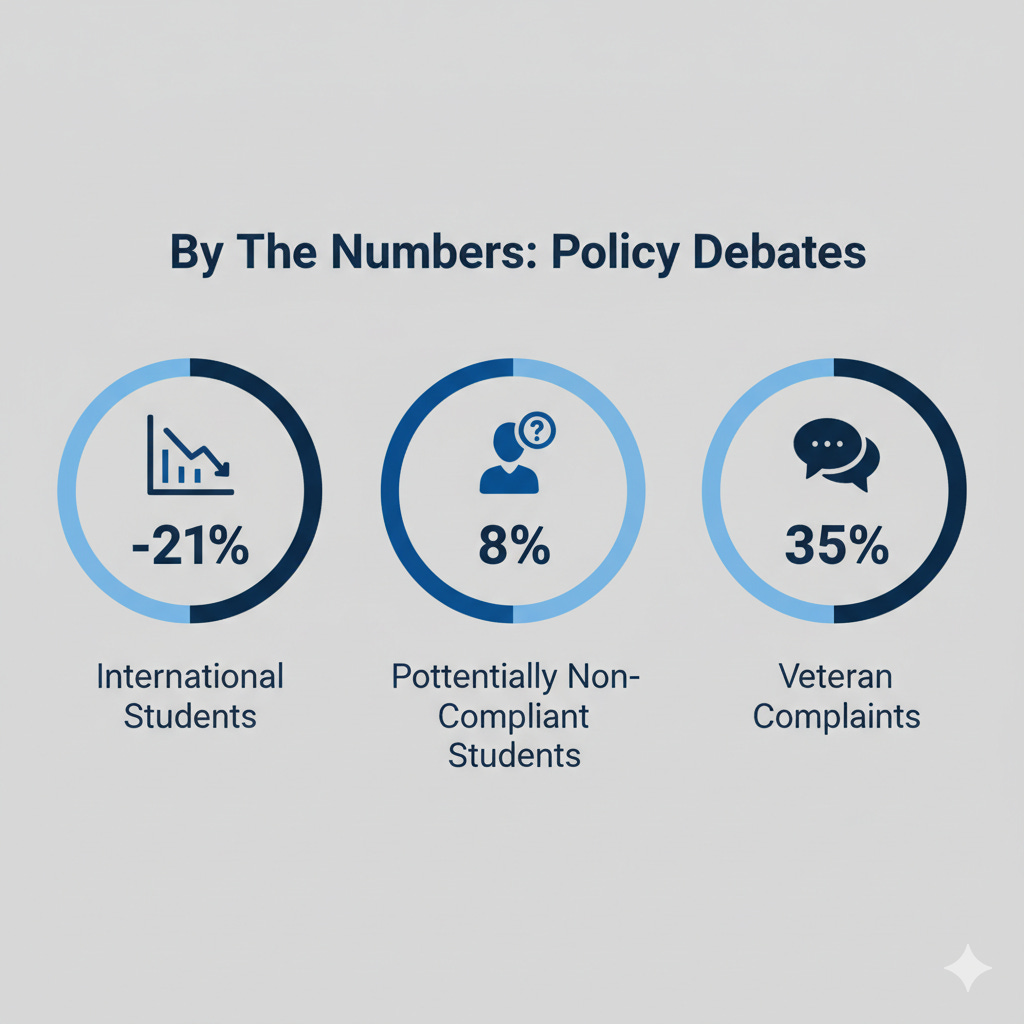
The committee is studying the international student program following its unprecedented growth in 2022 and 2023. The government has since introduced a cap, which has resulted in a 21% reduction in study permit holders and 98,000 fewer student arrivals so far in 2025 compared to last year.
Officials faced pointed questions about program integrity, particularly regarding a recent Radio-Canada report on an international criminal organization using the student visa system to enter Canada.
Why it matters: The 8% figure translates to a potential 47,175 individuals who may not be attending school as required. When pressed by Conservative MP Michelle Rempel Garner on the location of these individuals, officials stated they had not yet determined if they are fully non-compliant and that tracking them falls under the CBSA’s mandate. This raises significant questions about the government’s ability to monitor the program and enforce its rules, even with recent integrity measures like the verification of acceptance letters, which has already flagged over 14,000 potentially fraudulent applications.
VETERANS AFFAIRS
Access to a Family Doctor is Top Complaint from Veterans, Ombud Says
Driving the news: Colonel (Retired) Nishika Jardine, the Veterans Ombud, told the Standing Committee on Veterans Affairs on September 23rd that the number one concern she hears from veterans is the inability to access a family doctor.
Catch-up:
Military members receive their healthcare through the military medical system. Upon release, they must find a civilian doctor on their own, a task many find impossible.
The Ombud’s office has seen a 35% increase in individual complaints since 2020, which she attributes to a national outreach program that increased awareness of her office.
Why it matters: Without a primary care physician, veterans struggle to get prescriptions refilled and cannot obtain the diagnoses required to submit a disability claim to Veterans Affairs Canada. The Ombud also highlighted her priority recommendation: providing government-funded mental health treatment for veterans’ family members in their own right. She argued that families “shoulder the burden” of service and that legislative change is needed to provide them with support independent of the veteran’s own treatment plan.
On The Docket
The Standing Committee on Health voted to prioritize three new studies. The first will examine the impact of federal immigration policy on healthcare and barriers for internationally-educated health professionals, the second will study antimicrobial resistance, and the third will look at Canada’s “pharmaceutical sovereignty.”
During Question Period on October 3rd, the Conservative opposition highlighted that 86,000 Canadians have lost their jobs since the new Prime Minister took office, citing recent losses at Imperial Oil and GM. The government defended its record, pointing to new trade agreements and investments.
Opposition parties repeatedly called on the government to pass the Conservative “jail not bail act,” blaming the government’s Bill C-75 for a rise in violent crime. The government stated it would introduce its own new bail reform legislation this session.
In Their Own Words
Dr. Matt Strauss, Conservative MP, on Bill C-8
“The clause reaches Chinese Communist Party levels of government overreach, and the Liberals should be ashamed of themselves.”
Why it matters: This quote from the October 3rd debate in the House of Commons encapsulates the core of the opposition’s argument against the cybersecurity bill. Dr. Strauss and his colleagues contend that the bill’s language, particularly the power to cut off an individual’s telecommunications services under the broad pretense of “any threat,” grants the government unchecked power that is antithetical to Canadian constitutional rights.
Also Noteworthy
The Minister of Veterans Affairs has instructed her department to revert to the previous funding format for Remembrance Day wreaths for this year after proposed changes caused disruption.
The Standing Committee on Health has invited the Minister of Health, Marjorie Michel, to appear for two hours by October 10th to discuss her mandate.
Canada Post is losing $10 million a day, according to the Minister of Government Transformation, who defended the government’s intervention in the ongoing labour dispute.
A petition was tabled in the House of Commons calling on the government to repeal changes in Bill C-47 that regulate natural health products in the same way as therapeutic chemical drugs.
The government faces calls to ban the further transfer of Canadian fishing licenses and quotas to foreign interests, with petitioners arguing it hurts coastal communities and reconciliation efforts.
The Data Brief
-21%: The reduction in the number of study permit holders in Canada as of July 31, 2025, compared to the end of 2023, following the introduction of a national cap.
35%: The increase in individual complaints received by the Office of the Veterans Ombud since 2020.
47,175: The potential number of international students who are non-compliant with their study permits, based on IRCC’s finding that 8% of students were “potentially non-compliant.”
Sources:
Canada. Parliament. House of Commons. (2025, October 3). Debates of the House of Commons (Hansard) (No. 033). 45th Parliament, 1st Session.
Canada. Parliament. House of Commons. Standing Committee on Citizenship and Immigration. (2025, September 23). Evidence (No. 003). 45th Parliament, 1st Session.
Canada. Parliament. House of Commons. Standing Committee on Health. (2025, September 23). Evidence (No. 002). 45th Parliament, 1st Session.
Canada. Parliament. House of Commons. Standing Committee on Veterans Affairs. (2025, September 23). Evidence (No. 003). 45th Parliament, 1st Session.