


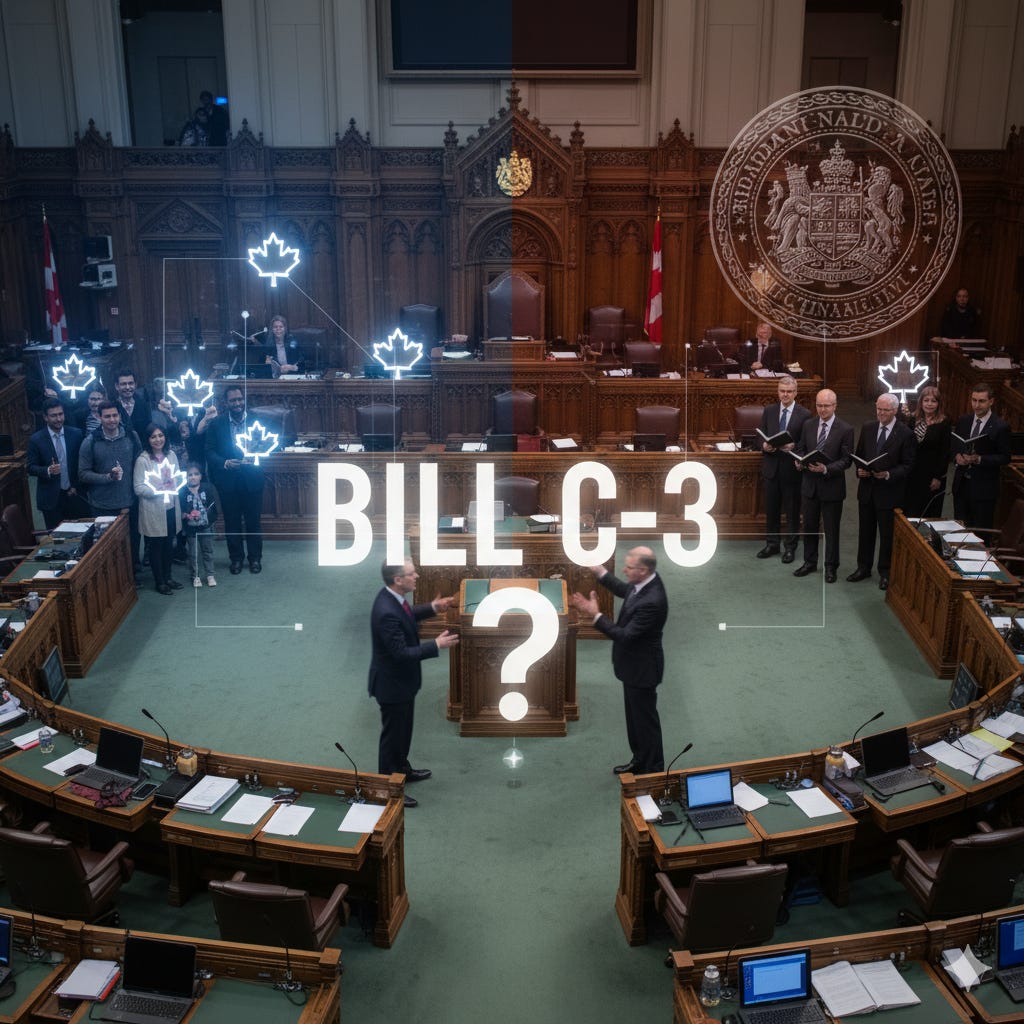
The House of Commons session on Friday, October 24, 2025, put a fundamental question on the floor: What does it mean to be a Canadian citizen? While the day’s agenda covered everything from international trade disputes to a rare moment of cross-partisan unity, the central debate over Bill C-3, an act to amend the Citizenship Act, exposed deep divisions over who gets to be Canadian and what obligations come with that status. The debate serves as a proxy for a much larger, more fraught conversation about national identity in an era of global mobility and rising economic anxiety.
The Battle Over ‘Lost Canadians’ and Bill C-3
At the heart of the day’s debate was Bill C-3. The bill is a response to an Ontario Superior Court ruling that found parts of the Citizenship Act unconstitutional. Specifically, it addresses the first-generation limit, a rule established by the previous Conservative government that prevents Canadian parents who were themselves born abroad from automatically passing their citizenship to their children if those children are also born outside of Canada.
This rule created a class of people often called “lost Canadians,” separating families and, in some cases, rendering children stateless. The government’s bill originally sought to fix this by allowing a Canadian parent born abroad to pass on citizenship if they could demonstrate a substantial connection to Canada, defined as having a cumulative physical presence of 1,095 days (three years) in the country before their child’s birth.
However, when the bill went to committee, the Conservative Party and the Bloc Québécois joined forces to pass several key amendments. They argued the original bill was too loose and created a pathway for what they termed citizenship of convenience. Their amendments sought to align the rules for citizenship by descent with those for naturalization, requiring language tests, a citizenship test, security screenings, and a more stringent residency requirement.
What are the competing visions?
On one side, you have members like Jenny Kwan of the NDP, the bill’s most passionate defender in its original form. She argued that the committee’s amendments are punitive, unconstitutional, and create two classes of Canadians. Her position is that citizenship is a fundamental right for the children of Canadians, not a privilege to be earned like an immigrant. She accused the Conservatives and Bloc of conflating citizenship rights with immigration anxieties, weaponizing the narrative of so-called Canadians of convenience to justify exclusionary rules. She argued that Canadians who live, work, or study abroad, and their children born abroad, should never be treated as lesser citizens.
On the other side, you have the Conservative and Bloc position, articulated forcefully by Michelle Rempel Garner. She argued that Canadian citizenship has immense value and that Parliament, not the courts, has the supreme authority to set the rules for acquiring it. She criticized the Liberal government for not challenging the court ruling and for embracing an ideology she described as postnationalism, which devalues Canadian identity. The amendments, she argued, were common-sense measures to ensure that anyone granted citizenship has a genuine connection to the country, understands its values, and accepts its responsibilities. She stated that language is a unifier and is integral to Canadian identity, especially in Quebec.
The Bloc Québécois added a procedural complaint, questioning why the government and NDP were now trying to overturn amendments that were passed by a majority at committee in a minority Parliament. This raises important questions about the role and power of parliamentary committees.
Economic Anxiety and Political Accountability
The tensions over national identity were amplified during Oral Questions, where the opposition relentlessly attacked the government’s economic record. The dominant theme was failure. Failure to secure a trade deal with the United States, failure to protect Canadian jobs, and failure to support young people.
The news that U.S. President Trump had terminated trade negotiations provided a major opening for the opposition. Conservative Michael Barrett questioned how the termination of negotiations could be considered great progress, mocking the Prime Minister’s optimistic assessment. With thousands of job losses in the auto, forestry, and steel industries, the opposition painted a picture of a government that is out of touch and failing to protect Canadian workers from external pressures.
This narrative was tightly woven with the plight of young Canadians. Multiple Conservative members rose to criticize the Prime Minister for telling students they would have to make sacrifices. After a decade of Liberal government, they argued, young people have already sacrificed the dream of home ownership and are facing the worst youth unemployment numbers in decades. The government’s response focused on its “generational investments” in housing, jobs, and social programs like the national school food program, which it accused the Conservatives of dismissing.
The Ethics Commissioner Under Fire
Beyond policy disputes, a serious institutional challenge emerged. Conservative MP Michael Barrett raised a question of privilege, accusing the Conflict of Interest and Ethics Commissioner of exceeding his authority. Barrett claimed the Commissioner unilaterally changed official forms required for members of Parliament, bypassing a procedure explicitly laid out in the House’s Standing Orders that requires committee and House approval.
This is more than just a fight over paperwork. As Barrett argued, it represents a potential contempt of Parliament and disrespect for the authority of the House of Commons. He framed it as part of a troubling pattern where government bodies and officials feel they can defy Parliament’s orders. Another Conservative MP, Scott Reid, added historical context, alleging a long-standing pattern of abuse from the commissioner’s office, including the use of unauthorized non-disclosure agreements to silence MPs under investigation. This issue touches on the fundamental principle of parliamentary supremacy, and the Speaker has taken the matter under advisement.
A Moment of Unity: Evan’s Law
In a striking contrast to the day’s partisan rancor, the House came together to debate Bill C-222, also known as Evan’s law. This private member’s bill, introduced by Liberal MP Terry Beech, offers a simple, compassionate fix to the Employment Insurance Act.
Currently, if a parent receiving parental benefits tragically loses their child, those benefits are immediately cut off. The parent must then apply for sickness benefits and repeatedly confirm their eligibility every two weeks, forcing them to relive their trauma with a new government agent each time. Evan’s law would allow grieving parents to continue receiving their parental benefits without interruption, removing a cruel and unnecessary administrative burden during an unimaginable time.
The debate was marked by deeply personal and moving speeches from all parties. Members shared their own stories of loss and expressed unanimous support for the bill. Conservative MP Dave Epp spoke emotionally about the loss of his own son, Brenton, 37 years ago, and the bureaucratic insensitivity his family faced on the morning of the funeral. It was a powerful reminder that despite profound political disagreements, Parliament can still find common ground rooted in shared humanity.
The Data Brief
Citizenship Under Debate: Bill C-3 has become a focal point for a larger debate about Canadian identity, with a clear divide between viewing citizenship as an inherent right for descendants versus a privilege that requires demonstrating a deep, ongoing connection.
Economic Pressure Mounts: The opposition is effectively tying job losses in key sectors like auto and forestry to the government’s perceived failure in international trade negotiations, creating a powerful narrative of economic decline.
Institutional Rules Tested: A formal challenge to the authority of the Ethics Commissioner has been lodged, raising fundamental questions about the accountability of officers of Parliament and the supremacy of the House of Commons.
Compassion Amid Conflict: Despite the deep divisions, the unanimous support for Evan’s law shows that Parliament can unite on issues of basic human compassion, offering a stark contrast to the partisan battles that dominate proceedings.
Source Documents
House of Commons. (2025, October 24). House of Commons Debates (Hansard), 45th Parliament, 1st Session (Vol. 152, No. 043).