


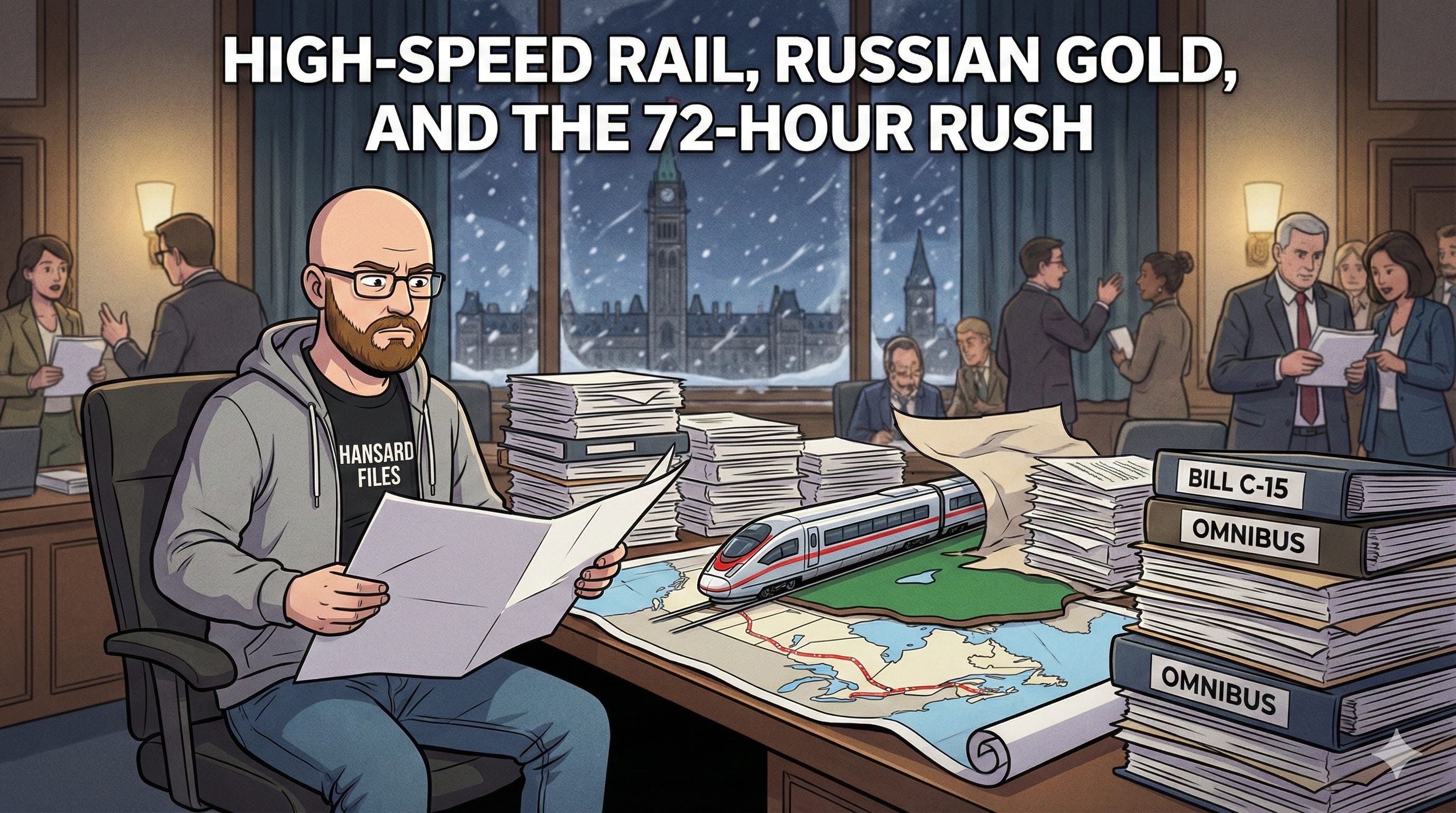
Ottawa is never colder than when Parliament is in a rush. On the evening of December 10, 2025, the wind howled off the Ottawa River, but inside the Senate committee rooms, the temperature was rising for a different reason: Bill C-15.
The Budget Implementation Act had landed like a meteorite—hundreds of pages of legislative density designed to reshape the Canadian economy before the winter break. But buried within the legal text was Division 1, a provision that Chief Francis Verreault-Paul of the Assembly of First Nations Quebec-Labrador warned would trigger a conflict as old as Canada itself.
“The route is declared ‘works for the general advantage of Canada,’” Verreault-Paul told the Transport Committee, his voice cutting through the dry procedural air.
That phrase is the legislative equivalent of a nuclear option. It allows the federal government to bypass local jurisdiction to build infrastructure. The infrastructure in question? The Alto High-Speed Rail corridor, a shiny, futuristic vision of modernity connecting Toronto to Quebec City. But to the Indigenous leaders watching the clock tick down on the 2025 session, it looked less like progress and more like a repetition of history: the steel spine of a railway slicing through unceded territory without consent.
The Iron Horse Returns
The centerpiece of Bill C-15 is the High-Speed Rail Network Act. Ideally, it promises a green transportation revolution. Practically, it grants VIA HFR Inc. sweeping powers to acquire and expropriate land.
Regional Chief Abram Benedict of the Chiefs of Ontario did not mince words. He reminded the committee of the “land theft for railway” that defined the 19th century. “The Government of Canada is once again attempting to advance major project development by overriding First Nations’ inherent rights,” Benedict said.
He revealed that Indigenous groups had successfully fought to remove the Indian Act from the scope of previous legislation, Bill C-5, to prevent this exact scenario. Yet, here it was again, buried in Division 1 of C-15. The bill proposes “fast-track approval” and “expropriation powers” that bypass the standard regulatory reviews.
“First Nations are not against development,” Benedict clarified. “They are against the erosion of rights.”
The tension in the room was palpable. The government wants to build faster, arguing that national interest projects must move at the speed of the 21st century. But as Sandra Schwartz of the Canadian Parks and Wilderness Society noted, speed often comes at the cost of the environment. She warned against choosing the “cheapest option” over the least harmful one, advocating for a route that respects biodiversity hotspots.
But for the Chiefs, the issue wasn’t just biodiversity; it was sovereignty. If the “general advantage” clause stands, the Crown could theoretically seize ancestral land before a single consultation table is set.
The Russian Windfall
While the Transport Committee fought over physical territory, the Foreign Affairs Committee was engaged in a different kind of warfare: economic.
Down the hall, officials from the Department of Finance and Global Affairs Canada were unpacking Division 18. This section of Bill C-15 targets the “windfall profits” generated by immobilized Russian sovereign assets.
Since Russia’s invasion of Ukraine in 2022, billions in Russian central bank assets have been frozen in Western financial institutions. Euroclear, a clearinghouse in Belgium, sits on €173 billion of these assets, generating €5 billion a year in interest alone.
“Financial institutions do not face competition to retain immobilized assets,” explained Erin Hunt, a Director General at Finance Canada. “They can remain on their balance sheets for extended periods, generating undue profits.”
Bill C-15 proposes a “made-in-Canada” mechanism to seize these profits and redirect them to the reconstruction of Ukraine. It is a bold move, aligning Canada with European allies, but it introduces a new level of state intervention in the banking sector. The bill empowers the Minister of Finance to order financial institutions to pay these profits directly to the Receiver General.
Simultaneously, Division 27 tightens the Export and Import Permits Act, allowing the government to curb trade to ensure “economic security.” Larisa Galadza of Global Affairs Canada described it as a tool to prevent dependence on “unreliable foreign suppliers”—a diplomatically veiled reference to supply chain vulnerabilities exposed by recent geopolitical tensions.
The Crypto Frontier
If land and war weren’t enough, Bill C-15 also attempts to drag the Canadian financial system into the digital age. In the Banking Committee, Ron Morrow of the Bank of Canada outlined the new responsibilities the central bank would assume under Division 9: the regulation of stablecoins and the enforcement of “consumer-driven banking” (open banking).
“It’s important for Canada to have its own regulatory framework for stablecoins,” Morrow said. The bill proposes a Stablecoin Act that would force issuers of crypto-assets pegged to fiat currencies to maintain 1:1 reserves, ensuring a digital dollar is actually worth a dollar.
This is the government attempting to tame the Wild West of cryptocurrency. But Senators raised concerns about the sheer weight of bureaucracy being built. Senator Pamela Wallin pointed out the dizzying array of regulators involved: the Bank of Canada, OSFI, FINTRAC, and provincial securities commissions.
“It’s almost like we’re going to have to have something to oversee how the bureaucracy is talking to the bureaucracy,” Wallin remarked dryly.
The stakes for consumers are high. Open banking promises to let Canadians share their financial data with third-party apps to get better rates. But as Senator Toni Varone noted, the security implications are terrifying. “I’ve been caught in situations where the 10 different passwords I use are no longer working,” he said, questioning if the burden of security is being shifted onto exhausted consumers.
The Policing Gap
Amidst the high-level debates on billions of dollars and high-speed trains, a quieter, more desperate crisis was highlighted in the Committee on Indigenous Peoples. They were studying Division 35, which amends the Cree-Naskapi Commission Act to modernize policing services.
While the amendment was technical—fixing a territorial discrepancy for the Naskapi Police Force—it opened a wound regarding the reality of Indigenous policing across Canada.
Senator Mary Jane McCallum raised a point that silenced the room. She noted that in many First Nations, the RCMP refuses to enforce local bylaws because they “don’t know if they are Charter compliant.”
“They’re at a standstill,” McCallum said. “They make their own laws... but they cannot prosecute.”
It was a stark illustration of the disconnect between the Ottawa bubble and the ground. While Parliament rushed to pass laws about high-speed rail and crypto-assets, basic rule of law in Indigenous communities remained in a jurisdictional limbo, unsupported by essential service designations.
The Final Hours
As the committee meetings adjourned on the evening of December 10, the scope of Bill C-15 became clear. It is a legislative leviathan. In a single stroke, it aims to build a railway through unceded land, seize the profits of a nuclear superpower, and regulate the digital currency of the future.
But the speed of its passage has left stakeholders breathless and wary. Chief Verreault-Paul cited a recent promise by Prime Minister Carney that national projects must be “carriers of reconciliation.” The text of Bill C-15, with its revival of expropriation powers, suggests that the old ways of doing business—where the “general advantage of Canada” trumps local rights—are far from extinct.
The bill moved on, propelled by the relentless calendar of the holiday break. But as the Senators packed their binders, the question remained: in the rush to build the future, who is being left in the past?
Independent journalism requires digging through thousands of pages of transcripts to find the story. Subscribe to Hansard Files to support the investigation.
Source Documents
Standing Senate Committee on Transport and Communications. (2025, December 10). Evidence (Issue 17). Senate of Canada.
Standing Senate Committee on Foreign Affairs and International Trade. (2025, December 10). Evidence (Issue 18). Senate of Canada.
Standing Senate Committee on Banking, Commerce and the Economy. (2025, December 10). Evidence (Issue 19). Senate of Canada.
Standing Senate Committee on Indigenous Peoples. (2025, December 10). Evidence (Issue 18). Senate of Canada.
Standing Senate Committee on Agriculture and Forestry. (2025, December 9). Evidence (Issue 17). Senate of Canada.
Standing Senate Committee on Legal and Constitutional Affairs. (2025, December 10). Evidence (Issue 20). Senate of Canada.
For some reason, I'm reminded of a situation that occurred in BC a few decades ago. I didn't have direct knowledge of this; it was relayed to me by a friend.
An FN chief bought a new truck. While showing it off, he managed to crash hard enough that the truck needed extensive & expensive repairs. The dealership registered the truck before delivery to the reserve but the chief hadn't made the arrangements to have the truck insured. From memory, there is a 10 day grace period. So when the chief went to make insurance arrangements, he also decided to make an insurance claim for the repairs.
BC has a curious system called ICBC, the Insurance Corporation of BC, which started off as being just a government mandated no-fault insurance but eventually ended up being merged with the Motor Vehicle Branch for licensing drivers and registering vehicles.
ICBC declined his claim because the reserve was not part of ICBC's coverage area. The only vehicles insured on the FN were those who expected to go off the reserve onto the provincial roadways. Within the reserve, no provincial traffic laws were enforced by the choice of the FN council.
The chief found this situation unsatisfactory and declared he would bring the FN into the coverage area so he could get his truck fixed. Great idea... until the residents pointed out most people on the reserve were unlicensed drivers using uninsured vehicles on the FN and most of the vehicles would not pass vehicle safety inspections.
I moved out of the area before they resolved the situation but it looked like the chief was going to have to fix his own truck.
The Law of Unintended Consequences is the second most powerful law of the Universe next to Murphy's Law... and unlike most laws, Unintended Consequences applies equally on FN reserves.
High speed rail to benefit those Canadians already well served by mass transportation options warrants the deployment of the "works for the general advantage of Canada" nuclear option, but pipelines to get energy products to tidewater do not?