


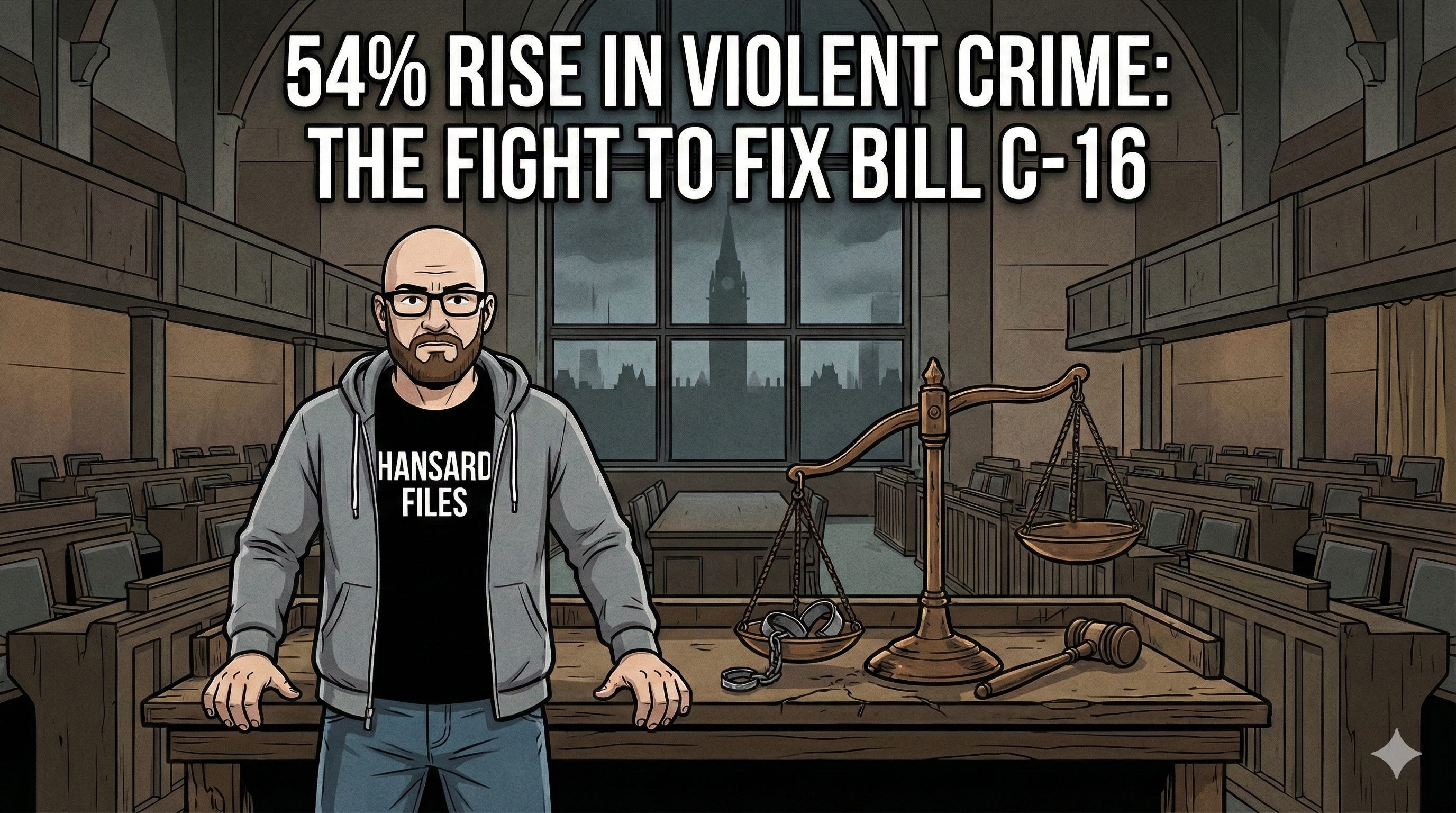
The House of Commons returned from its winter break on January 26, 2026, to a chamber that felt colder than the Ottawa air outside. The first order of business was not a celebration of the new year, but a somber notification of a vacancy: the seat for University—Rosedale was empty. Chrystia Freeland, the Deputy Prime Minister and Minister of Finance, had resigned effective January 9. Her departure left a void on the government benches just as the Liberal administration faced its most ferocious test yet on public safety.
The government was trying to turn the page with Bill C-16, the Protecting Victims Act. They promised it would be the most significant update to the Criminal Code in a generation. But as the week unfolded, the debate revealed a deep ideological chasm regarding how Canada handles its most dangerous offenders.
Conservative MP Arnold Viersen wasted no time stripping away the parliamentary pleasantries. He rose to tell the story of a fourteen-year-old girl in Lethbridge, Alberta. Police had found her in medical distress, confined for days alongside two other teenagers. She had been drugged and exploited. Her alleged trafficker, Skye Atoa, appeared in court and was released on bail almost immediately. Police, anticipating the revolving door, were waiting outside the courthouse. They rearrested him thirty minutes later for breaching his conditions.
Viersen used this harrowing narrative to anchor the opposition’s central thesis: the government’s catch-and-release bail policies were not a glitch in the system, but a feature of it. He cited another case in Brooks, Alberta, where a man facing eight charges, including sexual assault and trafficking, was immediately granted bail.
The Revolving Door
The statistical backdrop to these anecdotes was grim. Opposition MPs cited data showing violent crime had risen 54 percent since the Liberals took office. Extortion was up 350 percent. In communities like Surrey and St. Thomas, gunfire was becoming a terrifyingly common sound.
The government’s response was Bill C-16. Justice Minister Sean Fraser presented the legislation as a balanced, Charter-compliant solution that would restore order without inviting the Supreme Court to strike down laws. The bill proposed a suite of aggressive measures: elevating femicide—the killing of women and girls—to automatically qualify as first-degree murder, criminalizing “coercive control” in intimate relationships, and cracking down on the non-consensual distribution of deepfake pornography.
Liberal MP Julie Dzerowicz argued that the bill was a direct response to the lived reality of victims. She noted that in 2024 alone, there were 100 victims of intimate partner violence in Canada. She described the insidious nature of coercive control, where abusers isolate victims from friends and finances long before a physical blow is struck. For the government, Bill C-16 was about modernizing the law to catch predators who used technology and psychological terror as weapons.
The Safety Valve Controversy
However, the debate quickly settled on a technical but explosive provision regarding mandatory minimum penalties. The government claimed Bill C-16 would “restore” mandatory minimums that had previously been struck down by the courts. But there was a catch. The bill included a “safety valve”—a judicial off-ramp that would allow judges to bypass these minimum sentences if they felt the punishment would be “cruel and unusual.”
Conservative MP Michael Guglielmin attacked this provision as a Trojan horse. He argued that by codifying a loophole, the government was effectively turning mandatory minimums into mere suggestions. He warned that this “safety valve” would apply to offenses ranging from extortion with a firearm to human trafficking. In his view, the bill was a capitulation to the courts rather than an assertion of Parliament’s will.
Liberal MP Lisa Hepfner defended the measure. She cited a hypothetical used by the Supreme Court: a seventeen-year-old boy sharing an intimate photo of his sixteen-year-old girlfriend. Under strict mandatory minimums, that teenager could face life-altering prison time and sex offender registration. The government argued that without the safety valve, the Supreme Court would simply strike down the laws again, leaving victims with no protection at all. They positioned Bill C-16 as the “middle ground” that would finally make the laws stick.
A Nation in Distress
While the legal arguments regarding Bill C-16 raged inside the chamber, the economic reality outside threatened to overwhelm the government’s agenda. The debates on January 28 painted a picture of a country fraying at the edges. NDP MP Heather McPherson declared a “national housing emergency,” describing encampments growing in every major city.
The cost of survival had become the dominant anxiety for millions. Conservative MPs hammered the government with data showing Canada had the highest food inflation in the G7, at 6.2 percent. It now cost $17,600 a year to feed a family of four—a jump of $1,000 from the previous year. In a heated exchange, MP Richard Bragdon noted that 2.2 million Canadians were visiting food banks every single month.
The government attempted to counter this narrative by announcing a new “Groceries and Essentials Benefit” that would provide up to $1,900 for working families. Liberal MPs like Adam van Koeverden argued that climate change, not federal taxes, was the primary driver of food prices, citing the rising cost of imported goods like coffee and lettuce. But the opposition dismissed the rebate as a “band-aid” on a wound inflicted by the carbon tax and fuel regulations.
The Political Standoff
The tension in the House was palpable. The Liberals accused the Conservatives of filibustering critical safety legislation. Kevin Lamoureux, the Parliamentary Secretary to the Government House Leader, expressed frustration that the opposition was blocking the passage of bail reform while simultaneously complaining about crime. He demanded to know if the Conservatives would commit to passing the bill by the end of February.
The Conservatives fired back, arguing that the government controlled the calendar and had chosen to prioritize other bills, including online hate speech legislation (Bill C-9), over public safety. They pointed to the fact that the government had months to move on bail reform but had allowed it to languish in committee.
As the week closed, the fate of Bill C-16 remained uncertain. The government viewed it as a necessary evolution of the justice system—one that recognized new forms of violence and respected the Charter of Rights and Freedoms. The opposition viewed it as a surrender—a bill that used the language of toughness while giving judges the discretion to let offenders walk free.
With a vacancy in a key Toronto riding, a housing crisis spiraling out of control, and a justice system under the microscope, the 45th Parliament began its winter session not with a sense of renewal, but with a desperate scramble to prove it could still protect its citizens.
The “Hansard Files” are sourced from thousands of pages of unedited parliamentary transcripts to bring you the stories that usually get buried in committee. Subscribe today to support independent investigative journalism.
Source Documents
House of Commons. (2026, January 26). House of Commons Debates (Vol. 152, No. 073).
House of Commons. (2026, January 27). House of Commons Debates (Vol. 152, No. 074).
House of Commons. (2026, January 28). House of Commons Debates (Vol. 152, No. 075).
House of Commons. (2026, January 29). House of Commons Debates (Vol. 152, No. 076).
Something that doesn't get much press is the fact Skye Atoa is an immigrant from New Zealand.