


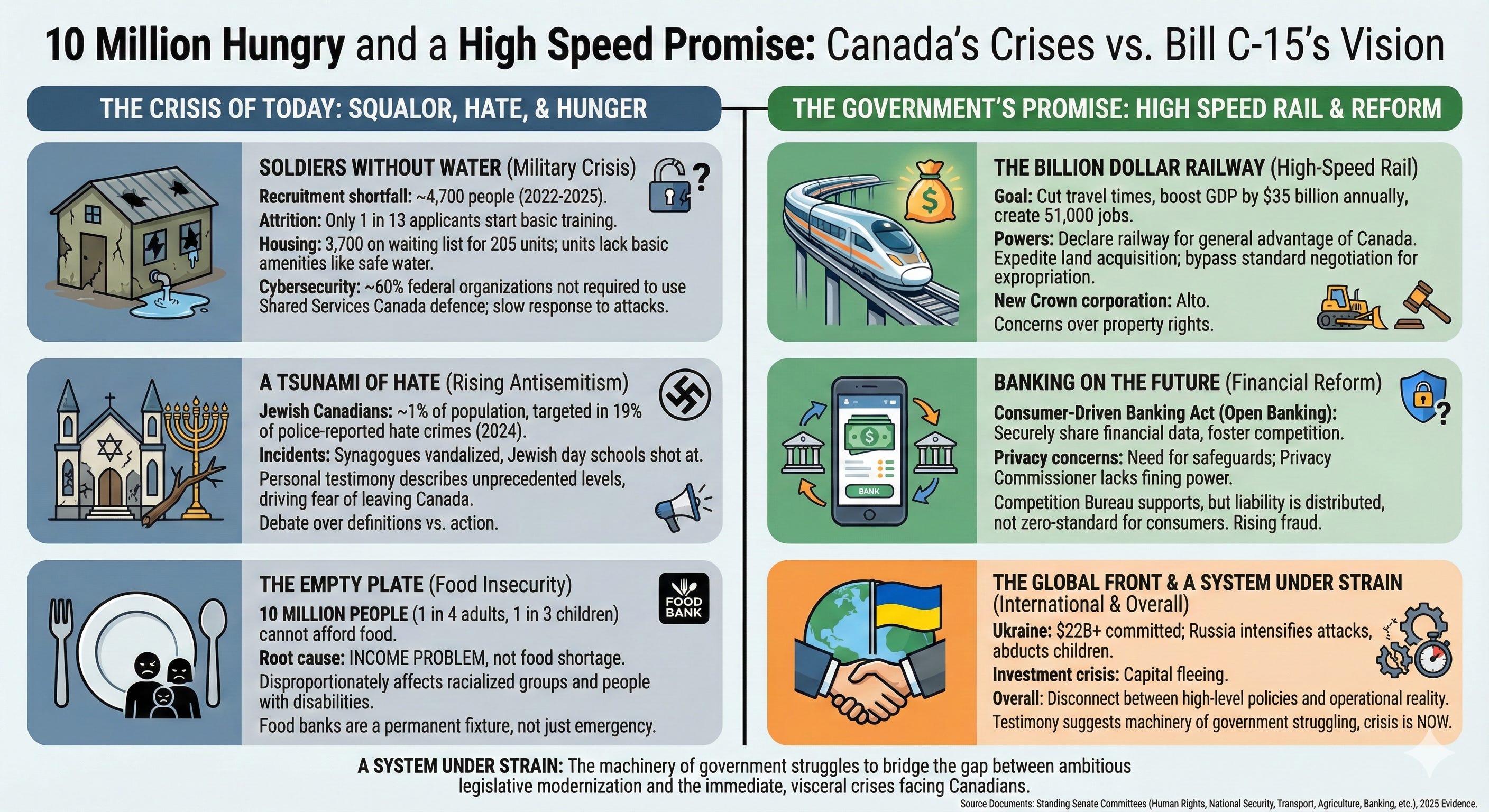
In the quiet, carpeted committee rooms of Parliament Hill, the dry language of legislation often masks the visceral reality of life in Canada, but this December was different. As senators gathered to scrutinize Bill C-15, the government’s latest budget implementation act, they were met not with abstract policy debates, but with a series of alarming snapshots of a nation straining at its seams. The testimony painted a picture of a country where soldiers lack basic amenities, Jewish Canadians fear for their safety in their own neighbourhoods, and one in four residents cannot afford to buy groceries. Against this backdrop of social fragility, the federal government pitched a transformative vision of the future anchored by high-speed rail and banking reform, setting up a stark contrast between the Canada of tomorrow and the crisis of today.
Soldiers Without Water
The most damning indictment of current state capacity came from the Auditor General of Canada, Karen Hogan, who appeared before the Senate Committee on National Security, Defence and Veterans Affairs. Her testimony dismantled the assumption that the Canadian Armed Forces could adequately house and train the men and women charged with defending the nation. Hogan revealed that between 2022 and 2025, the military fell short of its recruitment targets by approximately 4,700 people. Even more concerning was the attrition rate within the recruitment process itself, where only one in thirteen applicants ever started basic training.
The crisis extended far beyond recruitment numbers into the very living conditions of those who serve. Hogan reported that National Defence is failing to manage living accommodations to meet operational requirements. The details were graphic and disturbing. Some military housing units were in such poor condition that they lacked basic amenities, including safe drinking water and working toilets.
The committee heard that the Canadian Forces Housing Agency had no plan to build enough new units to fill the existing gaps. The assessment of housing needs was based on data from 2011, ignoring over a decade of market changes and population growth. Senator McNair noted the staggering statistic that there were 3,700 applicants on a waiting list for a mere 205 housing units available in the spring.
This logistical failure was compounded by a fragmented approach to cybersecurity. Hogan warned that nearly 60 percent of federal organizations are not required to use the cybersecurity defence services offered by Shared Services Canada and the Communications Security Establishment. During a recent major cyberattack, slow coordination and limited information sharing extended the time attackers had access to public servants’ personal information. The image presented was one of a defence apparatus struggling to manage its own infrastructure while facing increasingly sophisticated external threats.
The Billion Dollar Railway
While the military struggled to fix leaking pipes and fill its ranks, the government laid out plans for a massive infrastructure project intended to reshape the economic corridor between Quebec City and Toronto. Vincent Robitaille, Assistant Deputy Minister at Transport Canada, outlined the High-Speed Rail Network Act contained within Bill C-15. The project promises to cut travel times in half, boost the GDP by $35 billion annually, and create over 51,000 jobs.
However, the ambition of the project was matched by the extraordinary powers the government sought to realize it. The legislation proposed declaring the railway line to be for the general advantage of Canada, effectively asserting federal jurisdiction over the entire route. More controversially, it included provisions to expedite land acquisition. Robitaille explained that the geometric requirements of high-speed trains impose strict limits on track curvature, leaving a narrow range of viable alignments. To navigate this, the bill would allow the new Crown corporation, Alto, to purchase land proactively and introduce a temporary notice prohibiting work on lands potentially needed for the project.
Senators raised significant concerns about the expropriation powers. The legislation would allow land acquisition to begin before the impact assessment process was complete. Furthermore, the bill proposed removing the requirement for a negotiation process between a willing buyer and a willing seller before initiating expropriation, although Robitaille insisted that negotiation would still be the preferred method. Senator Simons questioned why the government felt the need to bypass standard negotiation requirements, suggesting it was a significant overreach.
The tension in the room was palpable as witnesses discussed the balance between national interest and property rights. While the government positioned high-speed rail as a nation-building necessity that would link economic hubs and reduce carbon emissions, the mechanism for achieving it required a suspension of normal procedural friction. It was a bold bet on future prosperity, requiring immediate legislative force to cut through the delays that have plagued Canadian infrastructure projects for decades.
A Tsunami of Hate
While the Transport Committee debated the future of rail, the Committee on Human Rights was confronting a much darker present reality. The rise of antisemitism in Canada has reached levels that witnesses described as unprecedented. Andrew Brown, Associate Deputy Minister at Canadian Heritage, provided a stark statistical backdrop: in 2024, Jewish Canadians, who make up only about 1 percent of the population, were the targets of 19 percent of all police-reported hate crimes.
Mohammed Hashim, CEO of the Canadian Race Relations Foundation, recounted a litany of recent attacks. In Toronto, a synagogue was vandalized for the tenth time, despite the installation of cameras and reinforced glass. A Jewish day school was shot at three separate times. Hashim argued that these incidents sent a singular message: that Jews cannot be safe in Canada.
The testimony became deeply personal when Artur Wilczynski, a retired public servant and son of Holocaust survivors, spoke. He described a level of antisemitism he had never experienced in his 56 years in the country. He spoke of the demonization of Israel and Zionism being intertwined with skyrocketing hate, and the fear that was driving some Jewish Canadians to consider leaving the country.
The committee heard divergent views on how to define and combat this hatred. Some witnesses, including Wilczynski, argued that debates over definitions were a distraction from the urgent need for action and enforcement of existing laws. Others, such as Professor Mira Sucharov and Professor Ivan Kalmar, warned against conflating antisemitism with anti-Zionism or criticism of Israeli government policy. They argued that definitions which blur these lines could chill academic freedom and legitimate political speech.
The discussion revealed a fractured social landscape where communities feel besieged and the mechanisms of justice seem unable to stem the tide. While statistics from early 2025 suggested a slight dip in police-reported hate crimes, witnesses cautioned that this might reflect a lack of trust in police and a reluctance to report rather than a genuine decrease in hate. The government’s response, including the Action Plan on Combatting Hate, was presented as a step forward, but the testimony suggested that for many Canadians, the feeling of safety had already evaporated.
The Empty Plate
Perhaps the most pervasive crisis discussed during the week was the one affecting the most basic human need: food. In the Agriculture and Forestry Committee, Sarah Stern of the Maple Leaf Centre for Food Security delivered a devastating statistic: 10 million people in Canada, including one in four adults and one in three children, cannot afford the food they need.
Stern emphasized that this is not a food shortage problem but an income problem. People are being forced to choose between paying rent, buying medication, or buying food. The crisis disproportionately affects racialized groups and people with disabilities. Nearly 50 percent of people over the age of 15 living in food-insecure households have a disability.
The government’s solution, embedded in Bill C-15, involves the creation of a National School Food Program. Jacqueline Thorne from Employment and Social Development Canada outlined the plan to provide meals to 400,000 children annually, with a long-term investment of $1 billion over five years. Until recently, Canada was the only G7 country without such a program.
However, witnesses like Dr. Daniel Dutton from Dalhousie University cautioned that school food programs, while beneficial for child health and learning, would not solve household food insecurity. He argued that treating the symptoms of poverty through in-kind transfers like food does not address the root cause, which is a lack of income. He pointed out that giving households food does not help them pay the rent or the heating bill.
The committee also heard from Tamara Petresin, a researcher at the University of Guelph, who described a community-led initiative called “Food Uniting Neighbours.” Her testimony highlighted the dignity and effectiveness of solutions designed by the communities they serve, rather than imposed from the top down. Yet, even these successful micro-interventions were presented against a backdrop of systemic failure, where food banks have become a permanent, rather than emergency, feature of the Canadian social safety net.
Banking on the Future
In the Banking, Commerce and the Economy Committee, the focus shifted to the financial architecture that underpins the nation. Bill C-15 introduces the Consumer-Driven Banking Act, often referred to as open banking. This framework aims to allow Canadians to securely share their financial data with third-party providers, fostering competition and innovation in a sector dominated by a few large players.
Privacy Commissioner Philippe Dufresne appeared to discuss the privacy implications of this new regime. He supported the move toward data mobility but emphasized the need for rigorous safeguards. He warned that privacy must be a fundamental right, not something traded away for convenience or competition. Dufresne also highlighted a critical gap in his own powers: the inability to issue fines or orders for privacy breaches, a limitation that leaves Canadian regulators toothless compared to their international counterparts.
The Competition Bureau also weighed in, arguing that consumer-driven banking is essential for breaking the oligopoly of the big banks. However, the testimony revealed tensions regarding liability. Senator Loffreda pressed the witnesses on why the legislation did not include a statutory zero-liability standard for consumers in cases of data misuse or fraud, similar to the protections in the United Kingdom. The response from government officials was that liability provisions existed but were distributed among participants, a nuance that left some senators concerned that consumers might still bear the risk.
Simultaneously, the banking sector faces a rising tide of fraud. Representatives from the Canadian Bankers Association faced tough questioning about their efforts to combat scams that are costing Canadians millions. Senators expressed frustration at the banks’ reliance on consumer education rather than systemic prevention, with Senator Deacon noting instances where banks failed to report fraud internally even when it occurred within their own branches.
The Global Front
Beyond the domestic crises, the Senate Foreign Affairs Committee turned its gaze to the war in Ukraine. Ambassador Andrii Plakhotniuk described a critical juncture in the conflict, with Russia intensifying air strikes on civilian energy infrastructure as winter approached. He detailed the horrific toll on civilians, including the abduction of thousands of Ukrainian children by Russian forces.
Jocelyn Kinnear from Global Affairs Canada confirmed that Canada has committed over $22 billion in support to Ukraine since 2022. She highlighted the launch of the International Coalition for the Return of Ukrainian Children, a diplomatic effort to address the deportation of minors. However, the testimony underscored the limits of soft power in the face of brutal aggression. While Canada provides financial and military aid, the ambassador’s plea was for robust security guarantees and a lifting of restrictions on long-range weapons, arguing that Putin will only stop when the cost of war exceeds the price of peace.
The economic fallout of the war and global instability was also a key theme. The Business Council of Canada warned that the country is in an investment crisis, with capital fleeing to more competitive jurisdictions. They argued that while the budget contained positive measures, the pace of change was too slow to break the stagnation trap. This economic anxiety underpinned every other discussion, from the inability to fund social programs to the lack of resources for national defence.
A System Under Strain
As the week of hearings concluded, a composite image of Canada emerged that was far more complex and troubled than any single bill could address. Bill C-15 attempts to pull levers in every direction: creating new agencies for housing and water, amending the Labour Code, tweaking the tax system, and launching vast infrastructure projects. Yet, the testimony from witnesses on the ground suggested that the machinery of government is struggling to gain traction.
We have a military that cannot house its soldiers, a justice system clogged by delays and shortages of judges, and a social safety net that leaves millions hungry. We are attempting to build high-speed rail with laws designed to bypass the very consultations that usually stall such projects, while simultaneously grappling with the slow, grinding reality of regulatory reform in banking and privacy.
The disconnect between the high-level policy objectives—net-zero emissions, economic reconciliation, digital transformation—and the operational reality of broken toilets in military barracks or empty fridges in Canadian homes was stark. The government is betting that legislative modernization and long-term investments will eventually close these gaps. But as the witnesses made clear, for the soldier sleeping in a car, the family at the food bank, or the community targeted by hate, the long term is too far away. The crisis is now.
Source Documents
Standing Senate Committee on Human Rights. (2025, December 1). Evidence.
Standing Senate Committee on National Security, Defence and Veterans Affairs. (2025, December 1). Evidence.
Standing Senate Committee on Human Rights. (2025, December 8). Evidence.
Standing Senate Committee on Official Languages. (2025, December 1). Evidence.
Standing Senate Committee on Transport and Communications. (2025, December 2). Evidence.
Standing Senate Committee on Energy, the Environment and Natural Resources. (2025, December 2). Evidence.
Standing Senate Committee on Transport and Communications. (2025, December 3). Evidence.
Standing Senate Committee on Foreign Affairs and International Trade. (2025, December 3). Evidence.
Standing Senate Committee on Agriculture and Forestry. (2025, December 4). Evidence.
Standing Senate Committee on Energy, the Environment and Natural Resources. (2025, December 4). Evidence.
Standing Senate Committee on Legal and Constitutional Affairs. (2025, November 27). Evidence.
Standing Senate Committee on Banking, Commerce and the Economy. (2025, December 4). Evidence.
Standing Senate Committee on Legal and Constitutional Affairs. (2025, December 3). Evidence.
Standing Senate Committee on Social Affairs, Science and Technology. (2025, December 3). Evidence.
Standing Senate Committee on Legal and Constitutional Affairs. (2025, December 4). Evidence.
Standing Senate Committee on National Finance. (2025, December 2). Evidence.
Standing Senate Committee on National Finance. (2025, December 2). Evidence.