


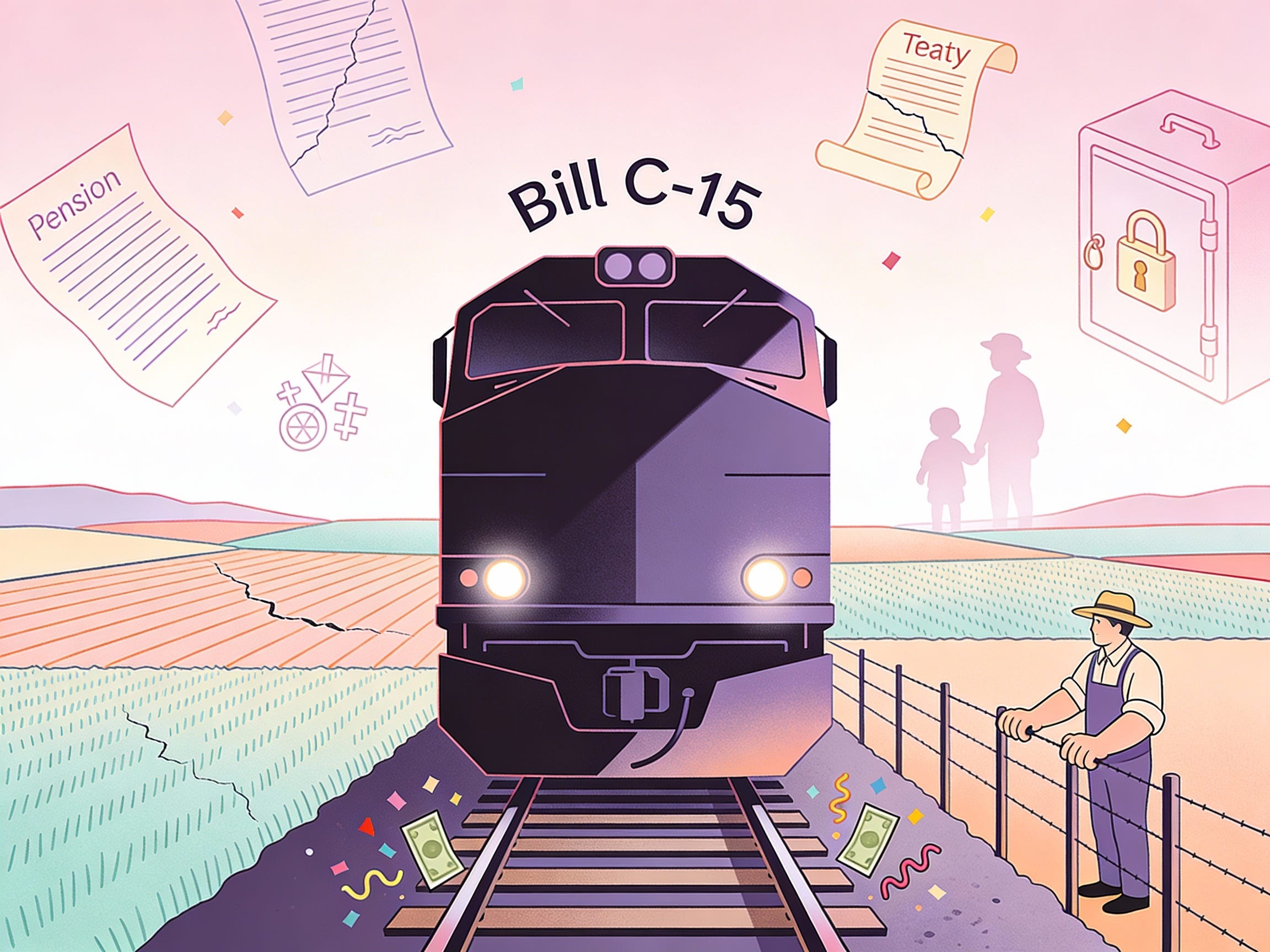
The numbers buried in the government’s latest fiscal plan are staggering, but one figure in particular stands out for its sheer, unexplained magnitude. In the fine print of Bill C-15, a quiet amendment to the Royal Canadian Mounted Police Superannuation Act proposes to index disability pensions solely to the Consumer Price Index. The government claims this single technical adjustment will save the federal treasury $5.8 billion over four years. For veterans and union representatives, the math simply does not add up. The total government contribution to the RCMP pension plan next year is only $370 million. To extract nearly $6 billion in savings from a disability pension program suggests a reduction in benefits so massive it has left observers baffled and alarmed.
This is the nature of Bill C-15. It is a legislative leviathan, a collection of disparate measures that will alter the fabric of Canadian life from the railway tracks of Ontario to the healing lodges of the Prairies. It promises modernization and economic security, yet in committee room after committee room, witnesses have arrived with the same urgent message: the details are missing, the consultations were rushed, and the consequences could be irreversible.
The Iron Road to Expropriation
Perhaps no element of the bill carries more physical weight than the proposed High-Speed Rail Network Act. The government envisions a transformative 1,000-kilometre corridor connecting Quebec City, Montreal, Ottawa, and Toronto—a nation-building project intended to rival the railways of Europe and Asia. But for the farmers and First Nations who live along the undefined route, the legislation reads less like a promise of connectivity and more like a threat of dispossession.
The bill grants the federal government sweeping powers to expropriate land, bypassing standard regulatory reviews to fast-track construction. For Chief Abram Benedict of the Chiefs of Ontario, this signals a return to a darker era of infrastructure development. He warned senators that the legislation allows the government to sidestep the Impact Assessment Act and ignore the duty to consult until the land is already taken. The spectre of “land theft for railway” looms large in Indigenous history, and this bill, he argued, threatens to recreate those same pathways of federal overreach.
The anxiety is shared by Canada’s agricultural heartland. Drew Spoelstra, a farmer from Hamilton and President of the Ontario Federation of Agriculture, described the potential for a high-speed line to slice farms in half, leaving fields stranded and livestock vulnerable. He painted a grim picture of high-speed trains acting as “cow slicers,” requiring massive fencing that would sever the natural flow of wildlife and agriculture alike. Matti Siemiatycki, a professor at the University of Toronto, questioned the very premise of the project. He noted that while high-speed rail is an attractive symbol of modernity, the estimated $60 billion to $90 billion price tag could revolutionize urban transit in every major Canadian city, moving millions more people daily than a single intercity line ever could.
The Taxonomy of Trust
While the government seeks to lay new tracks, it is also attempting to rewrite the fiscal relationship with Indigenous communities. Part 4 of the bill introduces the FACT tax framework—a voluntary system allowing Indigenous governments to levy sales taxes on fuel, alcohol, cannabis, tobacco, and vaping products on their lands. For the Department of Finance, this is a step toward economic reconciliation, a way for nations to generate “own-source revenue” to fund infrastructure and social programs.
For Chief R. Donald Maracle of the Mohawks of the Bay of Quinte, however, the proposal is fraught with historical trauma. He reminded the committee that Parliament stripped First Nations of their right to collect taxes in 1927, plunging communities into a century of dependency. While some nations, particularly in Western Canada, are eager to adopt these new powers to fund water treatment plants and hockey rinks, others see a trap. Chief Maracle warned that by accepting a delegated federal tax power, nations might inadvertently undermine their inherent treaty rights. He fears that any revenue raised will simply be clawed back by federal bureaucrats, leaving communities no better off than before.
The tension between economic opportunity and sovereign rights was palpable. Chief Derek Epp of the Tzeachten First Nation argued that tax jurisdiction is the foundation of government, a tool that has allowed his community to reduce the number of children in care to zero and build housing for its members. Yet Chief Maracle countered that calling it a “tax” would spark protests in his community, suggesting instead a revenue-sharing agreement that respects the treaties.
The Vault and the Void
Beyond the land and the treaties, Bill C-15 reaches deep into the digital vaults of the nation’s financial system. The legislation proposes a “windfall profit” tax on immobilized Russian sovereign assets, a move designed to align Canada with European allies and generate funds for the reconstruction of Ukraine. Department of Finance officials confirmed that approximately $185 million in Russian assets are currently frozen in Canada, though the exact nature of these assets remains opaque.
Simultaneously, the bill thrusts the Bank of Canada into a new role as the regulator of “open banking” and stablecoins. This shift is intended to foster competition by allowing consumers to share their financial data with third-party apps, potentially lowering fees and spurring innovation. But senators raised sharp concerns about privacy and security. Where will this data live? The legislation contains no requirement for data sovereignty, meaning sensitive Canadian financial information could potentially be stored on servers in jurisdictions with laxer privacy laws.
The complexity of these new financial regimes is matched only by the confusion surrounding them. Senator Toni Varone questioned whether a consumer, pressured by a bank to share data for a mortgage, could truly give free and informed consent. The Office of the Superintendent of Financial Institutions admitted that while they oversee the safety of banks, consumer protection in this new digital frontier falls to the Bank of Canada, creating a patchwork of oversight that left some committee members uneasy.
The Silent Crisis
While economists and lawyers debate tax structures and rail lines, a quieter, more desperate crisis simmers in the background. The bill proposes a National Strategy for Children and Youth, a measure long demanded by advocates. Yet, as Leila Sarangi of Campaign 2000 testified, the promise to end child poverty made in 1989 has gone unfulfilled for thirty-five years. Today, 1.4 million children in Canada still live in poverty.
Witnesses like Krista Carr of Inclusion Canada warned that without explicit language protecting children with disabilities, the strategy will fail the most vulnerable. She noted that children with disabilities are disproportionately represented in poverty statistics and the child welfare system, yet the bill remains silent on the UN Convention on the Rights of Persons with Disabilities.
The disconnect between high-level policy and street-level reality was brought home by Gabrielle Fayant of the Assembly of Seven Generations. She described a generation of Indigenous youth in survival mode, navigating a world of micro-grants and broken promises. “Living in crisis comes at a cost,” she told senators, describing the burnout of youth leaders trying to save lives with short-term funding.
In the halls of justice, a similar battle is being fought over the “healing lodges” meant to rehabilitate Indigenous offenders. Marlene Orr of the National Indigenous Healing Lodge Coalition warned that proposed changes in Bill S-205, studied alongside the budget bill, could allow non-Indigenous groups to run these lodges. She argued this would be a continuation of the cultural erasure begun by residential schools, handing control of sacred ceremonies to those who do not understand them. Meanwhile, Dr. Maryana Kravtsenyuk, a forensic psychiatrist, described the “warehousing” of mentally ill individuals in prisons, people who are terrified and detached from reality, locked in cells because the health care system has nowhere else to put them.
The Eleventh Hour
As the clock ticks toward the holiday break, the Senate faces a sprawling piece of legislation that touches every corner of Canadian society. From the spectre of expropriation along a high-speed rail corridor to the technicalities of crypto-asset regulation, Bill C-15 is a testament to the ambition—and perhaps the overreach—of the modern omnibus bill.
The government argues these measures are essential for economic security and growth. Critics see a rush to legislate that tramples on rights, ignores consultation, and leaves vulnerable Canadians behind. In the end, the question for senators is not just whether the budget balances, but whether the sweeping powers granted in its hundreds of pages will build the country up or carve it apart.
Source Documents
Standing Senate Committee on Internal Economy, Budgets and Administration. (2025, December 11). Evidence.
Standing Senate Committee on National Security, Defence and Veterans Affairs. (2025, December 8). Evidence.
Standing Senate Committee on Rules, Procedures and the Rights of Parliament. (2025, December 9). Evidence.
Standing Senate Committee on Official Languages. (2025, December 8). Evidence.
Standing Senate Committee on Indigenous Peoples. (2025, December 9). Evidence.
Standing Senate Committee on Agriculture and Forestry. (2025, December 9). Evidence.
Standing Senate Committee on Transport and Communications. (2025, December 10). Evidence.
Standing Senate Committee on Foreign Affairs and International Trade. (2025, December 10). Evidence.
Standing Senate Committee on Indigenous Peoples. (2025, December 10). Evidence.
Standing Senate Committee on Banking, Commerce and the Economy. (2025, December 10). Evidence.
Standing Senate Committee on Legal and Constitutional Affairs. (2025, December 10). Evidence.
Standing Senate Committee on Social Affairs, Science and Technology. (2025, December 10). Evidence.
Standing Senate Committee on Legal and Constitutional Affairs. (2025, December 11). Evidence.
Standing Senate Committee on National Finance. (2025, December 9). Evidence.