


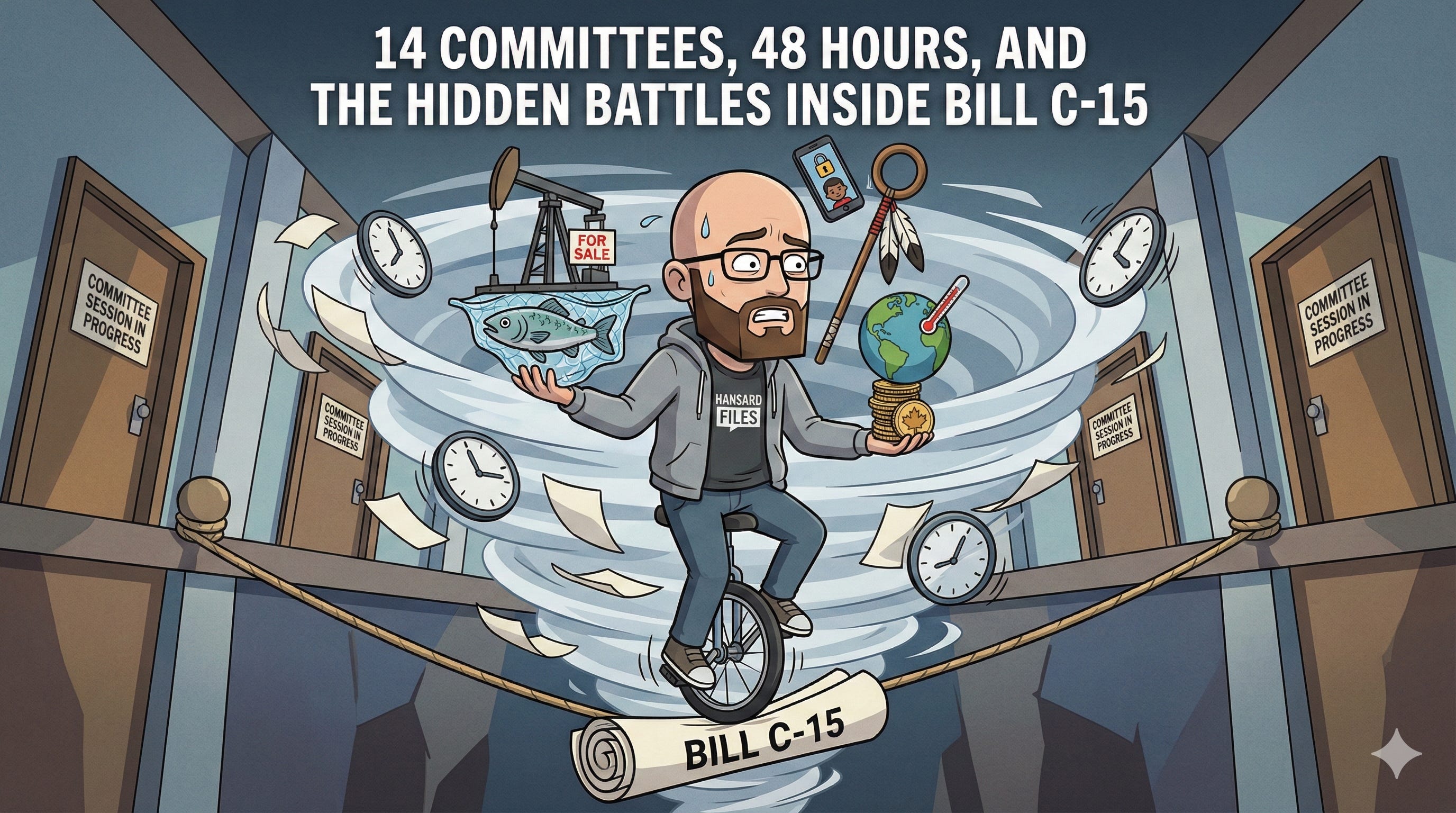
On the crisp winter mornings of February 4 and 5, 2026, the corridors of the Senate of Canada transformed into an intense legislative battleground. Parliamentarians were staring down a tidal wave of policy changes, anchored primarily by the massive and highly controversial omnibus Bill C-15. This sprawling budget implementation act, alongside a flurry of targeted Senate bills, triggered simultaneous hearings across more than a dozen different committees.
The sheer volume of testimony delivered over those 48 hours offers a rare, panoramic window into the most critical fault lines fracturing modern Canadian society. From the existential threat of climate change and the struggle for Indigenous economic independence to the predatory dangers lurking in children’s smartphones, lawmakers were forced to grapple with a world in profound transition. The proceedings were not mere bureaucratic exercises. They were high-stakes negotiations over the very soul of the country’s economic and social future.
The Financial Frontier and Indigenous Sovereignty in Bill C-15
Within the confines of the Standing Senate Committee on Indigenous Peoples, the review of Part 4 of Bill C-15 took on a distinctly historic weight. The committee focused on proposed amendments to the First Nations Goods and Services Tax Act. Chief Commissioner Manny Jules of the First Nations Tax Commission appeared via videoconference, delivering testimony rooted in a fifty-year fight for self-determination.
For Jules, the path to true Indigenous sovereignty is inextricably linked to financial independence. He argued passionately that First Nations cannot exercise their right to self-determination if they remain perpetually dependent on federal transfers. Jules pointed out that since 2005, taxing First Nations have facilitated approximately $10 billion in new investment on their lands, generating over $20 billion in new gross domestic product and creating well over 200,000 jobs. He presented a stark, compelling metric to the committee, noting that for every dollar First Nations receive in tax room, the federal and provincial governments receive seven dollars.
The proposed expansion of the First Nations tax on fuel, alcohol, cannabis, tobacco, and vaping products represents a critical shift from a relationship of dependency to a tax-based fiscal relationship. Jules urged lawmakers to look beyond the immediate text of Bill C-15 and consider further amendments to include services like gaming and automated banking machines, emphasizing that expanding tax room is the ultimate catalyst for growing the economy and dismantling the archaic Indian Act.
Meanwhile, the economic security of everyday Canadians was under the microscope at the Standing Senate Committee on Banking, Commerce and the Economy, which was concluding its pre-study of multiple divisions of Bill C-15. Sarah Bradley, Ombudsman and Chief Executive Officer for the Ombudsman for Banking Services and Investments, testified about her organization’s thirty-year history of resolving disputes between consumers and financial firms. As the banking sector modernizes, so do the avenues for exploitation and consumer vulnerability, making the consumer protection elements of the budget implementation act increasingly vital. The committee’s scrutiny extended to the foundational mechanics of commerce itself during a separate hearing on Bill S-3, An Act to amend the Weights and Measures Act and the Electricity and Gas Inspection Act.
Shielding the Vulnerable in a Rapidly Shifting Digital Age
While financial architecture dominated several rooms, the psychological and physical safety of Canadian youth took center stage elsewhere. The Standing Senate Committee on Social Affairs, Science and Technology undertook a rigorous clause-by-clause review of Bill S-212, which mandates a national strategy for children and youth.
The complexities of protecting children are magnified when considering the unique vulnerabilities of Indigenous youth. Senator Margo Greenwood successfully moved an amendment requiring the government to ensure that child and youth participants are consulted in culturally safe environments. This amendment directly addressed concerns raised by the Assembly of First Nations Quebec-Labrador, which warned that without proper safety nets, federal consultations could inadvertently inflict further harm and trauma on Indigenous children. Greenwood also championed a second amendment ensuring the national strategy explicitly incorporates commitments to Indigenous early learning and child care, fulfilling a critical Call to Action from the Truth and Reconciliation Commission.
Simultaneously, the Standing Senate Committee on Legal and Constitutional Affairs continued its harrowing study of Bill S-209, legislation designed to build a digital fence between minors and extreme online pornography. The committee struggled with the immense difficulty of regulating a multi-billion dollar borderless industry. Lawmakers debated aggressive measures to compel commercial adult websites to implement strict age verification without inadvertently censoring mainstream entertainment or violating user privacy. The discussions highlighted a terrifying reality, revealing that youth are increasingly navigating algorithmic minefields completely unshielded, absorbing violent and degrading content that fundamentally rewires their neurological development.
Navigating the Skies and Protecting the Seas
The necessity of proactive safety measures echoed strongly within the Standing Senate Committee on Transport and Communications, which examined Division 28 of Bill C-15 regarding the Aeronautics Act. The aviation industry is globally recognized for its rigorous safety standards, but maintaining that record requires continuous legislative evolution.
Shannon Saunders, Director of Operations and Regulatory Affairs at the National Airlines Council of Canada, and Julie Mailhot, President of the Air Transport Association of Canada, voiced strong support for amendments that protect voluntarily shared safety data. Modern aviation safety relies heavily on a “just culture,” where pilots, engineers, and dispatchers can report potential hazards without the paralyzing fear of punitive action. Mailhot stressed that individuals must feel confident in reporting safety hazards openly, allowing the industry to identify and mitigate risks long before they culminate in catastrophic accidents.
A very different kind of operational independence was fiercely defended at the Standing Senate Committee on Fisheries and Oceans. Ian MacPherson, Executive Director of the Prince Edward Island Fishermen’s Association, delivered a stark warning about the corporatization of Atlantic Canada’s fisheries. He argued that independent, core fishers are the absolute lifeblood of coastal communities, generating massive economic multipliers that sustain entire regions.
However, MacPherson cautioned that this independence is under siege. As the fishery increases in value, young harvesters find it nearly impossible to buy into the industry. Furthermore, a quiet consolidation is occurring in the processing sector, where large corporations are purchasing small operations in single transactions that cleverly avoid triggering reviews by the Competition Bureau. MacPherson pleaded for legislative frameworks that treat Canada’s seafood as a protected national asset, ensuring that the wealth harvested from the ocean remains within the communities that rely upon it.
The Climate Rupture and the Future of Global Development
Looming over all domestic policy debates is the inescapable shadow of the global climate crisis and geopolitical instability. At the Standing Senate Committee on Energy, the Environment and Natural Resources, lawmakers confronted the deeply entrenched economic reliance on offshore petroleum.
Gretchen Fitzgerald, Executive Director of Sierra Club Canada, delivered a blunt assessment of Newfoundland and Labrador’s energy future. She warned that continued reliance on the offshore oil industry places the province at extreme risk due to accelerating climate impacts and a projected rapid decline in global fossil fuel demand. Referencing the devastation of the historic cod moratorium, Fitzgerald urged lawmakers to avoid repeating past mistakes by clinging to dying industries. Instead, she pointed to the massive, untapped potential of offshore wind energy, noting that Eastern Canada possesses the capacity to power millions of homes. She called for an immediate transition plan, including upskilling programs for current oil workers and an end to all subsidies for the increasingly risky fossil fuel sector.
The transition toward sustainable practices was also a focus at the Standing Senate Committee on Agriculture and Forestry, where senators gathered to review Bill S-230, legislation aimed at developing a national strategy for soil health protection and conservation.
The compounding crises of climate change, conflict, and economic fragility are not contained within Canadian borders. Christopher MacLennan, Deputy Minister of International Development, addressed the Standing Senate Committee on Foreign Affairs and International Trade against the backdrop of International Development Week. Quoting Prime Minister Mark Carney, MacLennan stated that the world order is currently in the midst of a violent rupture, not merely a transition.
This rupture is devastating developing nations, erasing decades of hard-won progress in poverty reduction. Compounding this tragedy is the reality of constrained domestic budgets. Bill C-15 signals a reduction in Canada’s international aid funding by approximately $2.7 billion over four years, returning spending to pre-pandemic levels. MacLennan explained that Global Affairs Canada must adopt a ruthlessly pragmatic approach to achieve maximum impact with fewer resources.
To bridge the massive global financing gap, the government is increasingly relying on tools like FinDev Canada to crowd private capital into development projects. MacLennan highlighted the critical role of private sector engagement in building renewable energy grids and providing micro-loans to women smallholder farmers in Africa, individuals who are routinely ignored by traditional banking institutions due to perceived risks.
The legislative blitz of early February 2026 proved that the machinery of government is operating under immense pressure. Across a dozen distinct documents and multiple simultaneous hearings, a unified narrative emerged. Canada is standing at a critical juncture. Whether protecting the neurological development of children, securing the financial autonomy of First Nations, safeguarding the skies, or navigating the terrifying realities of a warming planet, lawmakers are no longer dealing with abstract future scenarios. The future has arrived, and the margins for error have vanished entirely.
Hansard Files digs through dense legislative archives and committee transcripts to uncover the high-stakes stories shaping our society. Subscribe to support our independent investigations and never miss a deep dive.
Source Documents
Standing Senate Committee on Transport and Communications. (2026, February 4). 19ev-57470.pdf. Parliament of Canada.
Standing Senate Committee on Agriculture and Forestry. (2026, February 5). 19ev-57471.pdf. Parliament of Canada.
Standing Senate Committee on Foreign Affairs and International Trade. (2026, February 4). 20ev-57464.pdf. Parliament of Canada.
Standing Senate Committee on Indigenous Peoples. (2026, February 4). 20ev-57468.pdf. Parliament of Canada.
Standing Senate Committee on Energy, the Environment and Natural Resources. (2026, February 5). 20ev-57472.pdf. Parliament of Canada.
Standing Senate Committee on Social Affairs, Science and Technology. (2026, February 4). 21ev-57467.pdf. Parliament of Canada.
Standing Senate Committee on Banking, Commerce and the Economy. (2026, February 4). 22ev-57465.pdf. Parliament of Canada.
Standing Senate Committee on Social Affairs, Science and Technology. (2026, February 5). 22ev-57477.pdf. Parliament of Canada.
Standing Senate Committee on Banking, Commerce and the Economy. (2026, February 5). 23ev-57475.pdf. Parliament of Canada.
Standing Senate Committee on Fisheries and Oceans. (2026, February 5). 15ev-57473.pdf. Parliament of Canada.
Standing Senate Committee on Legal and Constitutional Affairs. (2026, February 4). Transcripts & Minutes - Standing Senate Committee on Legal and Constitutional Affairs (45th Parliament, 1st Session).pdf. Parliament of Canada.
Standing Senate Committee on Legal and Constitutional Affairs. (2026, February 5). Transcripts & Minutes - Standing Senate Committee on Legal and Constitutional Affairs (45th Parliament, 1st Session)2.pdf. Parliament of Canada.
Standing Senate Committee on Foreign Affairs and International Trade. (2026, February 5). Transcripts & Minutes - Standing Senate Committee on Foreign Affairs and International Trade (45th Parliament, 1st Session).pdf. Parliament of Canada.
You know, it occurs to me if the politicians wanted to avoid the tidal wave of legislation, committee, and suchlike, they should start working more days of the year. Extending their Christmas break into February is kinda shitty, actually.