


The chamber was quieter than usual on Tuesday afternoon. Before the machinery of the state could grind into motion—before the debates on border security, foreign influence, and the cost of bread could begin—there was the silence of three empty seats in a locker room in Southern Alberta.
Senator Leo Housakos rose first, his voice heavy with the news that every parent dreads. Caden Fine, JJ Wright, and Cameron Casorso—three young players for the Southern Alberta Mustangs—had been killed on their way to practice. They were teenagers, 17 and 18 years old, doing what Canadian kids have done for a century: driving through the winter dark to play the game they loved. The tragedy hung over the Senate like a pall, a reminder of the fragility of life outside the stone walls of Parliament.
But the business of the nation does not pause for grief. As the tributes faded, the government moved to construct a different kind of wall. The Senate plunged into a high-stakes debate over Bill C-12, a piece of legislation officially titled the Strengthening Canada’s Immigration System and Borders Act. Proponents call it a necessary shield against fentanyl and organized crime; critics call it a capitulation to foreign pressure that threatens the soul of the country.
Between the lines of legal text, the Senate found itself grappling with the definition of Canada itself: Is it a sanctuary or a fortress?
The Fortress: The Case for Bill C-12
The defense of Bill C-12 fell to Senator Tony Dean. Moving the second reading, Dean painted a picture of a nation under siege—not by armies, but by complexities. He argued that for Canada’s immigration system to remain welcoming, it must first be “efficient, sustainable and secure”.
Dean’s rhetoric was sharp and urgent. He spoke of “transnational organized crime” and a “devastating fentanyl crisis fuelled by illicit precursors”. The bill, in his view, is a modernization effort, a way to clear the “long backlog of files” that is currently breaking the back of the asylum system. To Dean, Bill C-12 is the structural reinforcement the house needs before it collapses under its own weight.
But the bill is not just about paperwork; it is about power. Senator Marilou McPhedran immediately challenged Dean, questioning the “militaristic and police oversight” embedded in the legislation. She pressed Dean on whether the bill represented the “least oppressive ways” to manage borders, or if it granted officials excessive license to interfere in the lives of vulnerable people.
Dean dismissed the concern, telling McPhedran she could “relax,” assuring the chamber that her fears were not resident in the proposals he had been briefed on. It was a moment of friction that foreshadowed the storm to come.
“A Vain Effort to Appease”: The Sovereignty Trap
If Dean was the shield, Senator Paula Simons was the spear. In a blistering critique, Simons dismantled the government’s framing of the bill, focusing on the word “respecting” in its title.
“The irony is bleak,” Simons declared, “because Bill C-12 isn’t about respecting the integrity of Canada’s immigration system. It is about undermining it”.
Simons suggested that the bill was not designed for Canadians at all, but for an audience of one. She alleged the legislation was a “vain effort to appease the anti-immigrant backlash within our own country and to appease a former friend and ally who is now all too keen to find excuses to trespass on our national sovereignty”. While she did not name the “former friend,” the implication of American pressure—perhaps from a protectionist administration in Washington—was unmistakable.
She warned that while the bill claims to target money laundering and stolen cars, these clauses are merely the sugar coating for a poison pill “nestled in the middle” of the legislation. Her argument raised a chilling prospect: that in its rush to secure the border, Ottawa might be effectively outsourcing its sovereignty, turning Canadian law enforcement into a branch office of a foreign power.
The 50-Year Queue
While the Senators debated the theory of law, Senator Stan Kutcher brought the reality of the broken system onto the floor. He introduced the chamber to “Gala,” a Ukrainian displaced person and single mother living in Ottawa.
Gala is the model immigrant. In Ukraine, she managed a hotel with 400 employees and worked as a translator for stars like Depeche Mode and Bryan Adams. Since arriving in Canada to escape Russian bombardment, she has learned English, manages a coffee shop, and pays her taxes.
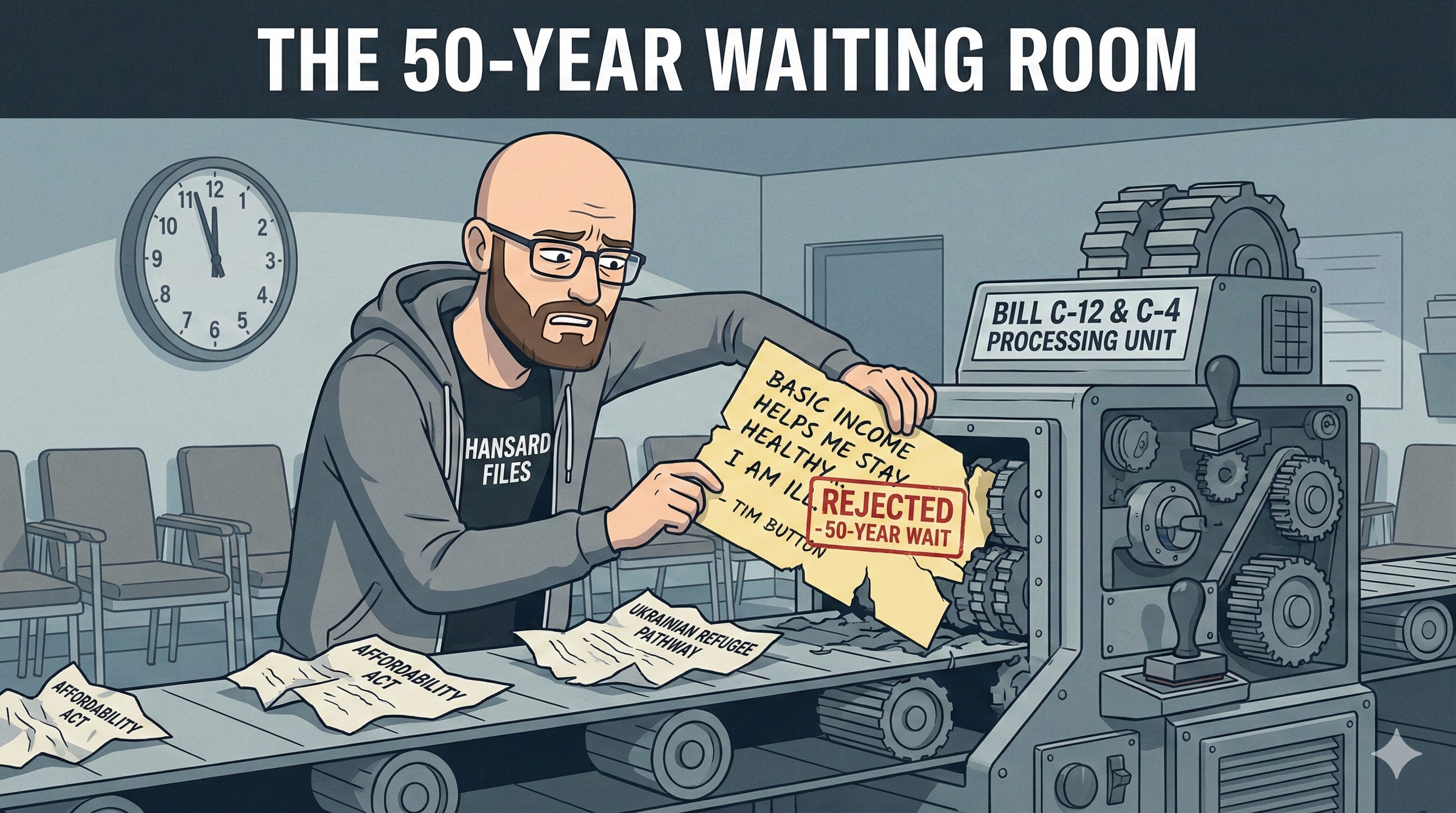
Yet, Gala lives in a state of “bureaucratic confusion”. Despite her contributions, she cannot access a permanent residence pathway. The “Family Reunification Public Policy” pathway, which she hoped to use, is effectively dead; of 15,000 applicants, only 1,000 have been processed. Kutcher revealed the absurdity of her situation: according to current estimates from Immigration, Refugees and Citizenship Canada, Gala could face a wait of 50 years for her permanent residency.
“This is not a pathway,” Kutcher said. “It’s a roadblock”.
Gala’s 50-year wait serves as a devastating counterpoint to Senator Dean’s call for “efficiency.” While the government seeks new powers to police the border under Bill C-12, the existing machinery is so seized up that a productive, tax-paying mother is told to wait half a century for security.
The Cost of Bread and the Ghost of Tim Button
The disconnect between the government’s legislative agenda and the reality on the street was not limited to immigration. The Senate also debated Bill C-4, the Making Life More Affordable for Canadians Bill.
Despite its friendly title, the bill became a lightning rod for criticism regarding what was hidden inside it. Senator Pierre Moreau and Senator Colin Deacon sparred over “Part 4,” a section of the bill dealing with the privacy of political parties, strangely tucked into a finance bill. Senator Deacon pointed out the “uncomfortable reality” that the Senate cannot easily amend finance bills, meaning this political privacy clause—which critics argue allows parties to harvest voter data without oversight—was effectively being smuggled into law.
Senator Marilou McPhedran stripped the veneer off the “affordability” bill entirely by invoking the memory of Tim Button.
Button was a basic income advocate who died in poverty. McPhedran described a photo of him holding a handwritten sign on ragged paper: “Basic income helps me stay healthy with good food. I am ill”. Button’s sign now sits in McPhedran’s office, yellowing and curling, a physical artifact of the system’s failure.
“Canada let Tim Button down,” McPhedran told the chamber. She argued that for the same cost as Bill C-4’s “inequitable and ineffective tax cut,” the government could have implemented income provisions that actually saved lives. Instead, the Senate was asked to rubber-stamp a bill that prioritized tax credits and political party data privacy over the desperate hunger of its poorest citizens.
The Guardians of Identity
Amidst the fights over borders and budgets, there was a quiet but significant movement on the cultural front. The Senate prepared to resolve into a Committee of the Whole to examine Kelly Burke, the nominee for Commissioner of Official Languages. In a country where language is the third rail of politics, Burke’s interrogation will be a critical test of the government’s commitment to the fragile bilingual consensus.
Simultaneously, the Senate took a moment to celebrate one of its own. Senator René Cormier was appointed a Knight of the Legion of Honour by the French Republic. Senator Housakos praised Cormier as a “staunch defender of the founding language of our country”. Cormier, in a moving response, dedicated the honour to the Acadian people and their “tenacious loyalties” , reminding his colleagues that defending language and identity is “never a luxury or a trend... It is a moral responsibility”.
Conclusion: The Machinery Grinds On
The week ended as it began: with the weight of responsibility. From the tragic loss of the Mustangs hockey players to the 50-year waiting room for Ukrainian refugees; from the privacy loopholes in Bill C-4 to the militarization of borders in Bill C-12—the Senate is the last line of defense in a system that often seems to have forgotten the people it was built to serve.
As the bills move to committee and the hearings begin, the question remains: Will these laws build a fortress that protects Canadians, or a labyrinth that traps them?
Hansard Files digs through the thousands of pages of parliamentary records so you don’t have to. If you value independent oversight of the machinery of power, please subscribe to support our work.
Source Documents
Senate of Canada. (2026, February 3). Debates of the Senate (Hansard), 1st Session, 45th Parliament, Volume 154, Issue 46.
Senate of Canada. (2026, February 4). Debates of the Senate (Hansard), 1st Session, 45th Parliament, Volume 154, Issue 47.
Senate of Canada. (2026, February 5). Debates of the Senate (Hansard), 1st Session, 45th Parliament, Volume 154, Issue 48.
Given our country population is burgeoning whilst our birthrate is one of the lowest in the G20, maybe it's time to stop flooding the country with 3rd world low skilled migrants? Invite the 3rd world, become the 3rd world.
Your article indicates that proposed legislation is both multi-faceted and rife with partisan positions. And perhaps it should be; legislation should not be a cakewalk exercise unless the subject is simple, transparent and clear in it purpose. I do find the 50waiting period is beyond ridiculous. Keep up the excellent work!