


The Anatomy of Outrage
To understand the controversy, you must first appreciate the powerful case built against BC Ferries in Ottawa. The arguments presented to the public were coherent, emotionally charged, and seemingly unassailable. The core of the accusation was that a federal Crown corporation, the Canada Infrastructure Bank (CIB), was using public financing to subsidize a hostile state’s industry at the direct expense of Canadian workers.
The political attack was led by figures from across the partisan spectrum. Minister Freeland framed the issue in stark geopolitical terms, connecting the deal to her broader concerns about China’s economic practices. In a letter to her provincial counterpart, she wrote:
“As you may know, China has imposed unjustified tariffs on Canada,” Freeland wrote, including 100 per cent tariffs on canola oil, meal, and pea imports, as well as a 25 per cent tariff on aquatic products and pork.
This framing was potent. It suggested that at the very moment Canada was engaged in a trade dispute, BC Ferries was rewarding the aggressor with a massive contract. Opposition parties amplified this narrative. Conservative MP Leslyn Lewis described the loan as “Liberal incompetence at best, and deliberately misleading to Canadians at worst.” Her colleague Dan Albas argued that the government was using Canadian tax dollars to subsidize jobs and economic activity outside the country, while Conservative Leader Pierre Poilievre called for the loan to be cancelled to “put Canadian shipbuilders, steel workers, and industry first.”
This political outrage was bolstered by voices from Canadian industry. James Davies, the CEO of Davie Shipyard, Canada’s oldest and largest shipbuilder, sent a letter to the transport committee explaining why no Canadian company bid on the contract. He argued the procurement criteria were “heavily weighted toward the lowest price, effectively favouring Chinese shipyards.” He stated that due to “massive state subsidies for Chinese shipyards, coupled with low wages, weak environmental standards, and minimal labour protections, no Canadian or Western shipyard could reasonably compete.” The B.C. Ferry and Marine Workers’ Union echoed this sentiment, launching a “Build Them Here” campaign and arguing that domestic shipbuilding was clearly not a priority in the decision. The case presented in Ottawa was complete: a quasi-public entity had taken a billion dollars in federal financing and sent it overseas, betraying the national interest. For many Canadians, the sense of righteous indignation was unavoidable.
The Governance Ghost
Here is the detail I find most revealing: the entire political attack is aimed at an organization that does not truly exist in the way its critics imagine. The controversy is haunted by a “Governance Ghost.” We politically and emotionally treat BC Ferries like the provincial Crown corporation it was before 2003, while it is forced to operate under the rules of the independent, regulated, user-funded entity it became. This disconnect is not a minor detail. It is the fundamental error that makes most of the public debate irrelevant.
In 2003, the provincial government passed the Coastal Ferry Act, which transformed BC Ferries from a Crown corporation into what its own governance model describes as a “private company.” This was not merely a cosmetic change. It established a complex, arms-length structure designed to insulate the ferry service from direct political interference and place its operations on a more commercial footing. If you want to understand why BC Ferries chose a Chinese shipyard, you must first understand this four-part structure:
BC Ferry Services Inc.: This is the service provider. It is an independent, regulated company responsible for the day-to-day operations of the fleet.
B.C. Ferry Authority: This entity is the “beneficial shareholder,” holding the single voting share of BC Ferry Services Inc. Its mandate is to oversee the company’s strategic direction in the “public interest” and to appoint its board of directors.
Coastal Ferry Services Contract: This is a 60-year contract between BC Ferries and the Province of British Columbia. It stipulates the minimum service levels, routes, and fees the province pays for those services.
British Columbia Ferry Commission: This is an independent regulator whose primary job is to set price caps on fares, balancing the interests of users, taxpayers, and the company’s financial sustainability.
The critical implication of this model is that BC Ferries is not a government department. Its Board of Directors has a fiduciary duty to the company to operate efficiently and sustainably under the price caps set by the Commissioner. As the company has repeatedly stated, “nearly 80 percent of our operating costs are funded directly by our customers.” This financial reality, imposed by the rules of the Governance Ghost, dictates its behavior. Prioritizing a bid that keeps capital costs low is not an act of political betrayal. It is a logical, even necessary, decision for an organization whose primary mandate is to control costs to prevent fares from spiraling upwards for the millions of British Columbians who depend on the service. The outrage in Ottawa was directed at a ghost, ignoring the real-world machine that structure created.
The Subsidy Shell Game
The focus on the Chinese shipyard successfully distracted from a much deeper and more politically damaging story. While Parliament debated the merits of one procurement decision, it avoided a conversation about a profound, decades-old inequity in how the federal government funds essential transportation in Canada. This points to a critical question: if the loan to BC Ferries was so problematic, how does the federal government itself support ferry services?
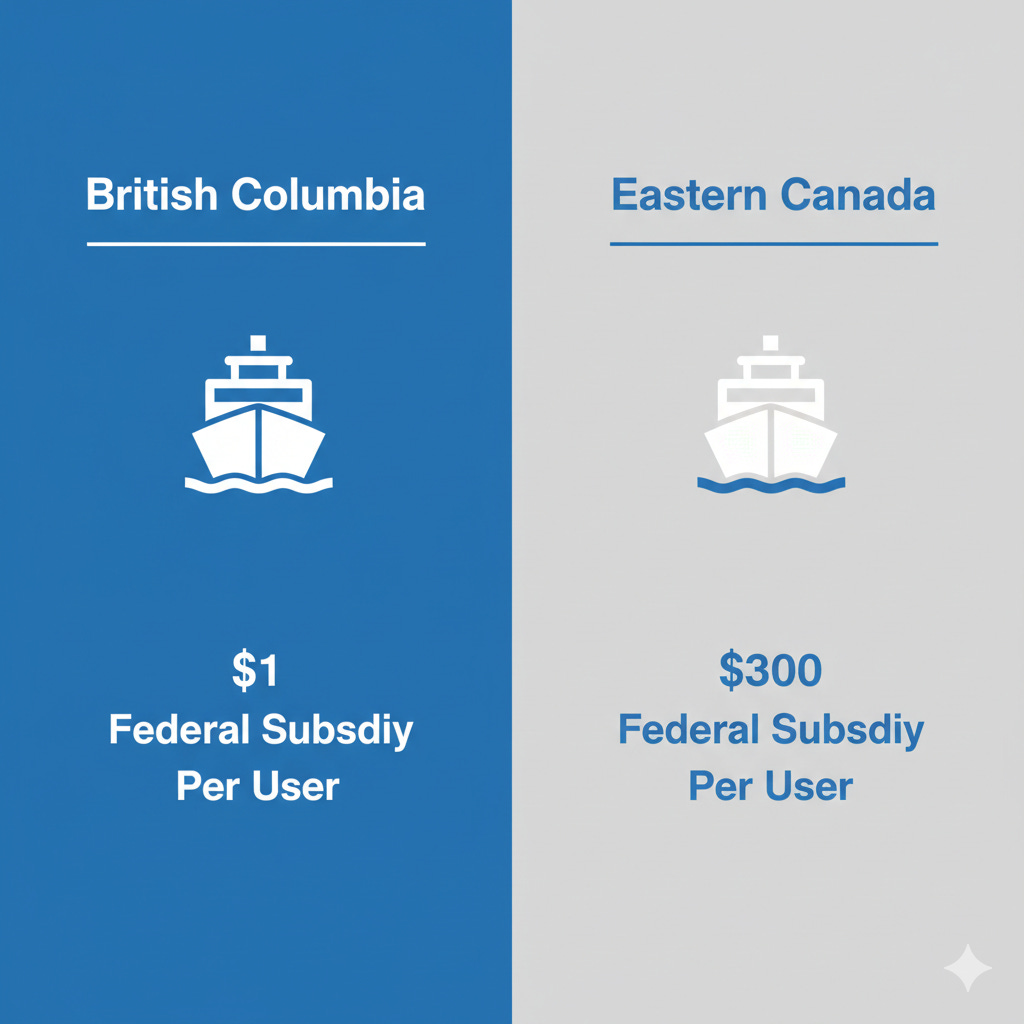
The answer is found by following the real money. B.C. Premier David Eby brought this issue to the forefront with an explosive and repeatedly stated claim:
“It is a situation where B.C. ferry users get, on average, $1 in federal subsidy, while eastern ferry users get $300 in federal subsidies. And so as a result, that disparity and that unfairness needs to be addressed.”
This is not just political rhetoric. The numbers are rooted in two completely different approaches to federalism. Federal support for BC Ferries comes from a 1977 agreement that provides an annual grant to the province. Originally valued at $8 million, this grant is indexed to inflation and reached approximately $32 million in the 2021-2022 fiscal year. This grant is a legacy commitment, a fixed amount transferred to the province in support of the service.
Contrast this with federal support for ferry services in Eastern Canada. Marine Atlantic, which connects Nova Scotia with Newfoundland and Labrador, is not an independent company receiving a grant. It is a federal Crown corporation, directly owned and operated by Ottawa as part of its constitutional obligations for inter-provincial transport. The federal government does not just subsidize its operations. It directly buys its ships. Here is the most stunning fact of the entire controversy: the federal government recently purchased a ferry, the Ala’suinu, to serve the Eastern Canada route. It was built by Weihai Shipyards, the exact same state-owned Chinese company at the center of the BC Ferries deal.
The federal minister who was “dismayed” by BC Ferries using a loan to buy ships from a Chinese shipyard works for a government that used direct taxpayer funds to buy a ship from that very same yard. The hypocrisy is stark, and it is best understood visually.
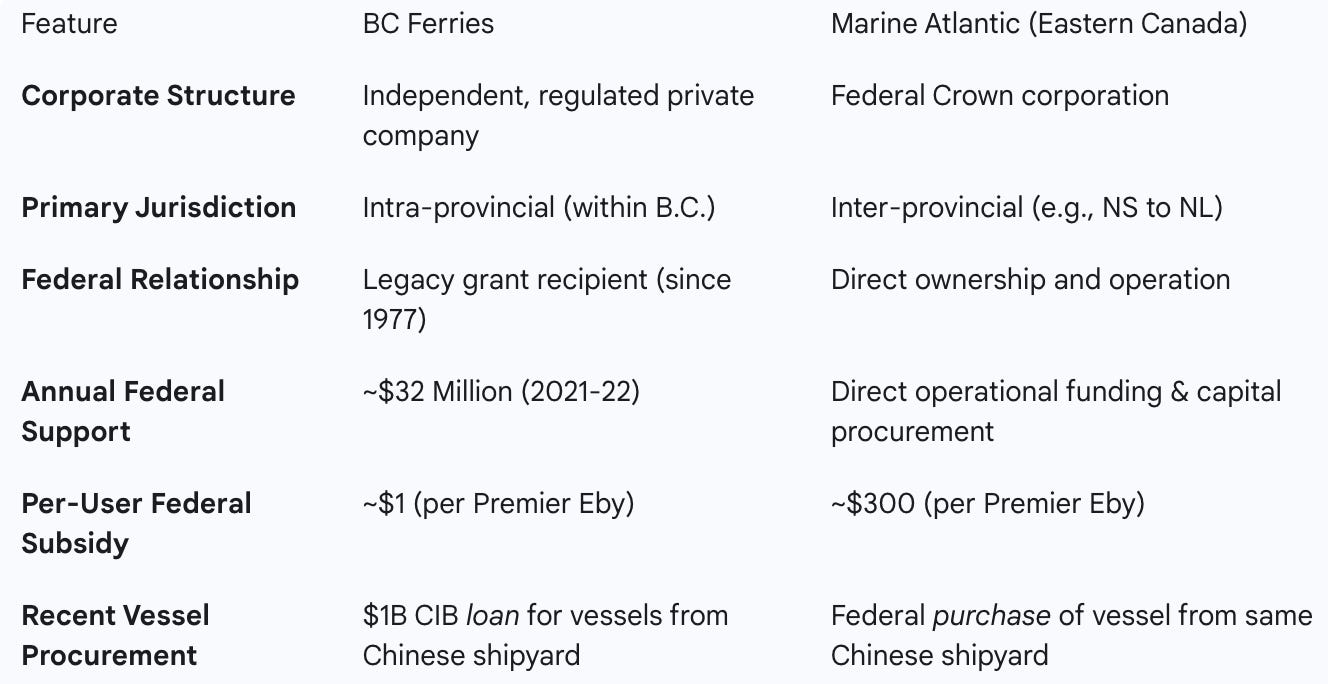
This table reveals the real story. The debate in Ottawa was never truly about a shipyard. It was a strategic deflection. By focusing public anger on China and a decision made by an arms-length B.C. entity, the federal government successfully avoided a much more dangerous conversation about national unity and regional fairness. Every minute spent debating the shipyard was a minute not spent debating the $1 versus the $300.
The Principle of Misaligned Accountability
This brings us to a core principle of governance that the BC Ferries affair perfectly illustrates: public outrage is misdirected when accountability is misaligned. The entire controversy is a case study in this phenomenon. We are holding the wrong actors accountable for the wrong things, allowing the true systemic flaws to persist.
First, thanks to the Governance Ghost, we hold BC Ferries, a private operator, accountable to the standards of a public Crown corporation. Its actual accountability is to its users and its regulator, primarily through fare affordability and service reliability. When it makes a decision to minimize capital costs, it is acting in accordance with that mandate, yet it faces public condemnation for failing a “national interest” test that its governing structure does not require it to meet.
Second, we hold the federal government accountable for a procurement decision it did not make, by an entity it does not control. The federal government’s true accountability lies in its own direct actions: the massive and undeniable funding disparity between East and West, and its own hypocritical procurement of a ferry from the very same shipyard it publicly condemned.
This misalignment creates a political theatre of the absurd. Every actor has a plausible reason to point a finger at someone else, ensuring that no one is held responsible for the core issues. Federal politicians blame BC Ferries for not “buying Canadian.” BC Ferries points to its mandate to keep costs low for its users. The B.C. Premier blames the federal government for the funding inequity. And Canadian shipyards blame a procurement process that prioritizes price over domestic content. The result is a vortex of blame that obscures the root cause: a hybrid public-private model operating within a federal system of profound regional funding inequality.
The Conversation We Should Be Having
The intense focus on a shipyard in Weihai is a low-stakes proxy war. It allows us to feel righteous about Canadian jobs and tough on China without engaging in the much harder, more honest national conversation this controversy has unearthed. The real issue is not where the ships are built, but how we build our country. It is about whether a highway of water connecting Canadian communities in the West is considered as nationally vital as one in the East. The agency you gain from this analysis is not the power to demand a cancelled contract. It is the clarity to shift the conversation. When this topic arises, you can now move past the distracting outrage over the shipyard and ask the more fundamental question about the $1 versus the $300.
We are arguing over the choice of a single tool, because we are afraid to admit the national blueprint itself may be drawn unfairly.
In Other News…
Beyond this deep dive, you can find more analysis and commentary on the On Hansard site. This approach keeps the newsletter from flooding your inbox, while offering more for those who want to go deeper.


Sources:
BC Ferry & Marine Workers’ Union. (n.d.). BCFMWU. BCFED. Retrieved from https://bcfed.ca/unions/bcfmwu
BC Ferry Authority. (n.d.). About Us. Retrieved from https://www.bcferryauthority.com/about-us/
BC Ferries. (n.d.). Current Conditions. Retrieved from https://www.bcferries.com/current-conditions
BC Ferries. (n.d.). Helping you during a service disruption. Retrieved from https://www.bcferries.com/contact-us/helping-you-during-a-service-disruption
BC Ferries. (n.d.). Leadership. Retrieved from https://www.bcferries.com/our-company/leadership
Bell, R. (2025, July 8). BC Ferries CEO, two MPs to testify in federal review of $1 billion loan for Chinese-built vessels. Georgia Straight. Retrieved from https://www.straight.com/city-culture/bc-ferries-ceo-two-mps-to-testify-in-federal-review-of-1-billion-loan-for-chinese-built
Canadian Press. (2025, September 18). Eby says unfairness needs to be addressed when it comes to federal ferry funding. CTV News. Retrieved from https://www.ctvnews.ca/vancouver/article/eby-says-unfairness-needs-to-be-addressed-when-it-comes-to-federal-ferry-funding
CBC News. (2025, July 28). Premier calls for ‘fair treatment’ for ferry users in B.C. after Ottawa cuts fares in Eastern Canada. Retrieved from https://www.cbc.ca/news/canada/british-columbia/eby-calls-for-fair-treatment-for-b-c-ferry-users-1.7595650
DeRosa, K. (2025, July 17). Davie shipyard slams B.C. Ferries’ Chinese shipbuilding contract. CBC News. Retrieved from https://www.cbc.ca/news/canada/british-columbia/davie-shipyard-slams-b-c-ferries-chinese-shipbuilding-contract-1.7608492
Eby, D. (2025, September 19). Eby criticizes Smith’s pipeline push, says feds’ treatment of B.C. ferry passengers unfair. CBC News. Retrieved from https://www.cbc.ca/news/politics/eby-smith-carney-pipeline-ferries-1.7637233
Hill Times. (2025, July 7). House committee summons ministers, CEOs to testify on $1-billion loan for Chinese-made ships. Retrieved from https://www.hilltimes.com/story/2025/07/07/house-committee-summons-ministers-ceos-to-testify-on-1-billion-loan-for-chinese-made-ships/466496/
Joannou, A. (2025, September 19). Freeland called back to testify on BC Ferries’ deal with Chinese shipyard. CityNews Vancouver. Retrieved from https://vancouver.citynews.ca/2025/09/19/freeland-called-back-to-testify-on-bc-ferries-deal-with-chinese-shipyard/
Province of British Columbia. (2023, February 27). B.C. takes action to keep ferry fares affordable. BC Gov News. Retrieved from https://news.gov.bc.ca/releases/2023MOTI0013-000236
Schuermann, J. (2025, August 13). Federal Conservatives urge Liberals to cancel B.C. Ferries loan after China tariff news. CityNews Vancouver. Retrieved from https://vancouver.citynews.ca/2025/08/13/federal-conservatives-urge-liberals-to-cancel-b-c-ferries-loan-after-china-tariff-news/
Standing Committee on Transport, Infrastructure and Communities. (2025, July 7). Minutes of Proceedings. 45th Parliament, 1st Session, Meeting 4. House of Commons. Retrieved from https://www.ourcommons.ca/documentviewer/en/45-1/TRAN/meeting-4/minutes
Standing Committee on Transport, Infrastructure and Communities. (2025, August 1). Notice of Meeting. 45th Parliament, 1st Session, Meeting 5. House of Commons. Retrieved from https://www.ourcommons.ca/DocumentViewer/en/45-1/TRAN/meeting-5/notice
Standing Committee on Transport, Infrastructure and Communities. (2025, September 23). News Release. 45th Parliament, 1st Session. House of Commons. Retrieved from https://www.ourcommons.ca/documentviewer/en/45-1/TRAN/news-release/13600831
Transport Canada. (2022). Update on the Evaluation of the Grant to the Province of British Columbia in respect of the provision of ferry and coastal freight and passenger services. Retrieved from https://tc.canada.ca/en/update-evaluation-grant-province-british-columbia-respect-provision-ferry-coastal-freight-passenger-services
Zussman, R. (2025, September 19). BC Ferries decision making waves. Yahoo News. Retrieved from https://ca.news.yahoo.com/bc-ferries-decision-making-waves-004759116.html