


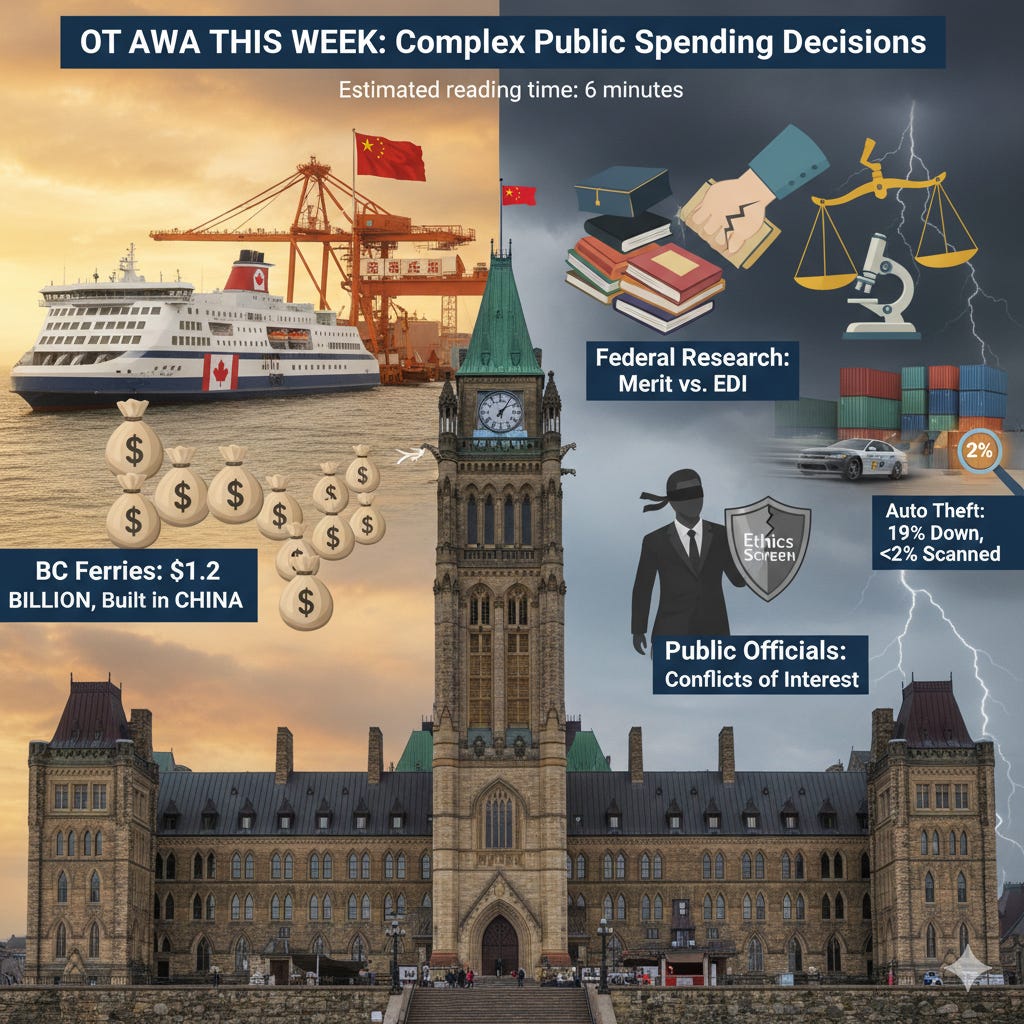
Your tax dollars are helping build new ferries for a Canadian province... in China. This is just one of the complex public spending decisions examined in Ottawa this week as parliamentary committees returned to their work.
Estimated reading time: 6 minutes
PROCUREMENT
BC Ferries Loan Ignites “Buy Canadian” Debate
Driving the news: Labour union leaders and B.C. labour federations strongly condemned the Canada Infrastructure Bank’s (CIB) decision to finance a $1.2 billion contract for BC Ferries to build its next vessels in China, arguing the move undermines Canadian industry and workers.
Catch-up: During a September 25th hearing of the Transport Committee, witnesses testified that the procurement process by BC Ferries prioritized the “cheapest bid,” making it impossible for Canadian shipyards to compete with state-subsidized foreign competitors.
Big Picture: The CIB’s mandate requires its investments to generate “social and economic benefits for Canadians.” Witnesses argued that sending the contract offshore forfeits thousands of Canadian jobs in steel production, fabrication, and downstream supply chains.
Why it matters: The decision exposes a fundamental tension in public procurement: lowest-cost bidding versus building domestic industrial capacity. Union leaders argued this is not an isolated incident but a “failed industrial and economic model” that has weakened Canada’s shipbuilding capabilities for decades. Eric McNeely, President of the BC Ferry and Marine Workers’ Union, stated, “Every vessel built offshore weakens our country.”
What’s next: Witnesses called for an expansion of the National Shipbuilding Strategy to include ferries and the implementation of a clear “buy Canadian” policy for all projects using public funds.
SCIENCE & RESEARCH
Academics Clash Over “Activist EDI” in Federal Research Funding
Driving the news: A heated debate unfolded at the Standing Committee on Science and Research over the increasing integration of Equity, Diversity, and Inclusion (EDI) principles into the criteria for awarding federal grants.
Catch-up: On one side, scholars like Dr. Dave Snow and Dr. Gad Saad argued that “activist EDI” diverts funds from merit-based research toward politically motivated projects. They cited grant applications that ask researchers how to challenge “White privilege” and university job postings open only to specific racial or gender identity groups.
Big Picture: On the other side, researchers like Dr. Imogen Coe and Dr. Nadia Hasan contended that diversity is essential for research excellence. They pointed to evidence that diverse teams are more innovative and that failing to account for differences in populations can lead to harmful outcomes, such as adverse drug reactions in women or minority groups.
Why it matters: This points to a critical question about the purpose of publicly funded research. Critics argue that prioritizing ideology over meritocracy undermines the search for truth and erodes public trust in science. Proponents maintain that inclusive research is more rigorous, relevant, and corrects for well-documented historical biases in academia without sacrificing merit.
PUBLIC SAFETY
National Auto Theft Strategy Shows Results, But Gaps Remain
Driving the news: Officials from the RCMP and CBSA reported to the Public Safety Committee that national auto theft trends decreased by 19.1% in the first half of 2025 compared to the same period in 2024.
Catch-up: The decrease is attributed to a national action plan launched in February 2024, which enhanced collaboration between law enforcement agencies and international partners like Interpol.
Big Picture: Despite the progress, significant challenges persist. Officials confirmed that only a small fraction of export containers—less than 2%—are physically scanned at ports, a key vector for exporting stolen vehicles.
Why it matters: The fight against auto theft reveals a complex battle against sophisticated organized crime networks. While interceptions are up—the CBSA intercepted 2,277 stolen vehicles in 2024 and another 1,155 so far in 2025—the scale of the problem is immense. A recent Carfax report cited at the committee estimates 372,000 vehicles with cloned VINs are currently operating in Canada, posing a massive risk to unsuspecting buyers.
ETHICS
Ethics Screens and Blind Trusts Face Renewed Scrutiny
Driving the news: The Standing Committee on Access to Information, Privacy and Ethics is reviewing the Conflict of Interest Act, with a specific focus on the effectiveness of blind trusts and ethics screens for public office holders like the Prime Minister.
Catch-up: Testifying on September 24, Professor Ian Greene highlighted the Ethics Commissioner’s recommendation to add “apparent conflicts of interest” to the Act, which are already prohibited for MPs under their code of conduct.
Big Picture: An ethics screen was established for Prime Minister Carney to manage potential conflicts related to his previous role at Brookfield Asset Management. Professor Greene argued that such screens, administered by the Clerk of the Privy Council and the PM’s chief of staff, are appropriate, but acknowledged their complexity.
Why it matters: The discussion reveals the difficulty in creating rules that both prevent conflicts and encourage experienced people to enter public life. The current system relies heavily on the integrity of the individuals involved, with Professor Greene noting that in most provinces, mandatory annual meetings between politicians and the ethics commissioner are critical for preventing scandals—a requirement that does not exist for federal MPs and cabinet ministers.
On The Docket
Haiti: With gangs controlling over 90% of Haiti’s capital, the U.S. and Panama have tabled a UN Security Council resolution to replace the current security mission with an expanded international force.
CBC: The Minister of Canadian Heritage, Steven Guilbeault, faced questions regarding allegations of a “toxic work environment” at the CBC after a prominent journalist filed a human rights complaint.
Fisheries: DFO officials described the process of allocating redfish quotas as more “art than science,” following a decision to reopen the fishery after a 25-year moratorium with a new formula that gives 10% shares to Indigenous groups and shrimp harvesters.
In Their Own Words
Dr. Gad Saad, Visiting Scholar
“Scientific truths and natural laws exist independent of researchers’ identities. The distribution of prime numbers does not change as a function of whether the mathematician is a white heterosexual Christian man or a transgendered, Muslim....(obese) individual.”
Why it matters: This quote, delivered to the Science and Research Committee on September 24, captures the core of the argument against incorporating identity-based criteria into scientific funding. Dr. Saad and other witnesses argued that meritocracy is the sole principle for judging research excellence and that introducing political or social goals—what they term “activist EDI”—is an “affront to individual dignity” that ultimately harms the pursuit of knowledge.
Also Noteworthy
The Government Operations committee voted to summon the Minister of Public Works to appear “as soon as possible” to address urgent issues.
Less than 2% of export containers are physically scanned by the CBSA.
CBSA has removed 10,585 inadmissible people from Canada since April 1, 2025.
Union leaders are calling for the National Shipbuilding Strategy to be expanded to include ferries.
The Ethics Commissioner recommends adding “apparent conflict of interest” to the Conflict of Interest Act.
The office of Canada’s fentanyl czar reports that U.S. data shows about 0.1% of fentanyl seized in the U.S. is from the northern border region.
The Department of Canadian Heritage faces a 15% budget reduction over the next three years.
Arms trafficking from the U.S. is identified as a primary reason for the power of gangs in Haiti.
The Data Brief
372,000 The estimated number of vehicles with cloned vehicle identification numbers (VINs) currently operating in Canada.
19.1% The decrease in national auto theft in the first half of 2025 compared to the same period in 2024.
$1.2 Billion The value of the BC Ferries contract for new vessels to be built in a Chinese shipyard, supported by federal financing.
97.5% The proportion of Canadian university job postings that referenced EDI in 2025, according to a report cited at a parliamentary committee.
>90% The percentage of Haiti’s capital, Port-au-Prince, now controlled by gangs.
Sources
Standing Committee on Access to Information, Privacy and Ethics. (2025, September 24). Evidence (No. 005). House of Commons.
Standing Committee on Canadian Heritage. (2025, September 24). Evidence (No. 003). House of Commons.
Standing Committee on Fisheries and Oceans. (2025, September 25). Evidence (No. 004). House of Commons.
Standing Committee on Foreign Affairs and International Development. (2025, September 23). Evidence (No. 002). House of Commons.
Standing Committee on Government Operations and Estimates. (2025, October 2). Evidence (No. 005). House of Commons.
Standing Committee on Public Safety and National Security. (2025, September 23). Evidence (No. 003). House of Commons.
Standing Committee on Public Safety and National Security. (2025, September 25). Evidence (No. 004). House of Commons.
Standing Committee on Science and Research. (2025, September 24). Evidence (No. 005). House of Commons.
Standing Committee on Transport, Infrastructure and Communities. (2025, September 25). Evidence (No. 008). House of Commons.