


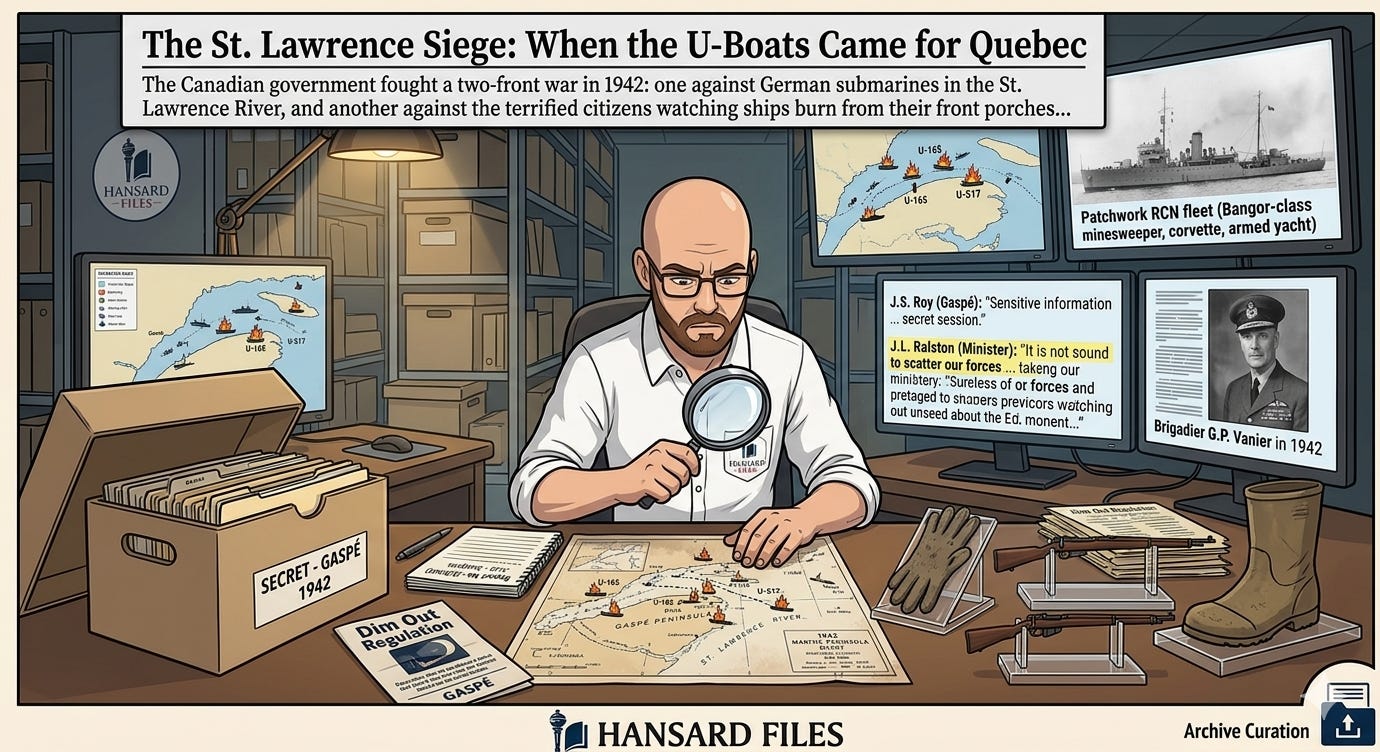
It was the night of May 12, 1942, when the illusion of distance was shattered. For years, the war had been a concept—a headlines-only nightmare unfolding in the Blitz of London or the deserts of North Africa. But on that dark spring night, between Anticosti Island and the mouth of the St. Lawrence River, a German U-boat surfaced and fired. Two merchant ships were torpedoed and sunk.
This was not the open Atlantic. This was the throat of Canada. The St. Lawrence River was the country’s industrial artery, the waterway that fed the heart of the nation. The attack didn’t just sink tonnage; it sank the psychological fortress of a country that believed itself safe behind the shield of an ocean.
The response from Ottawa was swift, bureaucratic, and terrified. The Navy immediately triggered “Plan GL 2,” a desperate measure that forced all ocean-going ships into convoys within the river itself, assembling at Sydney and Bic Island. But the ocean was vast, and the escorts were few. By early 1942, the U.S. Navy had been so stretched by the Pacific theater that, for a time, they had only two coastguard cutters available for escort duty in the entire Western Atlantic. The Royal Canadian Navy (RCN) was left to hold the line with a patchwork fleet of corvettes, Bangor-class minesweepers, and armed yachts.
The enemy knew exactly what they were doing. Pushed out of the heavily defended coastal waters of the United States, the U-boat commanders had turned their periscopes north. They found a target that was vital, vulnerable, and largely unprepared.
The Politics of Panic
While the Navy scrambled to organize convoys, a different kind of battle erupted in the House of Commons. The sinkings had occurred within sight of the Gaspé Peninsula, a region of isolated fishing villages and rugged coastlines. The war was suddenly visceral for the Gaspesians. They weren’t reading about it; they were watching it.
On May 15, just days after the first attack, J.S. Roy, the Member of Parliament for Gaspé, stood up in the House. He claimed to possess sensitive information that he wished to share only in a “secret session”. The Prime Minister, William Lyon Mackenzie King, wary of panic and perhaps wary of admitting the extent of the vulnerability, deflected. He urged Roy to speak privately with the Minister of National Defence, J.L. Ralston.
Roy didn’t back down. He fired off a letter to Ralston, detailing the terrified state of his constituents and the perceived defenselessness of the coast. Ralston’s reply on June 2 was a masterpiece of political management. He essentially told the people of Gaspé that the Army could not be everywhere. “It is not sound,” Ralston wrote, “to scatter our forces in small isolated groups through different localities to an unreasonable extent”.
The Minister’s solution was to tell the citizens that their safety lay in their own hands. He urged the “intensive efforts to have the citizens recognize that this is their obligation,” calling on those too old or unfit for the Active Army to join the Reserve. It was a polite way of saying: You are on your own. Defend yourselves.
The Hostage Nightmare
The terror in Gaspé wasn’t just about sinking ships. It was about invasion. Rumors flew through the coastal villages that U-boats weren’t just hunting freighters; they were preparing to land parties.
On July 10, Brigadier G.P. Vanier, the District Officer Commanding for Military District No. 5, sent a chilling letter to Headquarters. He reported that the people along the coast were paralyzed by the fear of German landing parties coming ashore to “kill or carry off as hostages the inhabitants of the more isolated communities”.
Vanier, a man of conscience, broke protocol to advocate for the people he couldn’t officially protect. “Although I am not responsible for its protection and security,” he wrote, “I feel bound in conscience to recommend that a motorized column... should be established at once”.
He pointed out a staggering tactical gap: from Matane to Gaspé, there was a 210-mile stretch of coastline that was completely open, undefended, and without railway communication. If a U-boat crew landed there, they could operate with impunity. Vanier demanded a motorized column that could “radiate” from a central point, patrolling the dark highways at night to reassure the population that they hadn’t been abandoned.
Headquarters listened, but the response was tepid. They authorized a single platoon—about 30 men—to patrol the coast between Cap des Rosiers and Ste. Anne des Monts. General Elkins, the Commander of Atlantic Command, made it clear that this was a morale exercise, not a military strategy. He wrote that his policy “does not envisage defence at all points where a small enemy landing may take place”. The Army was playing a game of probability, betting that the Germans were more interested in tonnage than in terrorizing fishermen.
The Ragtag Defenders
With the regular Army refusing to garrison every cove and inlet, the defense of the St. Lawrence fell to the locals. The call went out for the Reserve Army—civilians who would train in their spare time to repel the Wehrmacht.
The response was overwhelming. A recruiting drive in September 1942, aided by the local clergy, saw 1,500 men sign up for the “Fusiliers du St. Laurent”. They were eager, patriotic, and almost completely unequipped.
By November, Brigadier Vanier had to report a pathetic reality to Ottawa. He had 1,500 men, but they were “without arms and had had no training.” Worse, they were facing a Canadian winter with a critical shortage of “boots, trousers, overshoes, and gloves”. These supernumerary detachments were scattered across hundreds of miles of frozen coastline, connected only by poor roads and a lack of telephone lines.
Ottawa eventually authorized the formation of a new battalion, the 3rd Battalion of the Fusiliers, and promised to ship 1,000 Enfield rifles and 200 Sten guns. But for months, the “defense” of the St. Lawrence consisted of freezing fishermen and farmers, standing watch in their own clothes, waiting for a U-boat to surface.
The Information War
As the sinkings continued—four ships went down in a single night in July 1942 off Cap Chat —the government realized they were losing the information war. The “dim out” regulations (darkening coastal lights to prevent silhouetting ships) were being ignored, largely because the public didn’t understand why they were necessary.
Commissioner Marcel Gaboury of the Quebec Provincial Police bluntly told a secret conference in Quebec City that the population “could not be bulldozed into defence consciousness”. He warned that any propaganda campaign had to originate from within Quebec, with a “strong colloquial flavour,” or it would do more harm than good.
The result was a sophisticated attempt to manage the narrative. The government appointed a “Defence Co-ordination Officer,” Squadron Leader J.P.J. Desloges. Desloges was a perfect figurehead: a former Mountie, a Battle of Britain pilot who had lost an eye in combat, and a French-Canadian hero. His job was to bridge the gap between the anglo-dominated military command and the terrified French-Canadian populace, smoothing over the friction caused by a war that had arrived on their doorstep uninvited.
By the end of the 1942 shipping season, 21 ships had been sunk in the Gulf and River. The St. Lawrence, once the secure highway of the Empire, had become a graveyard. The Army had managed to avoid a full-scale panic, not by impregnable defense, but by a mixture of mobile patrols, local recruitment, and the calculated gamble that the Germans would never actually land.
If you enjoyed this deep dive into the archives, subscribe to Hansard Files. We sift through declassified military reports and forgotten parliamentary transcripts to bring you the history they didn’t want you to read.
Source Documents
Directorate of History. (1986, November 10). Army Participation in Measures taken by the Three Services for the Security of the Gulf of St. Lawrence and the Lower River during the Period of German Submarine Activity, 1942-45 (Report No. 30). National Defence Headquarters.
A very good read, Hansard!