


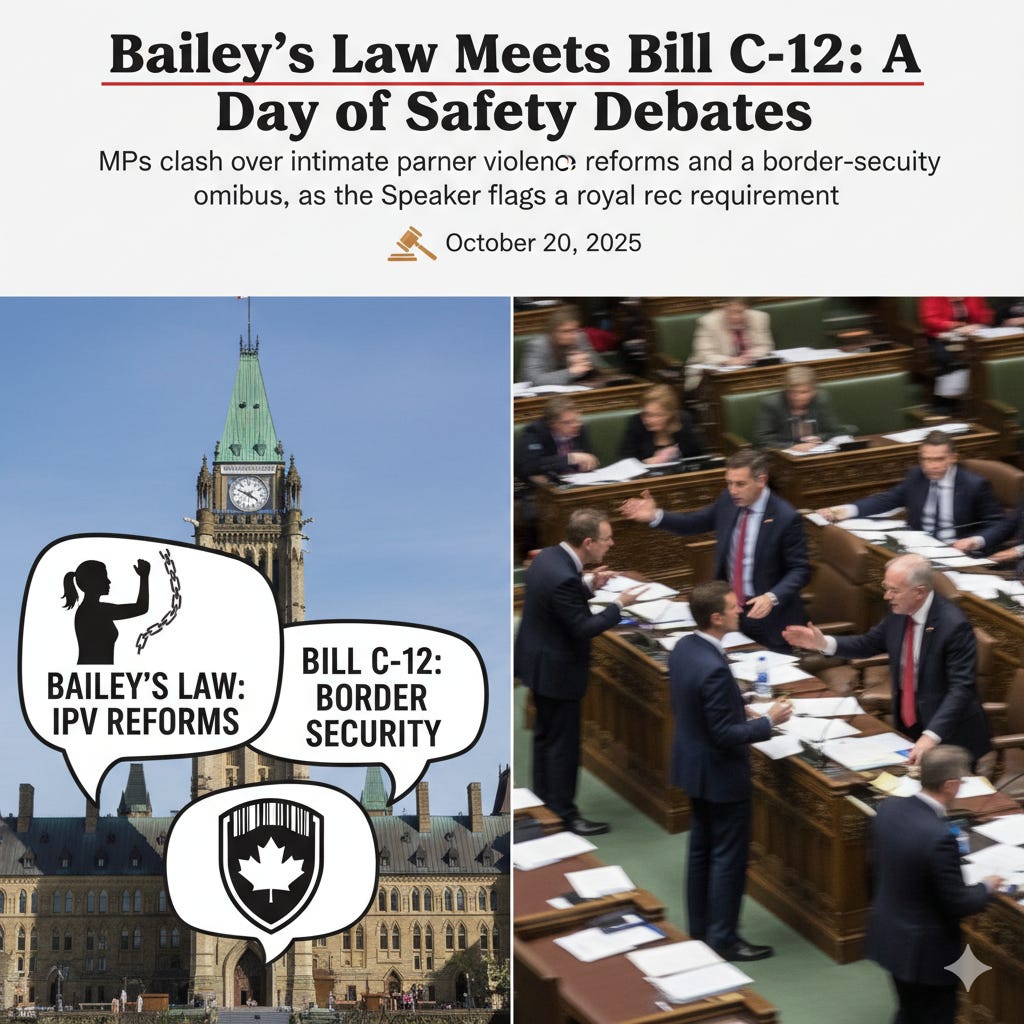
The House opened on October 20 with three big frames for your day: a Speaker’s reminder that one private member’s bill may need a royal recommendation, a raw and personal debate on “Bailey’s law” to redefine intimate partner violence in the Criminal Code, and a wide-ranging second-reading debate on Bill C-12 to tighten border and immigration security. What does this actually mean for you? Two hard policy fronts, both about state power and personal safety, moving in parallel, and each raising real design trade-offs.
Private Members’ Business: “Bailey’s law” and the Criminal Code
What the sponsor is proposing
Conservative MP Frank Caputo tabled Bill C-225 to do four things: create a distinct offence of assault against an intimate partner, classify the killing of an intimate partner as first-degree murder, allow courts to order up to seven-day risk assessments pre-trial, and modernize detention rules for seized property in investigations. He framed it as a non-partisan fix to an “epidemic” and anchored it in recent tragedies, including Bailey McCourt.
Caputo argued that naming the relationship matters and that risk-assessment powers are a preventive tool, not a doubling of provincial initiatives. He pressed the House to collapse debate and vote.
The evidence invoked on prevalence and harm
Supporters cited sharp increases over the last decade: intimate partner physical assault up 14 percent, harassment up 38 percent, and sexual assault within intimate partner contexts up 163 percent. They also pointed to 123,319 victims aged 12 and over in 2023. These numbers were used to justify new offences, risk assessments, and stricter bail and release practices.
Government response and cautions
Parliamentary Secretary Patricia Lattanzio set the government’s line: IPV is a priority, but reforms must be “thoughtful” and consistent with earlier changes like Bill C-75, which defined “intimate partner,” created a reverse onus at bail for prior IPV convictions, and elevated strangulation in the assault hierarchy. She also referenced C-233 on electronic monitoring and judicial education on coercive control, and C-48’s expanded reverse onus for repeat IPV offenders. The subtext: do not inadvertently criminalize abused partners who kill in self-defence by making all IPV homicides first-degree by default.
Bloc Québécois perspective
Bloc MPs signalled openness but stressed balance: preserve the presumption of innocence, support rehabilitation, and ensure federal criminal law aligns with Quebec’s specialized tribunals and prevention work. They asked whether Ottawa’s bill risks overlap and how it will respect provincial jurisdiction. They also floated electronic monitoring and resource needs as practical tools.
Temperature check
The debate got tense. Liberals pressed Conservatives on past votes for women’s supports; Conservatives replied that C-225 is the “most non-partisan bill” possible and should advance immediately. The exchange underscored that the policy design questions, not only party records, will decide this bill’s fate.
Government Orders: Bill C-12, Strengthening Canada’s Immigration System and Borders
What C-12 tries to do
Public Safety Minister Gary Anandasangaree pitched C-12 as a targeted subset of a larger border plan, meant to secure ports of entry and exit, expand the Canadian Coast Guard’s security role, and tighten anti-money-laundering and precursor-chemical controls. He linked it to new resources and operational measures.
Key elements highlighted in debate:
People and kit. Government members repeatedly cited hiring of 1,000 new RCMP and 1,000 new CBSA officers, alongside drones, helicopters, surveillance tools, canine teams, and training.
Operational results. The minister claimed illegal crossings from Canada to the U.S. are down 99 percent since a June 2024 peak, and said CBSA removals hit 18,000 in 2024–25 with a goal of 20,000 over two years.
Precursor chemicals and money laundering. C-12 would speed scheduling of new drug precursors by the Health Minister and strengthen the anti-money-laundering regime.
Coast Guard scope. The bill would add “security, including security patrols and the collection, analysis and disclosure of information or intelligence” to the Coast Guard’s functions under the Oceans Act, increasing its role in maritime security, especially in the Arctic.
Where C-12 breaks from C-2
Pressed by Conservatives, the minister said three contentious C-2 planks were not in C-12: warrantless lawful-access changes, postal search powers, and a $10,000 cash-use limit. He also signalled the government still wants to advance remaining C-2 elements later.
Bloc and Conservative speakers confirmed that civil-liberties “irritants,” including warrantless mail and ISP subscriber-data access, triggered the redesign. That is why C-12, while still broad, has a clearer path.
The friction points
Omnibus design and committee study. Critics warned that bundling border security, immigration ineligibility rules, Oceans Act changes, and AML tweaks risks thin scrutiny. Some pushed to split the bill so immigration provisions go to the Immigration committee.
Coast Guard mandate and capability. MPs asked whether adding “security” without law-enforcement powers, armament, sensors, and training creates a capability gap, especially if Coast Guard authorities straddle Fisheries and National Defence. Government backbenchers said the Coast Guard can deliver, and resources would follow as needed.
Resources versus throughput. Bloc MPs pressed that staffing must be matched with technology and infrastructure, not just headcount. The government indicated openness to training and continuous upskilling.
Border metrics and drug policy. Conservatives framed C-12 as a fix for “chaos” at the border and tied it to broader crime and drug-policy critiques. Expect this to surface in amendments on enforcement thresholds and reporting.
The Speaker’s early reminder: royal recommendation
Before debate, the Speaker flagged that Bill C-222, on EI and labour-code leave after the death of a child, appears to engage the Crown’s financial prerogative and may require a royal recommendation before third reading. Translation for your calendar: sponsors and critics should put constitutional arguments on the record early.
How to think about the trade-offs
On C-225: The core design question is whether distinct offences and automatic first-degree classification better protect victims, or whether blunt rules risk catching victims who fight back without documented histories. The government wants to keep judicial discretion and lean on earlier bail and sentencing reforms; the sponsor wants legislative signals and new pre-emptive tools. The sweet spot likely pairs clearer offences and risk-assessment powers with careful drafting on homicide classification and self-defence.
On C-12: The policy logic is clear, and the civil-liberties trims from C-2 matter. The test now is operational integrity. Adding “security” to the Coast Guard needs matching capability. Hiring targets must translate into throughput at ports, rail and marine terminals. And the immigration measures should be stress-tested in committee for constitutionality and administration.
The Data Brief
The House debated C-225 to define an intimate-partner assault offence, classify IPV killings as first-degree, enable court-ordered risk assessments, and update seizure-detention rules. Supporters cited double-digit growth in IPV measures and 123,319 victims in 2023.
The government countered with existing tools from C-75, C-233 and C-48, and warned against automatic first-degree rules that could harm abused women acting in self-defence.
C-12 advanced with a trimmed scope compared to C-2, dropping warrantless subscriber data, postal searches, and the cash-limit plank. It adds Coast Guard security functions, faster precursor scheduling, and AML powers, amid claims of 1,000 RCMP and 1,000 CBSA hires and a 99 percent drop in southbound illegal crossings since June 2024.
CBSA removals were cited at 18,000 in 2024–25, with a target of 20,000 over two years, and new equipment deployments were flagged. Committee study will likely focus on Coast Guard capability, resource alignment, and immigration-law constitutionality.
Source documents
Debates of the House of Commons, Hansard No. 039, 45th Parliament, 1st Session, October 20, 2025. Office of the Speaker, House of Commons.